
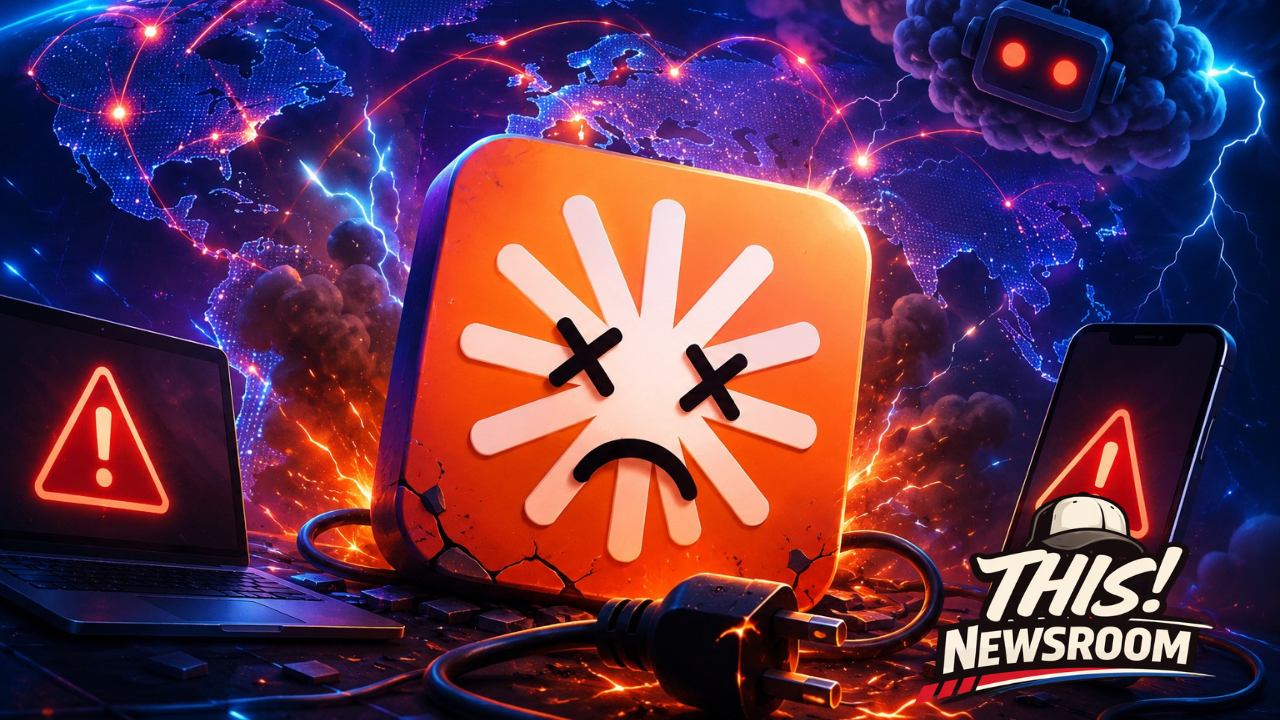
Anthropic’s Claude suffered a significant global service disruption Sunday evening, temporarily knocking users out of one of the world’s most prominent artificial intelligence platforms.
The outage began at approximately 21:58 UTC on Sunday, August 16, 2026, when Anthropic acknowledged that it was investigating authentication problems affecting Claude users. Within minutes, the company expanded the incident to include degraded performance across several Claude products.
The disruption affected Claude.ai, Anthropic’s developer platform, the Claude API, Claude Code and Claude Cowork, making the incident much larger than a simple chatbot outage.
For businesses and developers increasingly building workflows around generative AI, the outage offered another reminder of just how quickly an AI service interruption can ripple beyond a consumer-facing website.
What Happened to Claude?
Anthropic first reported at 21:58 UTC that it was investigating an issue involving users authenticating to Claude.ai, Claude Code and Claude Cowork.
By 22:02 UTC, the company said it was investigating degraded performance affecting a broader collection of services, including Claude.ai, its platform, Claude API, Claude Code and Claude Cowork.
Users reported being unable to log in, generate responses or access ongoing work.
Some were greeted with a straightforward message:
“Claude is temporarily unavailable. We’re working on it — try again in a moment.”
The problems appeared across multiple ways of accessing Claude rather than being isolated to a single app or device. Reports from users described trouble on desktop, mobile and the web.
Anthropic Deployed a Fix Within Minutes
The good news for Claude users was that the most severe portion of the disruption did not last particularly long.
Anthropic reported at 22:22 UTC that a fix had been deployed and that engineers were monitoring the platform’s recovery.
At 22:34 UTC, the company marked the incident resolved.
That puts the period from Anthropic’s initial acknowledgment to resolution at roughly 36 minutes.
Even a disruption measured in minutes, however, can have an outsized impact when a service is embedded inside software development, research, business automation and other production workflows.
Claude Code Going Down Makes This a Bigger Story
Claude isn’t simply an AI chatbot anymore.
Claude Code has become an increasingly important part of Anthropic’s ecosystem, allowing developers to use Claude for agentic programming and multistep software-development tasks.
Meanwhile, the Claude API enables businesses and developers to integrate Anthropic’s models directly into their own applications and services.
That means an outage affecting the API and Claude Code can potentially interrupt automated processes and developer workflows—not just conversations taking place on Claude.ai.
Anthropic itself describes Claude Code as a tool that lets developers delegate complex, multistep programming tasks directly from the terminal, while its broader Claude ecosystem spans web, desktop and mobile applications.
That growing footprint makes reliability increasingly important.
Users Immediately Took to Social Media
As Claude stopped responding, users quickly began asking whether the service was down for everyone or whether they were experiencing individual account problems.
Reports appeared across Claude and Anthropic communities describing authentication failures, stalled responses and inaccessible sessions.
One user joked that they had asked Claude whether Claude was down—and were still waiting for an answer.
Others weren’t laughing.
Developers reported having coding work interrupted, while students and professionals described losing access to Claude in the middle of active projects.
The reactions highlight something important about how rapidly AI has become integrated into everyday digital work.
A few years ago, a generative AI outage would have been an inconvenience for early adopters. In 2026, it can interrupt actual business operations.
The Outage Comes After Other Recent Claude Problems
Sunday’s disruption also didn’t happen in isolation.
Anthropic experienced another Claude incident on August 14, when degraded performance affected the Claude API, Claude Code and Claude Cowork. Anthropic’s incident updates said the impact occurred between 20:14 and 20:38 UTC before a fix was deployed.
Another incident around the same period involved elevated errors affecting Claude services and was resolved early August 15.
Those incidents don’t necessarily indicate a systemic problem, but they underscore the enormous infrastructure challenge facing AI companies as usage expands.
Research published earlier this year found that disruption days across major AI platforms increased sharply as adoption accelerated and AI became more deeply embedded in consumer and enterprise workflows.
AI Reliability Is Becoming as Important as AI Intelligence
For the first phase of the generative AI race, nearly everything revolved around model capability.
Which AI could reason better?
Which one could code better?
Which model had the largest context window?
Which could generate the best images, research or analysis?
The next phase may increasingly revolve around something far less glamorous: uptime.
If companies are going to build mission-critical systems around AI agents, those models need to be available when they’re needed.
A developer who relies on Claude Code doesn’t care how impressive a benchmark score is when the service cannot authenticate.
A company running customer-facing applications through an AI API similarly needs reliability, redundancy and contingency plans.
That’s particularly important as AI evolves from something people occasionally consult into infrastructure that performs work continuously.
The Bigger Picture
Claude’s Sunday outage was relatively brief, and Anthropic moved quickly to deploy a fix.
But the incident demonstrates how dramatically the role of artificial intelligence has changed.
Claude, ChatGPT, Gemini and other leading AI platforms aren’t simply websites people visit anymore. They are increasingly becoming an underlying layer of the modern technology stack.
Developers write software with them. Companies connect applications to their APIs. Workers use them for research and analysis. AI agents increasingly execute multistep tasks with limited human involvement.
As dependence increases, outages will matter more.
The AI race isn’t only about building the smartest model anymore.
It’s also about building one that’s there when the world asks it a question.
This with Krish — Faith. Family. Freedom. At the center of truth.