

LONDON — Quantum computing’s next major breakthrough may not simply be about building better qubits. It may be about figuring out how quantum machines fit inside the massive computing infrastructure businesses already use.
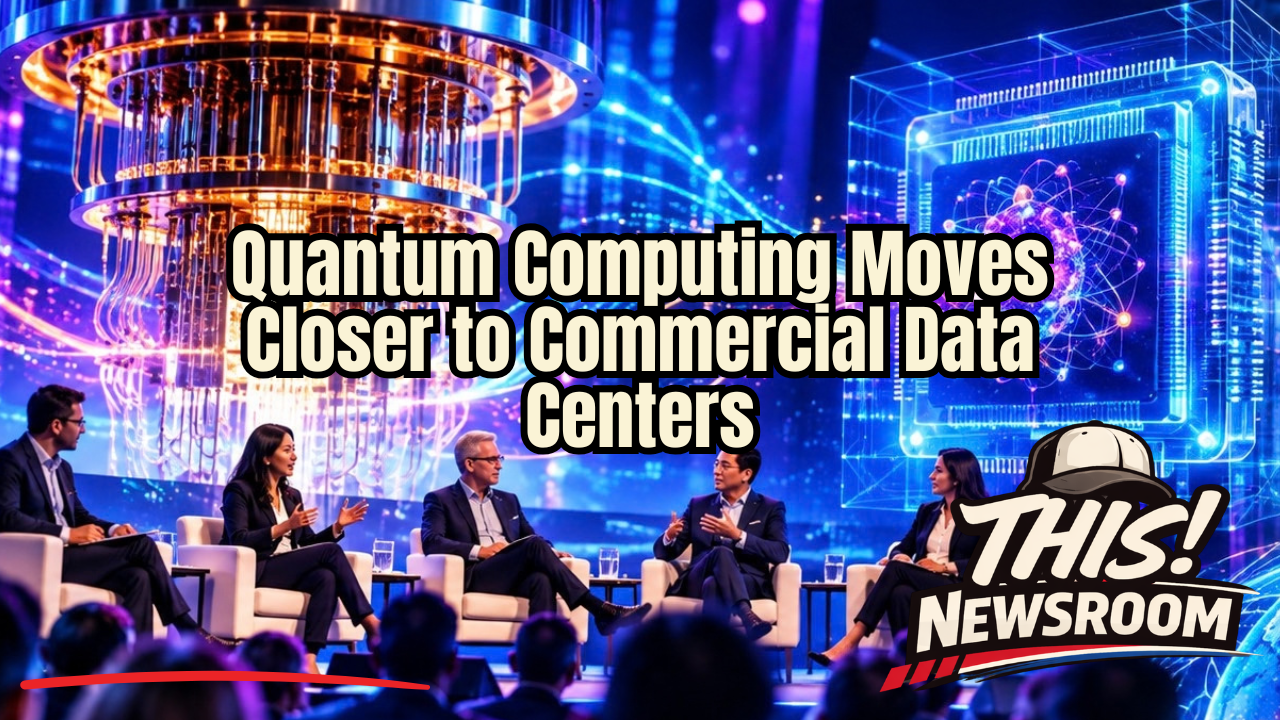
That challenge took center stage at the second international Quantum Datacenter Alliance Forum, where leaders spanning quantum computing, artificial intelligence, high-performance computing, data centers and government gathered to discuss what it will take to move quantum technology from experimental systems toward real-world commercial infrastructure.
Held at London’s iconic Battersea Power Station, the event brought together representatives from NVIDIA, IBM, Quantinuum, Atom Computing, Equinix, Coherent, Nu Quantum, the United Kingdom’s Department for Science, Innovation and Technology and other organizations working across the emerging quantum ecosystem.
And the message coming out of the gathering was increasingly clear: commercial quantum computing is moving closer, but the industry now has to solve the infrastructure surrounding the quantum processor.
Quantum Computing Is Becoming an Infrastructure Problem
For years, much of the quantum computing race has centered on qubits — how many a system has, how reliable they are and which underlying technology will ultimately scale.
Those questions remain critical.
But as quantum systems improve, attention is increasingly shifting toward something much bigger: how quantum processing units, or QPUs, can operate alongside traditional high-performance computing and AI infrastructure.
That means solving challenges involving control systems, networking, error correction, interoperability, power consumption and data-center architecture.
In other words, the quantum computer of the future probably won’t operate in isolation.
It could become another specialized computing resource within increasingly complex data centers combining CPUs, GPUs, AI accelerators and quantum processors.
That hybrid model was a major focus of the QDA Forum.
Quantum + AI + HPC Could Define the Next Computing Era
The timing is especially important because conventional computing infrastructure is undergoing its own enormous transformation.
Artificial intelligence has triggered unprecedented demand for GPUs, networking equipment, power and data-center capacity. At the same time, high-performance computing continues to handle some of the world’s most complicated scientific and industrial workloads.
Quantum computing could eventually become another layer of that infrastructure.
Rather than replacing classical computers, quantum processors are increasingly envisioned as specialized accelerators capable of tackling certain calculations that are extremely difficult for conventional machines.
A future workload could therefore move between different types of processors depending on the problem being solved.
Classical CPUs might handle general computation. GPUs could process AI workloads. Quantum processors could tackle specific optimization, chemistry, simulation or other computationally intensive problems.
Making those systems operate together efficiently is now becoming one of the industry’s biggest engineering challenges.
The Race Toward Fault-Tolerant Quantum Computing
Another major theme was fault tolerance.
Today’s quantum computers remain extraordinarily sensitive to errors. Environmental noise and imperfections in quantum operations can disrupt calculations, limiting the size and complexity of workloads that machines can reliably execute.
Fault-tolerant quantum computing aims to overcome that limitation through technologies including quantum error correction.
Reaching that point would represent one of the industry’s most important milestones because it could allow quantum machines to perform significantly longer and more complex calculations reliably.
But fault tolerance also creates additional infrastructure demands.
Large-scale systems may require enormous amounts of classical processing for error correction, sophisticated control electronics, advanced networking and tightly coordinated software.
That is why cooperation between traditional computing companies, quantum hardware developers and data-center operators is becoming increasingly important.
Real Deployments Are Already Beginning
The second QDA Forum also highlighted partnerships and deployments already taking place across the industry.
Speakers discussed lessons learned from commercial projects and early QPU-HPC deployments, offering a glimpse at what integrating quantum systems into traditional computing environments actually looks like.
These deployments are important because the industry’s challenges cannot all be solved inside research laboratories.
Quantum systems eventually need to operate reliably inside environments built around uptime, scalability, security, energy efficiency and interoperability.
Data-center operators need to understand requirements ranging from cooling and power to networking and physical infrastructure.
Quantum companies, meanwhile, need to build machines capable of fitting into an increasingly standardized computing ecosystem.
That transition is one of the clearest signs that quantum computing is beginning to mature.
The conversation is shifting from simply asking “Can we build a quantum computer?”
The industry is increasingly asking:
“How do we deploy thousands of them?”
Distributed Quantum Computing Could Be Critical
The forum also placed significant emphasis on distributed quantum computing architectures.
Instead of relying entirely on a single enormous quantum processor, future systems could potentially connect multiple quantum processors together.
That concept could eventually resemble the evolution of classical supercomputing, where enormous computational capability comes from connecting many individual processing systems through extremely fast networks.
Doing something similar with quantum computers introduces significant technical challenges.
Quantum information is exceptionally fragile, and connecting separate quantum processors requires technologies capable of transferring or entangling quantum states while preserving their properties.
Companies developing quantum networking technologies therefore could become an increasingly important part of the ecosystem.
If distributed architectures prove successful, quantum data centers could eventually consist of interconnected quantum processors operating alongside conventional computing clusters.
The Data Center Is Becoming the Battleground
The larger story extends far beyond quantum computing.
The modern data center is rapidly becoming one of the most strategically important pieces of global technology infrastructure.
AI has already transformed the economics of computing infrastructure, with technology companies spending enormous sums expanding GPU clusters, power capacity and networking capabilities.
Quantum computing could eventually introduce another infrastructure wave.
Facilities hosting quantum machines may require specialized cooling, vibration control, electromagnetic shielding, optical systems, networking and control hardware depending on the underlying quantum technology.
That creates opportunities not only for quantum-computing companies but also for semiconductor manufacturers, networking companies, optical technology providers, cloud platforms and data-center operators.
The quantum industry is becoming an ecosystem.
Interoperability Could Determine How Fast Quantum Scales
One of the most important themes emerging from the QDA gathering was interoperability.
If quantum computers are going to become part of mainstream computing infrastructure, organizations will need ways for systems from different vendors to communicate with existing hardware and software.
Without standards, companies could end up building isolated quantum ecosystems that are difficult to integrate.
Open architectures and common interfaces could accelerate adoption by allowing enterprises and researchers to combine technologies from multiple suppliers.
That approach helped accelerate previous generations of computing infrastructure.
Quantum computing may eventually require something similar.
The Commercial Quantum Timeline Is Getting More Interesting
Predictions about when quantum computers will deliver widespread commercial value have varied dramatically.
Some forecasts have placed transformative quantum computing many years into the future.
Others argue useful applications could arrive considerably sooner as hardware improves and hybrid quantum-classical computing techniques evolve.
What is changing, however, is the conversation.
The industry is increasingly discussing deployment architecture, data-center integration, networking, interoperability and operational requirements — problems typically associated with technologies preparing to scale.
That doesn’t mean fault-tolerant quantum computing has arrived.
It hasn’t.
But the infrastructure being built around it suggests companies are preparing for a future where quantum processors become another component of the global computing stack.
The Next Computing Revolution May Be Hybrid
The biggest takeaway from the QDA Forum may be that the future of computing isn’t necessarily classical versus quantum.
It could be classical plus quantum plus AI.
Tomorrow’s most powerful computing environments may combine CPUs, GPUs, AI accelerators and quantum processors, dynamically assigning workloads to whichever architecture can solve a particular problem most efficiently.
Getting there will require breakthroughs in quantum hardware.
But it will also require networking, software, error correction, power infrastructure, data centers and industry standards capable of tying everything together.
That is why meetings like the Quantum Datacenter Alliance Forum matter.
The quantum race is no longer happening exclusively inside physics laboratories.
It is beginning to move into the data center.
And once that transition accelerates, the race to build the next generation of computing infrastructure could become much bigger than quantum computing itself.
THIS! Take: For years, quantum computing felt like technology permanently stuck five or ten years away. What’s different now isn’t that someone suddenly flipped the “quantum is ready” switch. It’s that serious companies are starting to discuss the boring-but-important stuff — infrastructure, networking, deployment, interoperability and power. Technologies tend to get very real when engineers stop talking exclusively about the breakthrough and start figuring out where to plug the thing in.