
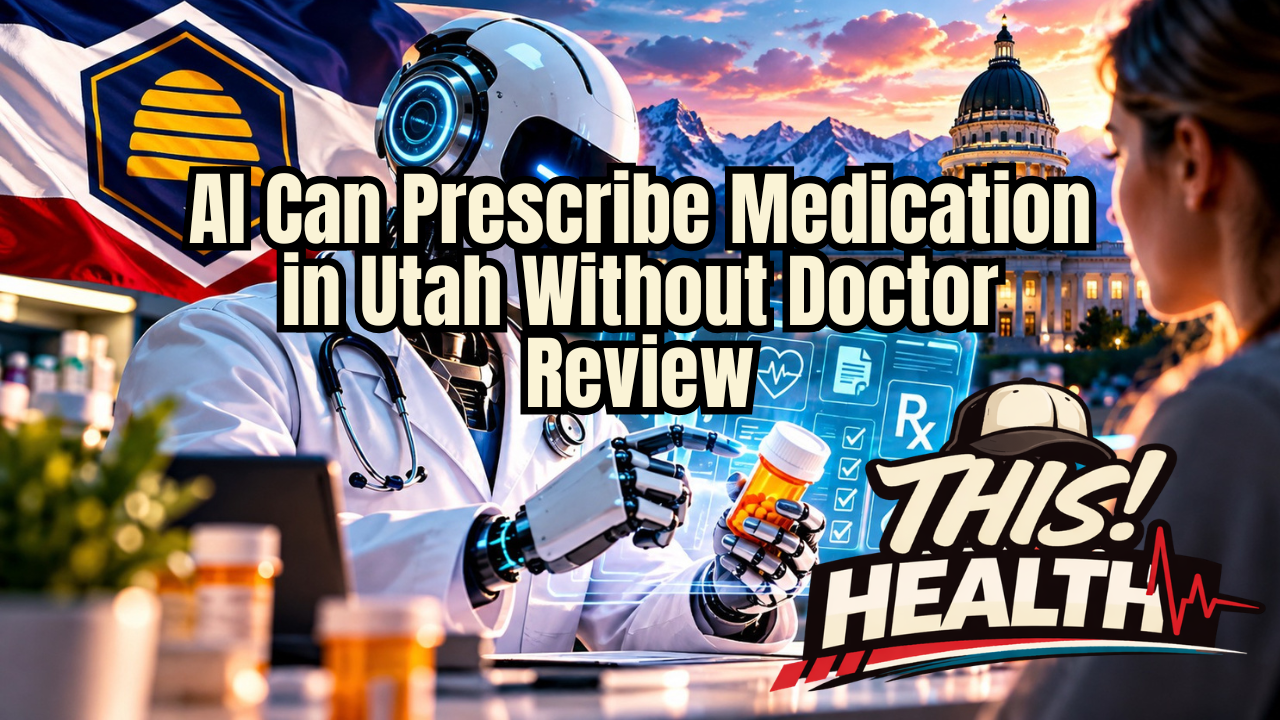
Utah is pushing artificial intelligence deeper into healthcare with new regulatory pilots that could allow AI systems to issue certain prescriptions or refills without a physician reviewing each order before it reaches the pharmacy.
The viral headline sounds almost unbelievable: AI can now prescribe medication in Utah.
There is truth behind it — but the reality is considerably more controlled than the headline suggests.
Utah’s Office of Artificial Intelligence Policy has authorized a series of healthcare AI pilots through the state’s regulatory sandbox. The programs are designed to test whether artificial intelligence can safely handle tightly defined medical tasks that traditionally require direct clinician involvement.
And one of the newest pilots goes beyond simply renewing an existing prescription.
AI Is Moving From Assistant to Prescriber
Utah approved a pilot involving Nolla Health, operated by Magic Health, that allows its AI system to evaluate adults with mild-to-moderate acne using facial images and potentially issue prescriptions for a limited selection of topical acne medications.
That distinction matters.
Earlier AI prescribing experiments in Utah largely focused on renewing medications that a human clinician had already prescribed. Nolla’s pilot allows first-time prescriptions within its narrow acne-treatment scope.
According to Utah’s official pilot registry, the system cannot prescribe oral medications or isotretinoin, commonly known by the former brand name Accutane. Severe acne is also excluded.
Initially, however, humans remain very much involved.
Two Utah-licensed physicians are required to review every prescription before it is sent during the first stage. Later phases can move toward retrospective physician review and eventually sampling rather than review of every prescription — but the company must receive written approval from the state before advancing.
That means the bigger story isn’t that Utah suddenly eliminated doctors.
It’s that the state has created a pathway where some prescriptions could eventually reach patients without a doctor personally reviewing each one beforehand.
How It Works
For Nolla Health’s acne pilot, an adult patient submits facial photographs that the AI uses to assess the severity of their acne. The system then determines whether the patient falls within the narrow population the pilot is authorized to treat.
There are significant guardrails.
Patients must be adults, their identity and age must be verified using government-issued photo identification, and prescriptions can only be sent to Utah addresses. Pregnancy, plans to become pregnant, breastfeeding, weakened immune systems and certain previous medication reactions trigger exclusions from the automated process.
Pharmacists are also informed that the prescription originated through an AI system and are given access to a physician for questions.
In other words, this isn’t ChatGPT casually deciding what medication somebody should take.
It is a narrowly defined medical system operating under a state-approved protocol.
Utah Is Testing AI Prescription Refills Too
Nolla isn’t the state’s only experiment.
Utah has authorized several healthcare AI pilots, including programs involving prescription renewals.
August AI, for example, received approval for a pilot involving routine 30-, 60- and 90-day refills of certain non-controlled maintenance medications that an adult patient is already taking under an established treatment plan.
The AI cannot start a new medication, change the dosage or substitute another drug.
Another company, Doctronic, has been operating under a Utah agreement covering prescription renewals. However, Utah’s current registry says its pilot remains in Phase 1, meaning a licensed practitioner still authorizes every request. Advancement into subsequent phases requires additional state approval.
Controlled substances have been excluded from Utah’s prescribing pilots.
Why Utah Is Doing This
Utah isn’t simply rewriting its medical laws and declaring AI a doctor.
Instead, the experiments are taking place through the state’s AI regulatory sandbox, overseen by the Utah Department of Commerce’s Office of Artificial Intelligence Policy.
The concept is essentially a controlled laboratory for regulation.
Companies can receive limited flexibility from particular state rules while testing a specific AI application. The agreements are narrow, temporary and supervised, and participation does not constitute an endorsement of the technology by Utah.
The state says the objective is to collect real-world evidence before deciding how laws and regulations should evolve.
Utah created the Office of Artificial Intelligence Policy in 2024 with three broad goals: observing and learning from AI deployment, protecting consumers and fostering innovation.
Healthcare may become one of the most consequential testing grounds.
There Are Still Humans Behind the AI
Perhaps the most important detail getting lost in social-media posts about the program is accountability.
Utah says clinical agreements still identify licensed professionals responsible for the AI system’s activities. The state’s framework does not simply grant an artificial intelligence company a medical license.
The pilots also include escalation requirements.
If a case falls outside the system’s approved parameters or raises safety concerns, the AI must stop the automated process and refer the patient to a human clinician.
Companies participating in the prescribing pilots must report performance information to the state, and Utah says it audits participants while agreements remain active.
Utah has also brought independent organizations into the program to evaluate healthcare AI systems, including clinical and technical testing of safety, privacy protections and system behavior.
This Could Be Much Bigger Than Acne Medication
Acne treatment may sound like a relatively small use case.
That’s precisely why it matters.
Regulators aren’t starting by allowing an AI system to diagnose complicated diseases or prescribe powerful controlled substances. They’re beginning with narrow, lower-risk scenarios where outcomes can be monitored.
If those systems perform reliably, the model could expand.
Imagine routine healthcare where an AI evaluates a straightforward condition, reviews medical history, checks contraindications and sends an appropriate prescription directly to the pharmacy — while human physicians concentrate on complicated cases.
That could potentially reduce wait times and expand access to care.
But it also raises serious questions.
Who is ultimately responsible when an AI makes the wrong decision? How much clinical oversight is enough? How transparent should algorithms be? What happens when a seemingly routine case isn’t routine at all?
Those aren’t theoretical questions anymore.
Utah is actively trying to generate the data needed to answer them.
The Bigger Picture
AI has spent the last few years helping doctors summarize records, analyze images, document visits and provide clinical decision support.
Prescribing represents another threshold.
For decades, the ability to prescribe medicine has been one of the clearest lines separating licensed healthcare professionals from software.
Utah’s experiment doesn’t erase that line.
But it certainly starts moving it.
And if these pilots demonstrate that narrowly focused AI systems can safely make certain routine medical decisions, the bigger question won’t simply be whether other states follow Utah.
It will be how quickly they do.
THIS NEWSROOM | This with Krish
Utah Office of Artificial Intelligence Policy — Authorized AI Pilots