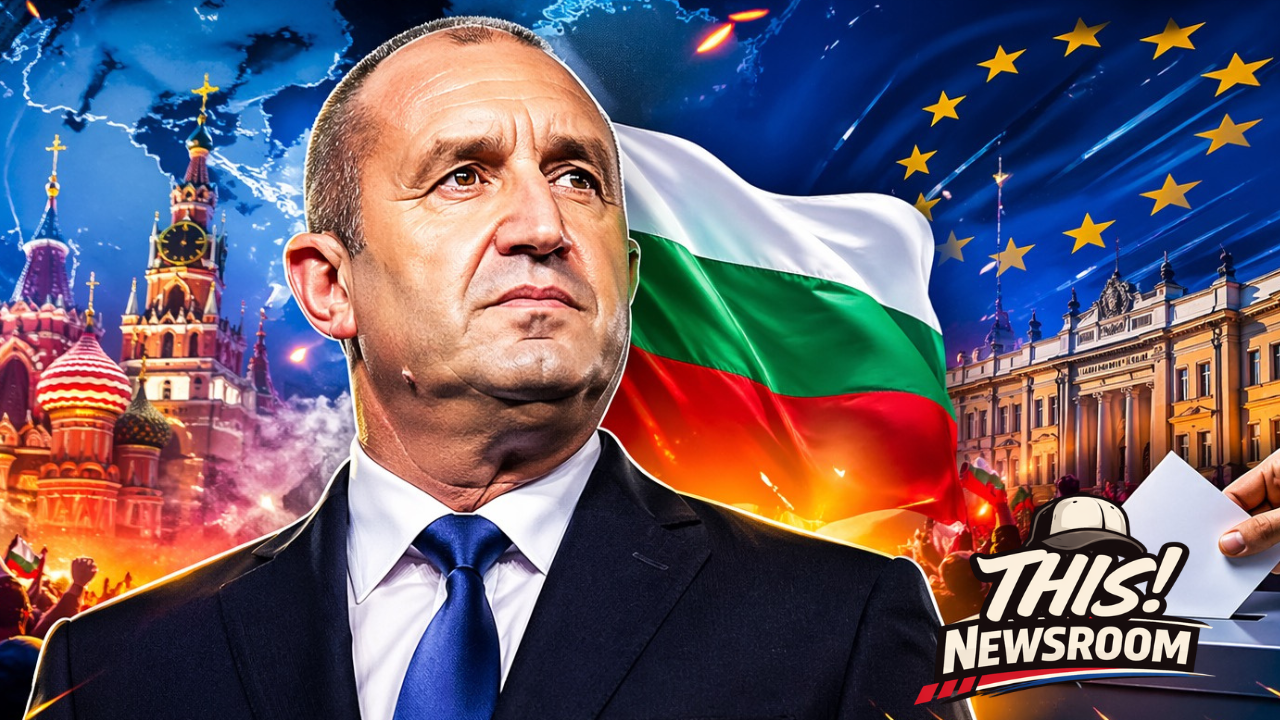
Bulgaria Election Shock: Rumen Radev Wins Landslide, Signals Shift Toward Russia

In a political earthquake that’s sending shockwaves across Europe, Rumen Radev—Bulgaria’s former president known for his Kremlin-friendly stance—has secured a landslide victory in Bulgaria’s parliamentary elections.
The result isn’t just a domestic shake-up. It has the potential to redefine Bulgaria’s position within the West, raising serious questions about the future of its alignment with both European Union and NATO.
A Landslide No One Fully Saw Coming
Official results released Monday confirmed that Radev’s political movement didn’t just win—it dominated, outperforming even the most optimistic polling projections.
This marks one of the strongest single-party performances in Bulgaria in decades, delivering a decisive mandate in a country that has struggled with political fragmentation.
For context:
- Bulgaria has endured eight elections in just five years
- Coalition governments repeatedly collapsed
- Public trust in traditional parties steadily eroded
Radev’s victory signals a clear message from voters: they want stability—and they’re willing to take a different geopolitical path to get it.
Why This Election Matters Beyond Bulgaria
Bulgaria is not just another European country. It sits at a strategic crossroads:
- A member of both the EU and NATO
- Positioned in Southeast Europe near key energy and security corridors
- Historically influenced by both Western Europe and Russia
Radev’s political stance has often been described as more accommodating toward Moscow, especially compared to previous pro-Western governments.
That raises critical questions:
- Will Bulgaria soften its stance on Russia?
- Could it become a bridge—or a fault line—within NATO?
- How will EU leaders respond if policy direction shifts?
The End of Political Chaos?
One of the most immediate impacts of this election could be domestic stability.
After years of:
- Short-lived governments
- Corruption scandals
- Policy gridlock
…this result offers something Bulgaria hasn’t had in a while: a clear governing majority.
That could mean:
- Faster policy execution
- Stronger centralized leadership
- Reduced reliance on fragile coalitions
But stability comes with trade-offs—especially if it shifts the country’s international posture.
Europe Is Watching Closely
Leaders across Europe are paying close attention. Bulgaria has been a reliable, if sometimes complicated, partner in EU and NATO decision-making.
A pivot—even a subtle one—could:
- Impact sanctions policy toward Russia
- Influence energy agreements and pipelines
- Create internal divisions within EU voting blocs
In short, this isn’t just Bulgaria’s moment. It’s a test case for Europe’s political cohesion in a rapidly changing geopolitical landscape.
What Comes Next
Radev’s next steps will define the real story:
- Cabinet formation and policy priorities
- Early signals on foreign policy direction
- Economic strategy amid regional uncertainty
Markets, diplomats, and defense analysts alike will be watching for any indication of a shift toward Moscow—or reassurance toward Brussels and Washington.
Final Take
This election is more than a landslide—it’s a signal.
A signal that voters are frustrated with instability.
A signal that geopolitical alignment is no longer guaranteed.
And a signal that Eastern Europe remains one of the most dynamic—and unpredictable—regions in global politics today.
Whether this becomes a turning point or just a moment of recalibration will depend on what happens next in Sofia.
About the Author