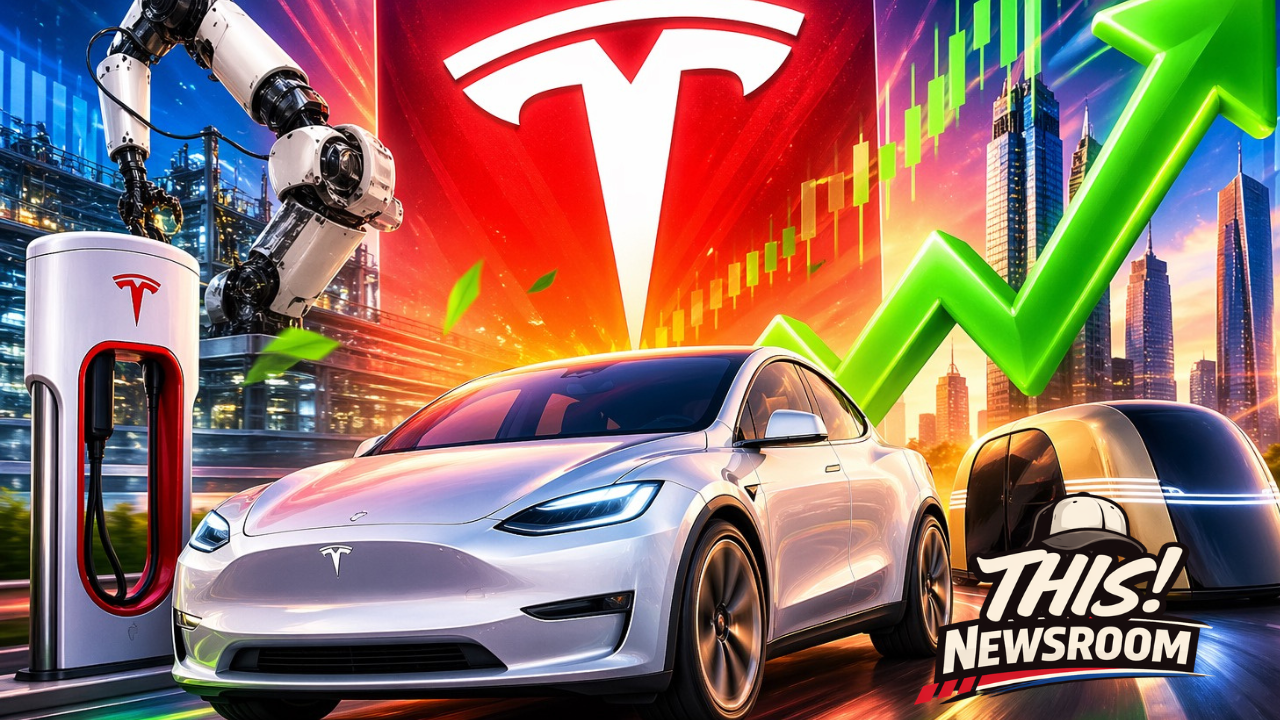
Tesla Q1 Earnings Beat Expectations as AI and Auto Demand Drive Growth
Tesla delivered a stronger-than-expected first quarter, signaling resilience in its core auto business while doubling down on its long-term bets in artificial intelligence and autonomous driving.
The company reported revenue of $22.39 billion, beating Bloomberg consensus estimates of $22.08 billion. That marks a 16% year-over-year increase, a notable performance amid growing competition in the electric vehicle market.
On the bottom line, Tesla posted adjusted earnings per share (EPS) of $0.41, surpassing expectations of $0.35. Even more impressive, the company’s gross margin reached 21.7%, well above the projected 17.7%, suggesting improved efficiency and cost control despite pricing pressures across the EV sector.
Auto Business Finds “Tailwinds”
Tesla pointed to multiple “tailwinds” supporting its automotive segment, including sustained global demand, operational efficiencies, and improved production scaling across its Gigafactories.
While competitors continue to crowd the EV space, Tesla’s ability to maintain strong margins indicates it is still benefiting from vertical integration and manufacturing scale advantages. The company has also leaned into cost optimization strategies, helping offset earlier price cuts designed to stimulate demand.
Robotaxi Rollout Still Under Scrutiny
Despite the strong quarter, investors remain focused on Tesla’s slow-moving Robotaxi rollout, a cornerstone of CEO Elon Musk’s long-term vision.
Tesla continues to emphasize its autonomous driving roadmap, but timelines have stretched, and concrete deployment details remain limited. Analysts are watching closely for signs that Tesla can transition from development to real-world scale in its self-driving fleet.
The Robotaxi initiative is widely seen as a potential game-changer for Tesla’s valuation, but delays have raised questions about execution risk and regulatory hurdles.
AI Investments Driving Future Growth
A major theme in Tesla’s outlook is its aggressive push into artificial intelligence. The company acknowledged that capital expenditures are expected to rise significantly, driven by investments in AI infrastructure, data centers, and training models for autonomous driving.
These investments are not just about vehicles. Tesla is positioning itself as an AI company, with applications spanning robotics, energy optimization, and full self-driving systems.
While rising capex could pressure near-term profitability, Tesla believes these moves will unlock long-term growth and competitive advantages.
The Bigger Picture
Tesla’s Q1 results reflect a company navigating two realities at once:
- A maturing EV business that still delivers strong financial performance
- A future-focused AI strategy that requires heavy upfront investment
For now, the numbers suggest Tesla is managing that balance effectively. However, much of the company’s long-term valuation still hinges on its ability to execute on autonomous driving and AI at scale.
What to Watch Next
Investors will be keeping a close eye on:
- Updates on the Robotaxi timeline and deployment
- Trends in vehicle demand amid global competition
- The pace and impact of AI-related capital expenditures
- Margin sustainability as pricing dynamics evolve
Tesla’s latest earnings show momentum—but the real story may lie in whether its ambitious vision becomes reality.
About the Author