AI Services Companies Disrupt IT Giants: Anthropic and OpenAI Challenge TCS and Infosys
The global AI race just took a sharp turn—and it’s heading straight for the heart of the consulting industry.
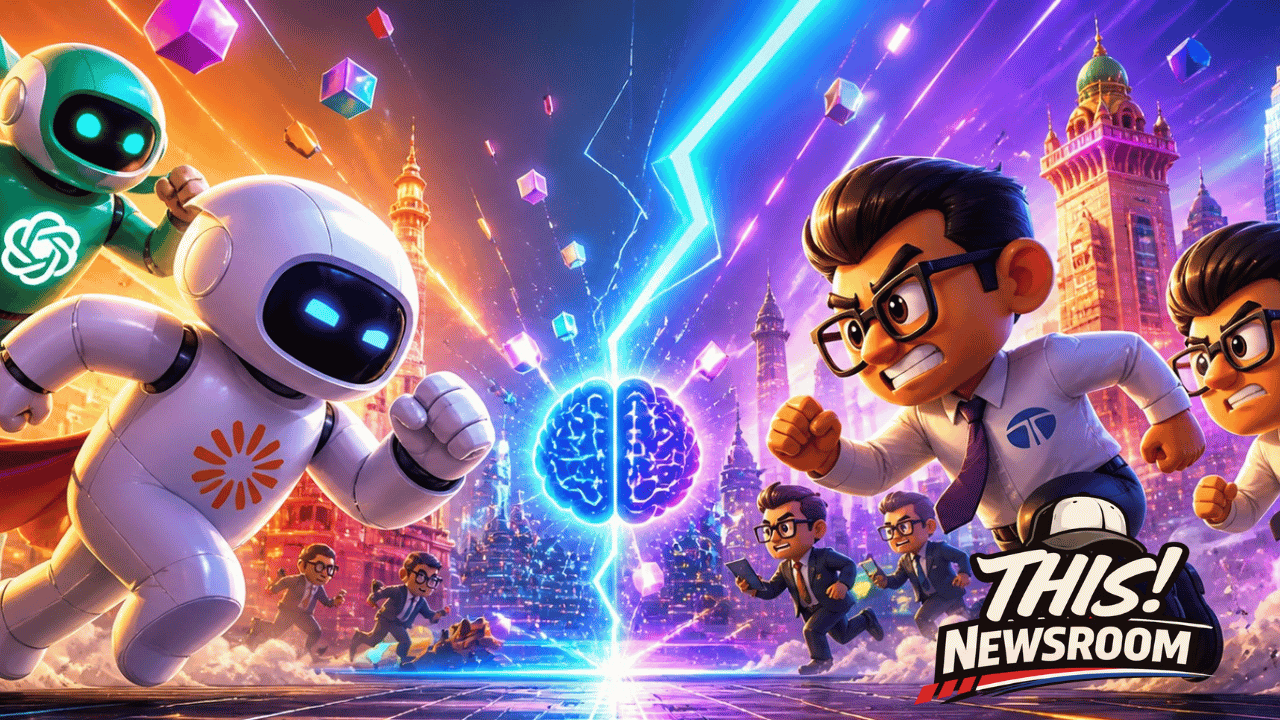
In a move that could reshape how companies adopt artificial intelligence, Anthropic and OpenAI are no longer just building models—they’re building full-scale AI services businesses. That puts them in direct competition with consulting powerhouses like Tata Consultancy Services and Infosys—two firms that have dominated enterprise IT transformation for decades.
And the battlefield? India, the global epicenter of IT services.
The $1.5 Billion Bet on AI Services
Anthropic recently announced a massive $1.5 billion joint venture backed by financial heavyweights including Blackstone, Goldman Sachs, and Hellman & Friedman.
But this isn’t just another funding round—it’s a strategic pivot.
The new company is designed to sell AI as a service, embedding Anthropic’s Claude model directly into the daily operations of businesses. The goal is simple but ambitious: take AI out of the lab and put it into real workflows—finance, healthcare, manufacturing, and more.
Additional backing from firms like Apollo Global Management, Sequoia Capital, and General Atlantic signals just how serious the market is about this shift.
Why This Is a Direct Threat to TCS and Infosys
For decades, companies like TCS and Infosys have thrived by helping enterprises modernize—handling everything from IT outsourcing to digital transformation.
Here’s the scale they’re operating at:
- TCS employs over 600,000 people globally
- Infosys has 300,000+ employees
- India’s IT services industry generates $250+ billion annually
- These firms serve Fortune 500 companies across 50+ countries
Their model? Large teams, long contracts, and deep integration into enterprise systems.
AI companies are now attacking that model directly.
Instead of sending in thousands of consultants, Anthropic and OpenAI are offering:
- Smaller, highly specialized AI engineering teams
- Faster deployment cycles (weeks vs. months)
- Automation that replaces repetitive human workflows
This isn’t just competition—it’s compression of the entire services stack.
What the New AI Services Model Looks Like
Anthropic’s approach flips traditional consulting on its head.
A typical engagement looks like this:
- Discovery Phase
Engineers sit with business operators (not just executives) to identify inefficiencies. - Custom AI Build
Claude-powered tools are tailored to existing workflows—not the other way around. - Embedded Deployment
AI integrates into systems employees already use (EHRs, CRMs, finance tools). - Continuous Optimization
Instead of one-off projects, AI systems evolve in real time.
Take healthcare as an example:
- Doctors currently spend up to 40% of their time on documentation and admin tasks
- AI tools can automate coding, prior authorizations, and compliance reviews
- That translates into more patient time and lower operational costs
Now scale that across industries—and you start to see the disruption.
OpenAI Is Playing the Same Game
While Anthropic is making headlines with this joint venture, OpenAI is quietly building a similar ecosystem through:
- Enterprise partnerships
- Custom GPT deployments
- Developer platforms integrated into business workflows
The strategy is clear: own not just the intelligence layer—but the implementation layer too.
Because here’s the reality:
The biggest bottleneck in AI adoption isn’t the technology—it’s execution.
Why India Matters So Much
India isn’t just another market—it’s the backbone of global IT services.
- Over 5 million people work in India’s tech services sector
- Companies worldwide rely on Indian firms for cost-effective, scalable talent
- TCS and Infosys have decades-long relationships with enterprise clients
But AI changes the equation.
If fewer engineers are needed to deliver the same—or better—results:
- Margins shift
- Pricing models collapse
- Talent demand evolves dramatically
This doesn’t mean TCS and Infosys disappear—but it does mean they must reinvent fast.
The Real Opportunity: Mid-Sized Companies
One of the most interesting angles in Anthropic’s strategy is its focus on mid-sized organizations.
Why?
Because:
- Large enterprises already have consulting partners
- Small businesses often lack budgets
- Mid-sized firms are underserved—and highly scalable
These companies:
- Want AI
- Need automation
- But don’t have internal teams to build it
That’s the gap this new AI services company is designed to fill.
The Bigger Shift: From Software to Outcomes
This isn’t just a new product category—it’s a new business model.
Traditional SaaS sells tools.
Consulting firms sell expertise.
AI services companies are now selling outcomes.
Instead of:
- “Here’s software your team can use”
It becomes:
- “Here’s a system that does the work for you”
That’s a fundamental shift—and one that could redefine enterprise spending over the next decade.
Final Take: The Consulting Industry Is Being Rewritten
Anthropic and OpenAI aren’t just competing with each other anymore.
They’re going after:
- Consulting firms
- IT outsourcers
- Systems integrators
And they’re doing it with:
- Faster deployment
- Lower costs
- Higher automation
For companies like TCS and Infosys, this is a moment of truth.
For businesses adopting AI, it’s a moment of opportunity.
And for the rest of us?
It’s a glimpse into a future where the line between technology and labor gets thinner every day.
About the Author