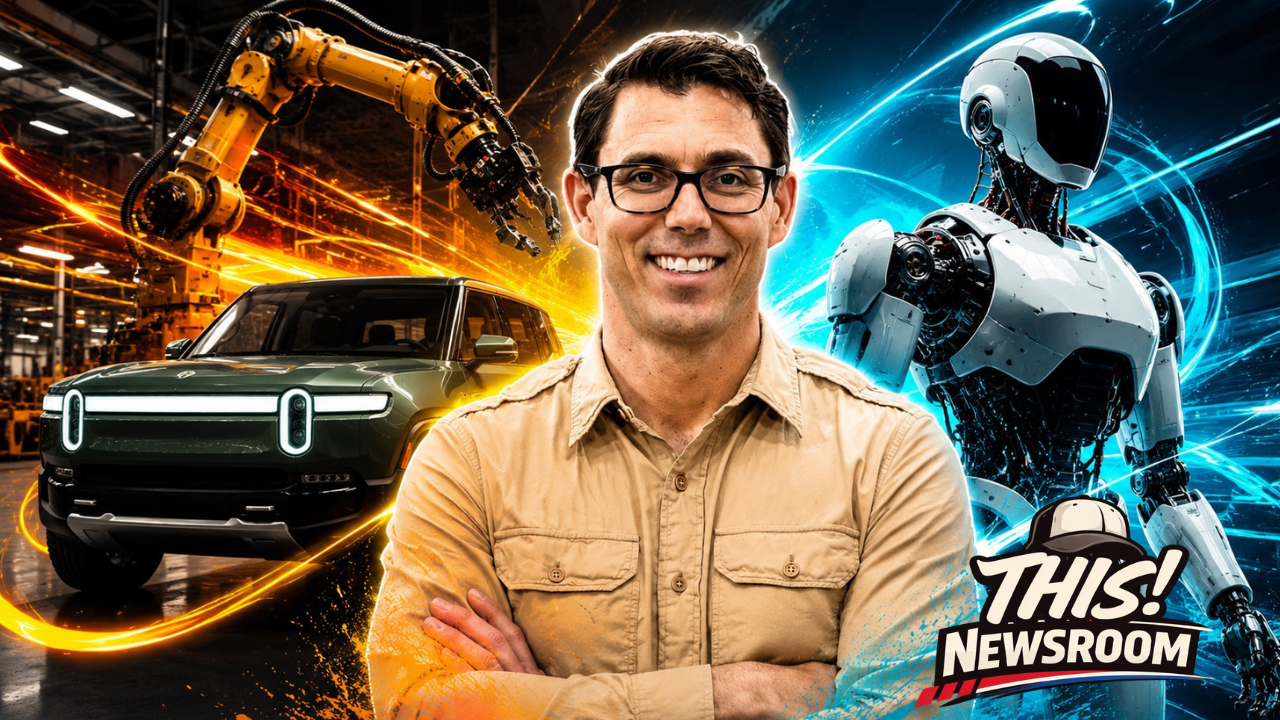
Rivian CEO’s Robotics Startup Hits $3.4 Billion Valuation
The electric vehicle war may have only been the beginning.
Now, the next massive technology battle appears to be robotics — and one of the biggest names in EVs is already moving aggressively into the space.
According to recent reports, the robotics startup founded by Rivian CEO RJ Scaringe has reportedly reached a staggering $3.4 billion valuation, signaling that investors believe the future of automation could become even larger than the future of electric vehicles themselves.
The company, called Mind Robotics, is quietly positioning itself at the center of what many analysts believe could become the next trillion-dollar industry.
And honestly? This feels familiar.
A decade ago, electric vehicles were viewed as niche experiments. Today, nearly every major automaker is spending billions trying to catch up to companies like Rivian and Tesla.
Now robotics is starting to follow that same trajectory.
Why Investors Are Pouring Billions Into Robotics
The robotics industry is no longer just about factory arms building cars.
Modern AI-powered robotics is expanding into:
- Warehouses
- Manufacturing
- Logistics
- Healthcare
- Home assistance
- Autonomous mobility
- Construction
- Agriculture
- Military and defense applications
And perhaps most importantly — humanoid robots.
Companies are racing to combine artificial intelligence with physical machines capable of performing real-world tasks. The breakthrough in large language models and AI reasoning has accelerated robotics development dramatically over the last two years.
In simple terms:
AI gave machines a brain.
Now robotics companies are trying to give them bodies.
That combination is what has Silicon Valley investors throwing around valuations that sound almost absurd.
The Rivian Connection Matters
The reason this story is getting so much attention is because of who is behind it.
RJ Scaringe built Rivian from a startup into one of the most recognized EV brands in America. Even while Rivian faced production challenges and market pressure, the company earned respect for its engineering, design, and long-term vision.
That credibility matters.
Investors are betting that someone who understands advanced manufacturing, automation, battery systems, AI integration, and scalable engineering may have a major advantage in robotics.
The overlap between EV manufacturing and robotics is actually massive.
Electric vehicles already rely heavily on:
- Sensors
- Cameras
- AI systems
- Advanced computing
- Autonomous decision-making
- Precision manufacturing
Robotics is simply the next evolution.
Why This Could Become Bigger Than Cars
This is the part most people still underestimate.
Cars have a limited market.
Robots potentially do not.
If robotics companies successfully create adaptable AI-powered machines, they could eventually become part of nearly every industry and household on Earth.
That sounds like science fiction until you realize how quickly AI has already changed daily life.
Just three years ago, most people had never touched generative AI.
Now millions use it every day.
The same pattern could happen with robotics over the next decade.
Imagine:
- Robots unloading delivery trucks overnight
- AI assistants helping elderly patients at home
- Humanoid robots handling dangerous industrial work
- Automated restaurants and retail stores
- Personal home robotics for cleaning, repairs, and security
The labor implications alone are enormous.
The Bigger Tech Arms Race
Mind Robotics enters a crowded but rapidly growing battlefield.
Major companies investing heavily in robotics include:
- Tesla with Optimus
- Figure AI
- Boston Dynamics
- NVIDIA
- Amazon
- OpenAI partnerships in robotics research
This is becoming less about gadgets and more about infrastructure.
The companies that dominate robotics may eventually control enormous portions of global logistics, manufacturing, and labor automation.
That is why valuations are exploding before many consumers have even seen these products in daily life.
The Real Question Nobody Can Answer Yet
The biggest unknown is whether society is truly ready for this shift.
People love automation when it makes life easier.
They become nervous when automation starts replacing jobs.
That tension is coming fast.
Some economists believe robotics and AI could unlock unprecedented productivity and economic growth. Others warn it could reshape employment faster than governments and workers can adapt.
Both arguments may end up being true at the same time.
Final Thoughts
The $3.4 billion valuation attached to Rivian’s robotics startup is not really about today.
It is a bet on what the world looks like 10 years from now.
Silicon Valley increasingly believes the future will not just be electric.
It will be autonomous, AI-powered, and robotic.
And if that future arrives faster than expected, the companies building intelligent machines today could become even more influential than the automakers that dominated the last century.
About the Author