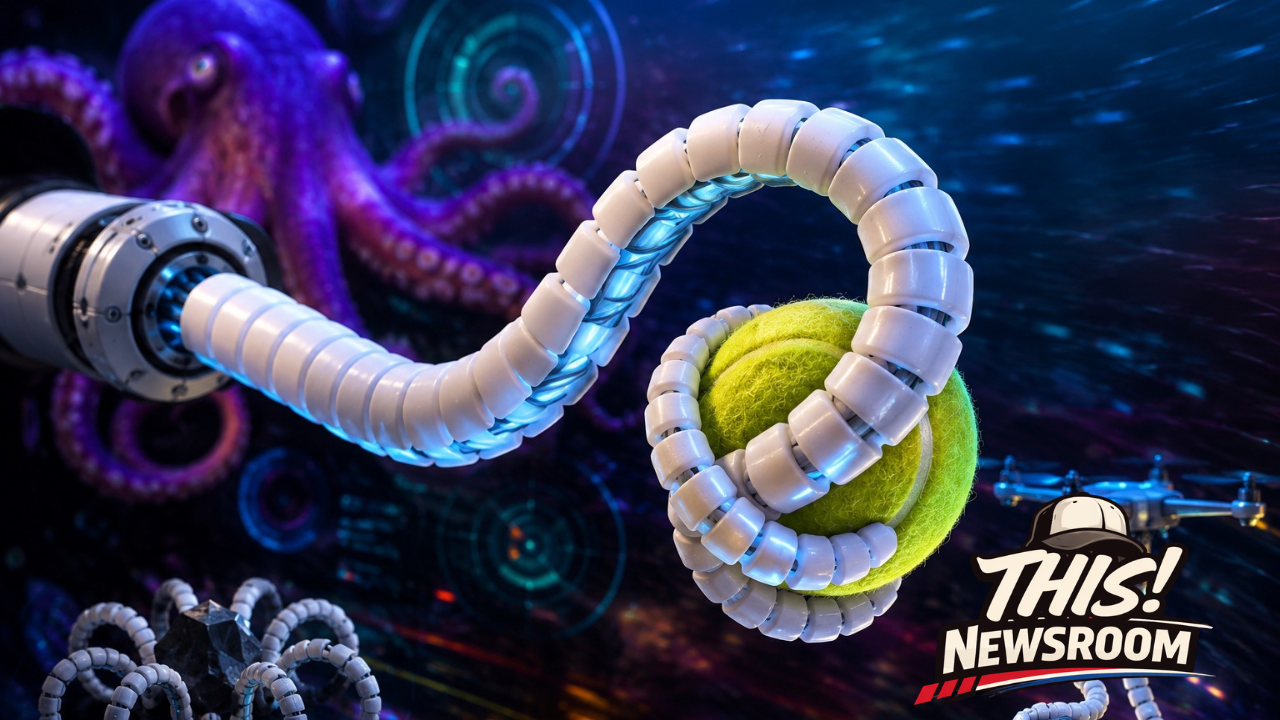
SpiRobs use flexible, spiral-shaped structures to wrap around and grip objects rather than relying on conventional robotic fingers.
Researchers have developed a radically different kind of robotic arm that doesn’t rely on fingers, joints or traditional mechanical claws. Instead, it curls around objects like a tentacle — and the design could point toward a new generation of adaptable robots.
Robots have traditionally been built around rigid joints, motors and mechanical grippers. But nature solved the problem of grabbing oddly shaped objects long before humans started building machines.
Think octopus arms. Elephant trunks. Prehensile tails.
Researchers have taken inspiration from those biological systems to develop SpiRobs, a class of soft robotic manipulators built around a mathematical shape known as a logarithmic spiral. The robots can curl around objects rather than simply pinching them between rigid fingers.
And their capabilities are impressive.
Experiments reported by the researchers showed SpiRobs grasping objects across a huge range of sizes and, in some configurations, supporting loads up to 260 times the robot’s own weight.
Instead of Robotic Fingers, Think Robotic Tentacles
The concept comes from an observation found throughout nature.
Flexible appendages including octopus arms and elephant trunks can curl into shapes resembling logarithmic spirals. The researchers designed SpiRobs around the same geometry.
Rather than filling the robot with dozens of individually controlled joints, the system uses a relatively simple cable-driven mechanism.
Two- and three-cable versions allow the robotic structure to curl and uncurl. As the spiral makes contact with an object, its flexible body can conform to the object’s shape.
That means the robot doesn’t necessarily need to know the exact geometry of everything it encounters before attempting to pick it up.
The researchers describe an octopus-inspired grasping strategy in which passive deformation helps the robot adapt to objects of different shapes and sizes without requiring extremely complicated planning and feedback systems.
They Can Be Tiny — Or More Than Three Feet Long
One of the most interesting parts of SpiRobs isn’t simply how the robot moves.
It’s how dramatically the design can scale.
Researchers demonstrated versions ranging from approximately one centimeter long to a one-meter robotic manipulator.
The miniature version was created with a tip measuring just fractions of a millimeter and was demonstrated gently grasping an ant without breaking it.
At the opposite extreme, researchers built a one-meter-long, three-cable SpiRob capable of wrapping around substantially larger objects.
They even mounted the large robotic arm underneath a drone, demonstrating a flying system capable of approaching and grabbing objects.
That’s where this technology starts getting particularly interesting.
Multiple Tentacles Can Work Together
The researchers didn’t stop with a single arm.
They also constructed a gripper consisting of six SpiRob arms.
Instead of attempting to precisely pinch an object, the collection of soft arms can essentially surround and entangle it.
That could be especially useful when robots encounter irregular objects that conventional claws struggle to grasp.
A traditional robotic gripper works exceptionally well when engineers know what it needs to pick up.
The real world isn’t always that predictable.
Branches, cables, debris, plants, tools and damaged objects can have wildly different geometries. A soft system capable of physically adapting itself to whatever it touches could potentially give robots much greater versatility.
3D Printing Could Make Them Relatively Simple to Produce
Another advantage is manufacturing.
Researchers reported producing numerous SpiRob prototypes using 3D printing, including versions made with flexible TPU material. The design uses a comparatively straightforward combination of a flexible body, cables and motors.
That could make the technology attractive for experimentation because engineers can potentially change the robot’s scale without completely redesigning its underlying mechanical principle.
The same basic spiral concept can become a tiny precision gripper, a larger robotic arm or an array of tentacle-like manipulators.
Where Could This Technology Eventually Be Used?
SpiRobs remain research technology rather than the arrival of commercial robotic tentacles everywhere tomorrow.
But the demonstrations highlight several areas where soft robotics could become valuable.
Search-and-rescue robots could eventually benefit from manipulators capable of reaching through confined spaces and wrapping around irregular debris. Agricultural robots could handle produce without crushing it. Industrial robots could manipulate objects whose exact dimensions aren’t known beforehand. Small versions could potentially contribute to delicate laboratory or biological manipulation.
Drone-mounted versions also introduce another possibility: aerial robots capable of interacting physically with their environment rather than simply observing it.
The underlying idea is bigger than any one application.
Nature May Be the Ultimate Robotics Engineer
For decades, robotics largely tried to reproduce human mechanical movement with motors, hinges and joints.
Soft robotics takes another approach.
Instead of forcing machines to behave like rigid industrial equipment, engineers are increasingly studying organisms that already perform incredibly complicated movements with flexible bodies.
The octopus doesn’t need five mechanical fingers.
An elephant doesn’t need a robotic claw.
Their appendages bend, curl and wrap themselves around whatever needs to be manipulated.
SpiRobs attempts to capture part of that biological advantage using mathematics, flexible materials and remarkably simple actuation.
And that may ultimately be the most important part of this research.
The future of robotics might not always look like humanoid machines with hands.
Some of the most capable robots could look much stranger.
They might have tentacles.
About the Author