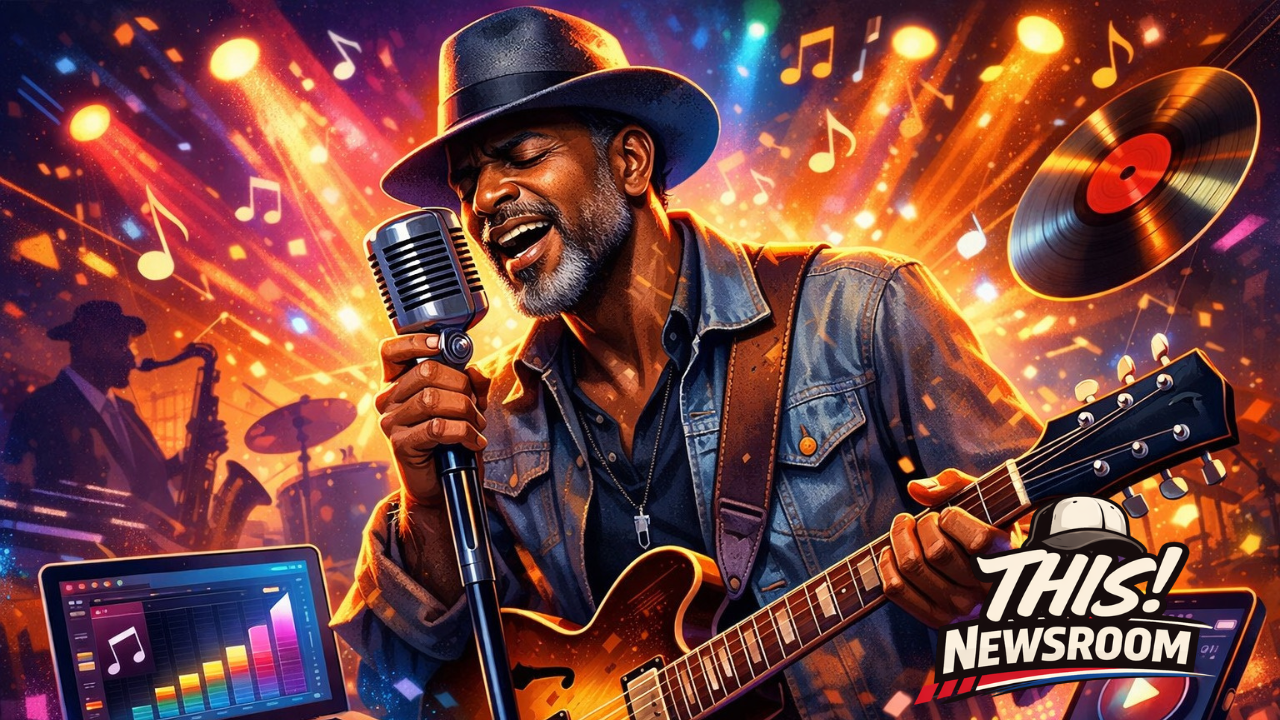
In a moment that feels equal parts groundbreaking and controversial, AI-generated blues artist Eddie Dalton has climbed to the top of the iTunes charts with his soulful track “Another Day Old.”
Yes, you read that right. Not a comeback story, and not a lost recording rediscovered. Instead, a fully AI-created blues singer just went #1.
Naturally, the internet has a lot to say about it.
The Song That Sparked It All
“Another Day Old” sounds like it was pulled straight from a dimly lit Mississippi juke joint. From gritty vocals to aching guitar riffs, the song delivers lyrics that feel deeply lived-in.
For example, one line hits particularly hard:
Another day older, but the pain don’t fade…
At first listen, it checks every box of traditional blues authenticity. However, the twist changes everything. Eddie Dalton doesn’t exist—at least not in the human sense.
Behind the scenes, the track was created using advanced AI music generation tools capable of writing emotionally resonant lyrics, producing instrumentals with genre-specific nuance, and generating a human-like voice with tone, texture, and even imperfections.
As a result, the final product feels incredibly real—maybe even too real.
Who (or What) Is Eddie Dalton?
Eddie Dalton is a fictional persona—an AI-generated blues artist crafted to embody the essence of classic American blues.
In many ways, he represents a digital composite. On one hand, you hear the rasp of old Delta blues legends. On the other, you feel the storytelling of modern Americana layered with today’s production quality.
Unlike traditional artists, there are no tours, no interviews, and no origin story about learning guitar on a front porch. Instead, there is only code—and a lot of it.
How Did It Reach #1?
The rise of “Another Day Old” wasn’t accidental. Rather, it was a perfect storm of curiosity, distribution, and repeat listening behavior.
First, viral curiosity played a massive role. People didn’t just listen—they had to hear it. Questions like “Wait… this is AI?” became the hook.
Next, social media amplification accelerated the momentum. Clips spread rapidly, and audiences began debating whether they loved it or feared it.
In addition, playlist placement pushed the track into mainstream discovery. Once it landed on major blues and mood playlists, streams increased significantly.
Finally, and perhaps most importantly, the song had real staying power. Listeners kept coming back—not as a novelty, but because they genuinely liked it.
The Internet Reacts
As expected, reactions have been mixed.
On one side, some listeners are all in. They argue that if it sounds good, it is good. Others go even further, calling it the future of music.
On the other side, critics are uneasy. Many question whether something created by AI can truly have soul, while others worry about what this means for real artists.
Meanwhile, a large group sits somewhere in the middle, simply trying to process what this moment represents.
Can AI Have Soul?
This is the question hanging over everything.
Traditionally, blues music is rooted in lived experience—pain, struggle, and resilience. Because of that, it has always been more than just sound; it’s deeply tied to storytelling.
So when an AI produces a song that feels authentic, it challenges a core belief.
Does emotional impact require a human origin? Or, alternatively, is emotion something that can be convincingly simulated?
If listeners genuinely feel something, then perhaps the source matters less than we once thought.
What This Means for Artists
Clearly, this isn’t just a one-off viral moment. Instead, it signals a broader shift.
AI is no longer just a tool for production. Increasingly, it is becoming a creator in its own right.
Because of this, several important questions emerge. Will AI artists begin competing directly with human musicians on the charts? Could labels start investing in entirely digital personas? And how do royalties even work when there is no traditional “artist”?
For independent musicians, the answer could go either way. While some may see this as a threat, others may view it as an opportunity to use the same tools and compete in new ways.
The Bigger Picture
Ultimately, Eddie Dalton going #1 isn’t just about a single song—it represents a shift in how we define creativity.
We’ve already seen AI write articles, generate images, and assist in filmmaking. Naturally, music was always going to be next.
However, blues makes this moment feel different. As a genre built on human struggle and storytelling, it carries a weight that is hard to replicate—yet somehow, AI just did.
Final Thought
“Another Day Old” isn’t just climbing charts—it’s forcing a conversation.
Whether you love it or hate it, one thing is clear. AI didn’t just enter the music industry—it just topped it.
So now the real question becomes: what happens when it does it again?
In a m
About the Author