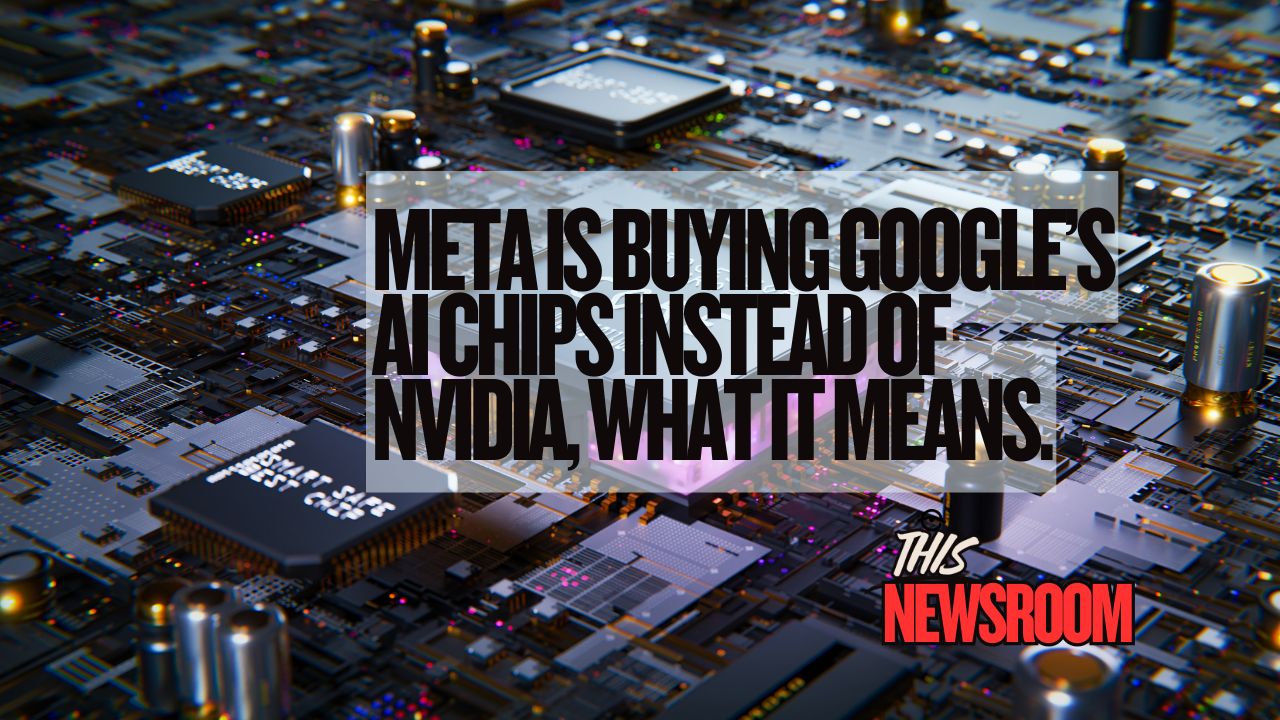
Meta is reportedly preparing to shift a significant portion of its artificial intelligence chip strategy away from Nvidia and toward Google. According to reporting from The Information and confirmed by Reuters, Meta is in advanced discussions to spend billions on Google’s custom AI processors—Google’s Tensor Processing Units (TPUs)—marking one of the most substantial competitive threats Nvidia has faced in the AI hardware landscape.
This strategic move has implications for Meta, Google, Nvidia, the broader AI ecosystem, and the future of compute infrastructure. Below is a detailed breakdown of what this pivot means, who else is aligning with Google, and how Nvidia responded defensively on Twitter/X.
For related analysis on technology and business trends, visit the Newsroom section at
https://thiswithkrish.com/category/newsroom/
A Major Shift: Meta Evaluates Google TPUs Over Nvidia GPUs
Nvidia has long dominated the AI-chip market, supplying Meta with tens of thousands of high-end GPUs every quarter for model training and data-center scaling. But a report from The Information reveals that Meta is negotiating to rely heavily on Google’s TPUs for both cloud-based and on-premise deployments beginning as early as 2026, with large-scale integration targeted for 2027.
External source:
Reuters – “Meta in talks to spend billions on Google’s chips”
https://www.reuters.com/business/meta-talks-spend-billions-googles-chips-information-reports-2025-11-25/
For Google, this would represent the company’s largest-ever hardware sale and a signal that TPUs are becoming a viable alternative to Nvidia’s expensive and often supply-constrained GPUs.
Why Meta Is Interested in Google Chips
1. Cost Efficiency
Analysts estimate that Google’s latest-generation TPUs may offer meaningful cost advantages for inference workloads. The combination of lower energy consumption and specialized accelerators appeals to companies scaling AI models globally.
2. Diversification Beyond Nvidia
Nvidia GPUs are powerful but expensive, and supply has consistently lagged demand. Meta, which trains some of the largest AI models in the world—including Llama 3 and its successors—has strong incentives to diversify suppliers.
3. Strategic Leverage
By bringing in Google as a second major chip partner, Meta gains negotiating power against Nvidia’s pricing and product cycles.
For deeper AI-industry analysis, explore the Technology section:
https://thiswithkrish.com/category/technology/
Why This Matters for Google
If finalized, the Meta deal would thrust Google into a new tier as an AI-hardware provider. Historically, Google developed TPUs primarily for internal use and Google Cloud customers. Selling TPUs to third-party hyperscale companies like Meta signals:
- A direct challenge to Nvidia’s de facto monopoly
- A new revenue stream in the tens of billions
- A broader shift toward vertically integrated AI stacks
This move positions Google not only as a cloud platform but as a major chip supplier capable of shaping the future of AI compute.
Who Else Is Choosing Google Over Nvidia?
Meta is not alone. Multiple companies and AI labs have begun expanding their use of Google’s TPUs, including:
1. Anthropic
Anthropic reportedly expanded its cloud commitment, agreeing to use up to one million Google TPUs to support model training and inference.
2. Enterprise Cloud Customers
Google Cloud’s AI platform has added several large enterprise clients seeking more predictable compute availability than what Nvidia’s supply chain can currently provide.
3. Select Data-Center Operators
Industry reporting suggests specialized data-center operators are exploring TPU deployments due to lower cooling requirements and improved performance-per-watt metrics.
This growing momentum toward TPUs points to a larger trend: companies want alternatives to Nvidia, and Google is aggressively positioning itself as the answer.
Nvidia Responded Defensively on Twitter/X
News of Meta’s potential switch caused an immediate reaction from Nvidia, which posted a public statement on its official Newsroom account on X:
“We’re delighted by Google’s success. They’ve made great advances in AI and we continue to supply them. NVIDIA is a generation ahead of the industry. It is the only platform that runs every AI model and does it everywhere computing is done.”
Source:
X/Twitter – NVIDIA Newsroom
https://x.com/nvidianewsroom/status/1993364210948936055
The tone was congratulatory but defensive. Nvidia emphasized its ecosystem dominance, model compatibility, and continued supply relationship with Google. The company’s message highlighted the core challenge it faces: even as competitors rise, Nvidia still believes its platform is the most universal and capable.
What This Means for the AI Industry
1. A More Competitive Hardware Market
For years, Nvidia’s architecture has been the standard. But as Google pushes TPUs and competitors like AMD invest in AI accelerators, 2025–2027 may mark the beginning of true diversification.
2. Pressure on CUDA Dominance
Nvidia’s software platform, CUDA, has been its greatest moat. If major AI companies shift to TPUs or custom silicon, demand for cross-platform frameworks will grow.
3. Lower Costs for AI Development
More competition forces downward pricing pressure, enabling startups and mid-market companies to access compute previously reserved for hyperscale firms.
4. Shifts in Cloud Strategy
Google Cloud becomes more strategically important. AWS, Microsoft, and Oracle must respond with their own silicon strategies or risk losing high-volume AI clients.
Internal link for cloud and tech news:
https://thiswithkrish.com/category/newsroom/economy/
A Turning Point for AI Infrastructure
The potential Meta–Google deal is bigger than a single shift in purchasing strategy. It signals the beginning of a multi-chip future. Nvidia is still the global leader in AI hardware, but Google is proving that custom silicon can compete at scale.
If Meta follows through, it will send a message across the industry:
AI compute may no longer be synonymous with Nvidia.
More competition means better pricing, more innovation, and rapid acceleration in the development of AI tools, products, and research.
For ongoing coverage of AI, technology, and economic trends, visit:
https://thiswithkrish.com
About the Author