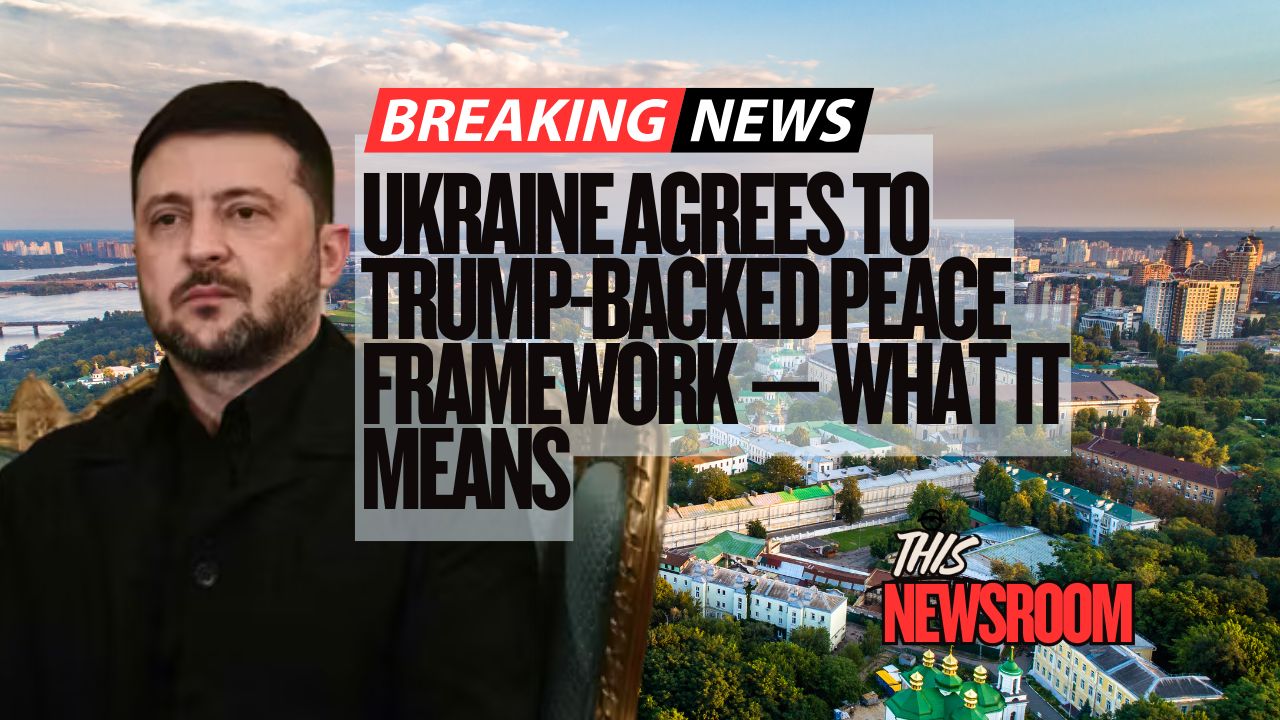
In a dramatic turn of events in the prolonged war between Ukraine and Russia, Kyiv has announced that it has agreed in principle to a peace deal framework put forward by the United States under President Donald Trump. While final signatures are still pending, Ukrainian officials say only “minor details” remain to be settled. Axios CBS News The Washington Post
What Has Been Agreed
- The deal is rooted in what began as a 28-point peace plan crafted by the U.S. government with significant input and pushing from Trump’s team. Axios PBS
- In negotiations between Kyiv and Washington held in Geneva, Ukraine accepted a revised version of the plan — now trimmed to 19 points — which removed some of the more controversial demands originally aimed at Ukraine, including a blanket restriction on NATO membership and full withdrawal from contested territories. The Guardian The Washington Post
- A U.S. official told CBS News that Ukraine has agreed to the deal, with only “minor details” left to be hammered out. CBS News
- The next step is a more formal signing, likely involving President Volodymyr Zelenskyy traveling to the U.S. to meet Trump for a wrap-up of the deal. Axios
Why It’s Significant
- For Ukraine: Accepting the framework represents a momentous shift — relinquishing parts of the firm negotiating position it has held for years. Ukraine’s President Zelenskyy described the moment as one of the most difficult in his country’s history. The Guardian
- For Russia: While Russia has been a party to the war, the direct treaty would bypass much of the European-mediated architecture and place the U.S. front and center. The Kremlin said it had not yet received the updated plan in full. Reuters
- For the U.S./Trump: Securing a deal in Ukraine could be a major diplomatic legacy item. Trump has repeatedly pressed for a clear end-to-war deal and set Thursday (U.S. Thanksgiving) as an acceptable deadline for Ukraine’s “yes” answer. Wall Street Journal
- For Europe: Many European allies are cautious. They question whether the deal safeguards Ukraine’s sovereignty sufficiently and whether the U.S. plan properly reflects European concerns. Newsweek
Key Terms & Remaining Questions
What’s in the deal (in broad brushes):
- A commitment from Ukraine to a cease-fire and eventual peace arrangement with Russia. PBS
- A scaling back of Ukraine’s NATO aspirations (in the original draft) and restrictions on its military size were among the draft’s controversial elements — many of which were later softened. Al Jazeera
- Security guarantees from the U.S., and possibly a multinational “reassurance” or peacekeeping force from Europe and others, to support Ukraine’s post-peace stability. Wikipedia
What remains unclear or undecided:
- The full territorial outcome: Which areas Ukraine holds, which are relinquished, and under what status (autonomy, joint administration, etc.).
- Final ratification by Russia: While Ukraine has agreed in principle, Russia has yet to accept the revised framework formally. Axios
- Implementation details: Monitoring, verification, troop withdrawals, cease-fire enforcement, reconstruction, security guarantees.
- The role of Europe: Whether European allies will have equal say in enforcement and guarantee mechanisms. Some are insisting on stronger roles. The Guardian
- Domestic politics: In Ukraine, accepting major concessions may spark backlash; in the U.S., the timing and optics will matter; in Russia, costs and benefits are still being weighed.
Reactions & Risks
- Ukraine: While accepting the framework might end years of grinding war and uncertainty, many Ukrainians worry that concessions could undermine sovereignty or leave them vulnerable. Zelenskyy has warned that the country is facing an “impossible choice.” The Guardian
- Russia: For Moscow, any deal that preserves significant losses or doesn’t cement territorial gains could be seen as insufficient. The Kremlin’s dismissive reaction to the European counter-proposal signals it wants better terms. Reuters
- U.S./Trump: If the deal collapses without meaningful implementation, it could backfire. On the other hand, success could give Trump a major diplomatic win.
- Europe: If sidelined, European states may feel the U.S. has brokered a deal that undermines European security architecture. Divisions within NATO may deepen.
What Happens Next
- Formal signing: Expect Zelenskyy to visit Washington in the near term to sign the deal with Trump. Axios
- Presentation to Russia: Once Ukraine and the U.S. finalize their side, the deal will be presented to Russia, likely sparking intense bargaining over final labels and guarantees.
- Follow-on diplomacy: European states will push for involvement in implementation; a multinational force or peacekeeping component may be floated.
- Monitoring and enforcement: A mechanism for cease-fire, verification, reconstruction, and security guarantees will need to be agreed and funded.
- Domestic ratification: In Ukraine, parliamentary approval may be needed; in the U.S., Congress may demand adhering guarantees or oversight; Russia may seek formal legislative sign-off.
Why This Matters for the World
- A successful deal could end Europe’s largest land war since World War II, shift the balance of power in Eastern Europe, and redefine U.S., Russian, and European roles in the region.
- If mis-handled, it could leave Ukraine vulnerable, embolden Russia, fracture NATO, and destabilize the continent further.
- It signals a shift toward diplomatic resolution rather than open-ended military stalemate — but only if the enforcement holds.
Conclusion
Ukraine’s agreement to a Trump‐backed peace framework marks a dramatic pivot — one that could either end a protracted and destructive war, or open a new set of risks and uncertainties. The deal’s success will depend heavily on the details: security guarantees, territorial arrangements, implementation, and who holds Ukraine’s back if the agreement is tested.
For Ukraine, choosing peace means balancing the desire to end the war with preserving sovereignty and security. For Trump and the U.S., this is a high-stakes diplomatic moment. And for Europe and Russia, the outcome will shape the next chapter of European security.
Suggested:
Resources
- Axios (peace plan details)
- The Guardian (Ukraine accepting revised plan)
- CBS News (Ukraine agreed “in principle”)
- Reuters (Russian response)
- PBS / Al-Jazeera (plan breakdown)
About the Author