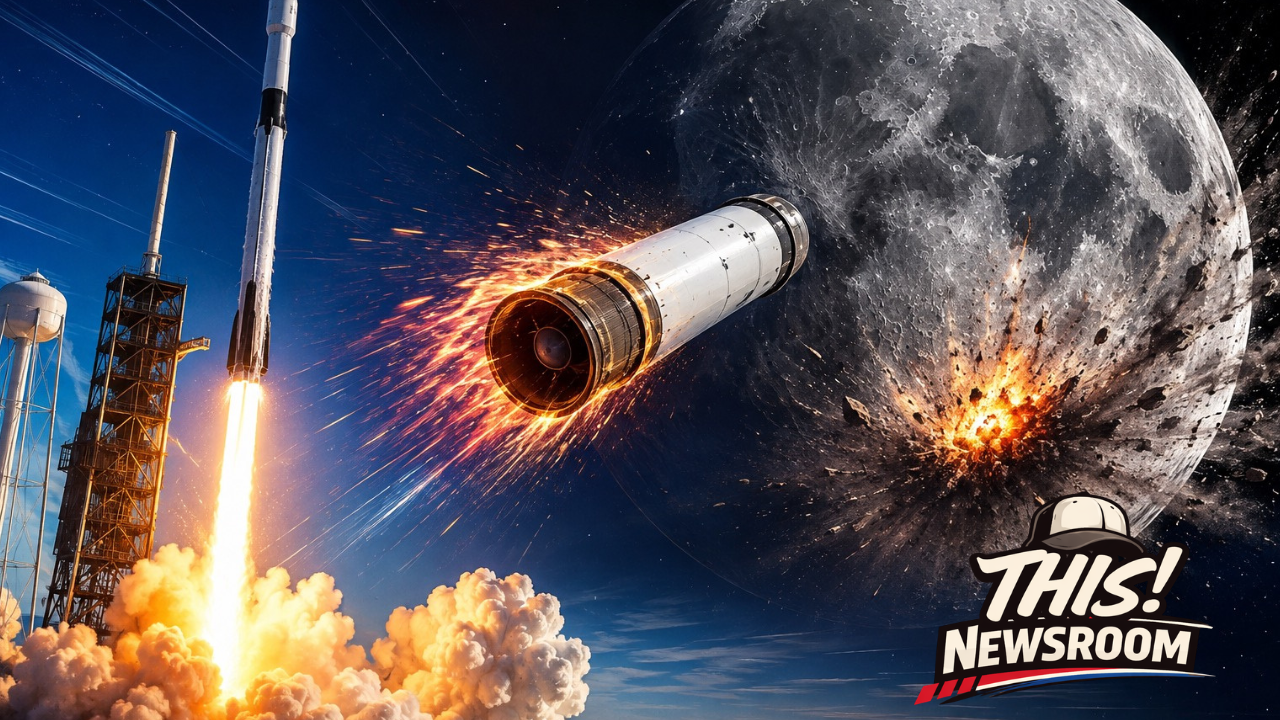
A spent Falcon 9 upper stage from a January 2025 mission is expected to impact the Moon near Einstein Crater on August 5, 2026.
A discarded Falcon 9 upper stage is heading toward the Moon. Astronomers expect it to strike near Einstein Crater on Wednesday, August 5, 2026.
The rocket stage will travel at roughly 5,400 mph, or about 8,700 km/h, when it reaches the lunar surface.
The collision wasn’t part of the original mission. The rocket completed its primary job more than a year ago. Since then, gravity has slowly changed its path through the Earth-Moon system.
Now scientists plan to turn the unusual crash into a research opportunity.
Where Did the Falcon 9 Rocket Stage Come From?
The upper stage comes from a Falcon 9 mission launched on January 15, 2025.
That mission carried two commercial lunar spacecraft. Firefly Aerospace launched its Blue Ghost lunar lander, while ispace sent its HAKUTO-R Mission 2 spacecraft toward the Moon.
The Falcon 9 completed its primary mission after deploying the spacecraft. However, its upper stage remained in a highly elongated orbit around Earth.
Earth and the Moon continued to pull on the discarded stage over the following months. Those gravitational forces gradually changed its trajectory.
Astronomer Bill Gray later calculated that the stage would eventually collide with the Moon.
Observers have collected more than 1,000 measurements of the object. Those observations have helped researchers narrow down its expected path and impact location.
The Rocket Will Hit the Moon at Nearly Full Speed
The Falcon 9 upper stage measures roughly 45 feet long.
Unlike Earth, the Moon has almost no atmosphere. That means atmospheric friction won’t destroy the rocket before impact.
Instead, the stage will travel directly toward the lunar surface.
Researchers estimate that it has a mass of about 3,900 kilograms. They expect it to hit at approximately 2.43 kilometers per second.
The collision should release a significant amount of energy.
Computer models suggest the impact could throw lunar material 15 to 20 kilometers above the surface. A central plume could climb even higher, potentially reaching 75 to 100 kilometers.
That possibility has caught the attention of astronomers.
Scientists Plan to Watch the Impact
Researchers are preparing telescopes and other instruments for the August 5 event.
They hope to detect the initial flash and study the debris plume that follows.
The collision gives scientists an unusual advantage. Researchers already know several important details about the incoming object.
They know its approximate size, mass, trajectory and speed.
That information allows scientists to compare what actually happens with their computer models. The results could improve our understanding of lunar impacts, crater formation and lunar dust.
Researchers may also learn more about how debris moves after a high-speed collision.
Could the Impact Help Future Moon Missions?
The research could have implications beyond this single rocket stage.
NASA and other space agencies plan to expand human and robotic activity around the Moon. Private companies also have ambitious lunar programs underway.
Scientists will need better ways to understand the lunar environment as those missions increase.
Known impacts can help.
Researchers can use precisely tracked collisions to study how the Moon responds to impacts. Future missions could combine impact observations with seismic instruments placed on the lunar surface.
Apollo-era scientists used similar techniques to learn about the Moon’s interior.
The Falcon 9 collision wasn’t designed for that purpose. Still, researchers can gather valuable information from it.
Can People See the Falcon 9 Hit the Moon?
Don’t expect a giant explosion visible to the naked eye.
Current estimates place the collision at approximately 06:35 UTC on August 5. That translates to about 2:35 a.m. Eastern Time.
Astronomers may adjust that estimate as they gather more tracking data.
The stage should strike sunlit terrain near the Moon’s eastern limb from Earth’s perspective.
Researchers don’t yet know how bright the initial flash will appear. Ordinary backyard observers may struggle to detect it.
The debris plume could provide a better target for powerful telescopes.
Professional observatories will likely lead the effort. Experienced amateur astronomers may also attempt to capture the event with suitable equipment.
The Collision Highlights a Growing Space-Debris Question
The story also points toward a larger challenge.
Humanity is sending more spacecraft toward the Moon than ever before.
Governments, private companies and research organizations are launching lunar landers, orbiters and supporting hardware. Some of that equipment will remain in space long after completing its mission.
Earth orbit already contains huge amounts of human-made debris.
The space surrounding the Moon could eventually face a similar challenge.
A single Falcon 9 stage hitting an empty section of the lunar surface poses little immediate danger. However, future lunar operations could become much more crowded.
Scientists expect the coming decades to bring more lunar satellites, research stations and commercial spacecraft. Human settlements could eventually join them.
Mission planners will need to know where abandoned hardware goes.
They’ll also need to prevent old spacecraft and rocket stages from threatening active missions.
From Space Junk to an Unexpected Science Experiment
The Falcon 9 stage began its journey as part of a commercial Moon mission in January 2025.
More than a year later, its journey will end on the Moon.
Scientists didn’t plan this collision as an experiment. They still intend to learn as much as possible from it.
Telescopes could capture the flash, debris and dust created during the impact. Researchers can then compare those observations with their predictions.
That makes an otherwise discarded piece of rocket hardware surprisingly valuable.
On August 5, a 45-foot rocket stage traveling thousands of miles per hour will reach the lunar surface.
Scientists will be watching.
This Newsroom Take
The collision itself makes for a spectacular headline. But the larger story matters even more.
Human activity around the Moon is accelerating quickly. More missions mean more spacecraft, rocket stages and discarded hardware traveling through lunar space.
The Falcon 9 impact offers scientists a chance to learn from that new reality.
As humanity expands its presence beyond Earth, we must think about more than getting there. We also need a plan for everything we leave behind.
About the Author