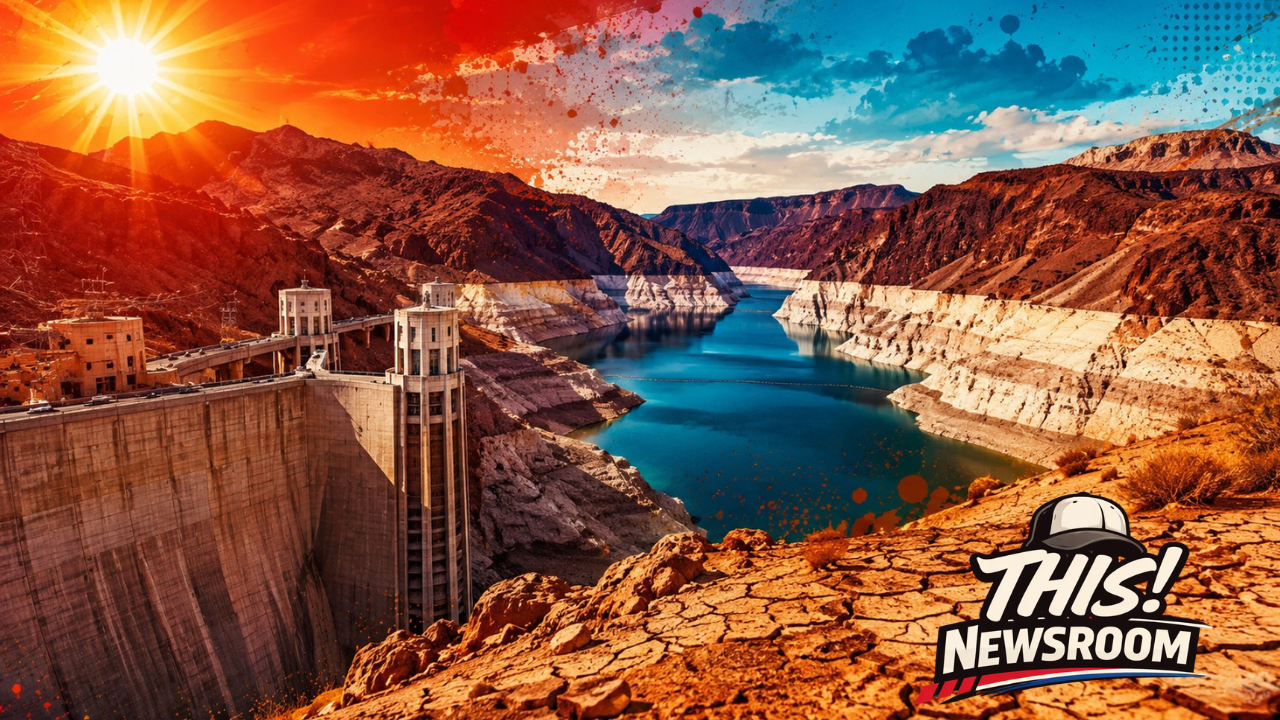
Lake Mead’s falling water levels are raising new concerns about Hoover Dam, Colorado River supplies and the future of water across the Southwest.
LAS VEGAS — One of America’s most important reservoirs is once again sending a serious warning about the future of water in the Southwest.
Lake Mead, the massive reservoir behind Hoover Dam on the Arizona-Nevada border, has fallen to historically low levels. The decline is renewing concerns about Colorado River water supplies, hydroelectric power, agriculture, population growth and the long-term future of several Western states.
On August 9, Lake Mead fell to approximately 1,040.4 feet above sea level, slipping below the previous record low reached during the severe drought of 2022.
That milestone matters because Lake Mead had recovered somewhat after several wetter periods earlier in the decade.
Now, much of that progress is disappearing.
The crisis goes far beyond the famous white “bathtub ring” surrounding the reservoir.
The Colorado River system supplies water to roughly 40 million people, major agricultural regions, Tribal communities and Mexico.
The bigger question is becoming increasingly urgent:
What happens if Lake Mead continues to fall?
Lake Mead Is Back Near Record-Low Territory
Lake Mead formed after workers completed Hoover Dam in the 1930s. It remains the largest reservoir in the United States by capacity.
For decades, the reservoir acted like an enormous water savings account for the American Southwest.
In recent years, however, withdrawals have increasingly outpaced what nature puts back.
More than two decades of drought, unusually high temperatures, weaker runoff, changing snowpack and enormous demand have put the Colorado River system under severe pressure.
Poor hydrological conditions have accelerated the decline.
Federal data showed Lake Mead dropping rapidly through July. Bureau of Reclamation measurements placed the reservoir at about 1,044.5 feet on July 1, with levels continuing lower afterward.
That decline matters because several critical thresholds remain below today’s water line.
Lake Mead’s minimum power pool sits near 950 feet, while its so-called dead pool lies near 895 feet.
At dead pool, water could no longer flow normally through Hoover Dam to downstream users.
Lake Mead has not reached that point.
Still, every additional drop moves the reservoir closer to conditions that once seemed almost impossible.
What Does This Mean for Hoover Dam?
Hoover Dam does far more than store water.
It also serves as one of the country’s most recognizable hydroelectric facilities.
The power plant contains 17 main generating turbines and historically has produced roughly 4 billion kilowatt-hours of electricity each year.
Customers in Nevada, Arizona and California rely on that power.
Hydroelectric generation depends partly on hydraulic head, which describes the height difference that creates water pressure as water moves through the turbines.
When reservoir levels fall, that pressure decreases.
Lower pressure reduces the dam’s ability to generate electricity efficiently.
The Bureau of Reclamation has already reported reduced electrical capacity at Hoover Dam because of drought and declining Lake Mead elevations.
Federal officials have responded by investing in equipment that can handle lower-water conditions.
In May, the government announced roughly $52 million in Hoover Dam infrastructure and reliability upgrades. Plans include replacing as many as three older turbines with specialized “wide-head” turbines designed to operate more effectively when Lake Mead sits at lower elevations.
That investment does not mean Hoover Dam is about to shut down.
Instead, it shows that engineers increasingly expect lower reservoir levels to remain part of the operating environment.
Could Hoover Dam Stop Producing Electricity?
Yes, if Lake Mead eventually falls far enough.
The critical level sits around 950 feet above sea level, known as minimum power pool.
Below that elevation, normal hydropower generation would become severely limited or potentially impossible.
Today’s water level near 1,040 feet leaves roughly 90 feet before reaching that threshold.
At first glance, that may sound like a comfortable buffer.
Reservoir systems do not work that simply.
Future levels depend on Rocky Mountain snowfall, temperatures, evaporation, upstream use, releases from Lake Powell, agricultural demand, conservation and new Colorado River operating rules.
For that reason, it would be inaccurate to say Hoover Dam is about to stop producing electricity.
It is not.
However, the trend has become serious enough that federal officials are actively preparing for a future with less water.
Who Is Most Affected?
The Colorado River supports communities across Arizona, California, Colorado, Nevada, New Mexico, Utah and Wyoming.
It also serves Tribal nations and Mexico.
However, shortages do not affect every region equally.
Arizona
Arizona remains one of the states most vulnerable to Colorado River reductions.
Large portions of the state depend on water transported through the Central Arizona Project.
That system plays a major role in serving communities and farms around Phoenix, Tucson and central Arizona.
Previous shortage rules already forced Arizona to absorb significant reductions.
If deeper cuts become necessary, agriculture could again face some of the largest losses.
Nevada
Southern Nevada receives most of its water from Lake Mead.
Las Vegas, however, has spent billions of dollars preparing for lower reservoir levels.
The Southern Nevada Water Authority built Intake No. 3 so the region could continue drawing water even if Lake Mead fell below 1,000 feet.
Officials also constructed the Low Lake Level Pumping Station, which can deliver up to 900 million gallons per day to treatment facilities.
Those projects give Las Vegas substantial protection against an immediate drinking-water crisis.
But pumps cannot create water that does not exist.
If the Colorado River continues shrinking, conservation will become even more important.
California
Southern California depends heavily on Colorado River water for both cities and agriculture.
The river supports millions of residents while also supplying major farming districts such as the Imperial and Coachella valleys.
Deeper shortages could intensify battles over how much water cities, farms and other users receive.
Farmers
Agriculture could experience some of the greatest economic pressure.
Farming consumes a significant share of Colorado River water, largely through irrigation.
Whenever policymakers search for water savings measured in hundreds of thousands or millions of acre-feet, agriculture inevitably enters the conversation.
Farmers could face pressure to plant fewer water-intensive crops, fallow land temporarily, improve irrigation systems or accept compensation for conserving water.
Those decisions would not stop at the farm gate.
Reduced agricultural production can affect jobs, food processing, regional economies and eventually consumer prices.
Could Las Vegas Run Out of Water?
Not tomorrow.
The situation is also more complicated than the phrase “running out of water” suggests.
Southern Nevada prepared for dramatically lower Lake Mead levels years ago.
Its third intake and low-level pumping infrastructure allow the region to access water at extremely low reservoir elevations.
The Southern Nevada Water Authority says its system could continue drawing water even below Lake Mead’s approximate 895-foot dead-pool elevation, although downstream releases through Hoover Dam would become impossible at that point.
Las Vegas has also cut per-capita water consumption through reuse, conservation programs, landscaping restrictions and other measures.
Even so, one distinction matters.
Physical access to water does not guarantee unlimited legal or hydrological access to water.
If the Colorado River produces less overall, every state eventually must adjust to a smaller supply.
Recreation Around Lake Mead Is Already Changing
Visitors can already see the drought’s impact throughout the Lake Mead National Recreation Area.
Boat ramps that once reached deep water have closed, moved or required extensions as the shoreline retreated.
When Lake Mead was full, the recreation area supported 10 operating boat ramps and six marinas.
Today, officials maintain a much smaller low-water access network.
The National Park Service has developed strategies to maintain boating access as water levels continue to fluctuate.
Falling water has also transformed the landscape itself.
Old roads, foundations and terrain that spent decades underwater have reappeared.
Meanwhile, the white mineral “bathtub ring” around the canyon walls has become a visual record of how much water Lake Mead has lost.
Lake Powell Makes the Problem Even More Complicated
Lake Mead cannot be viewed in isolation.
Upstream, Lake Powell sits behind Glen Canyon Dam and plays an equally important role in Colorado River management.
Together, Lake Powell and Lake Mead act like the river system’s two major storage batteries.
Both reservoirs have struggled.
Lake Powell has also experienced severe declines, raising concerns about hydroelectric generation and water deliveries downstream.
That creates an extremely difficult balancing act.
Keeping more water in Lake Powell can reduce the amount flowing toward Lake Mead.
Sending more water downstream to protect Lake Mead can place additional pressure on Powell.
Officials therefore must protect two major reservoirs within the same shrinking system.
The Colorado River Has a Structural Problem
Drought explains only part of the crisis.
A deeper issue has existed for generations.
Governments divided Colorado River water using expectations developed during relatively wet periods.
Modern river flows often fail to match those historic assumptions.
At the same time, the Southwest has grown dramatically.
Phoenix, Las Vegas and other metropolitan areas have expanded.
Agriculture remains enormously productive.
Higher temperatures increase evaporation.
Warmer conditions can also reduce how much mountain snow ultimately reaches reservoirs.
The result is a simple but uncomfortable equation:
The West has built a system capable of demanding more water than the Colorado River can reliably provide.
Engineering can improve efficiency.
Technology can help conserve water.
Infrastructure can move water more effectively.
None of those solutions can permanently overcome a river that delivers less water than users collectively demand.
What Happens Next?
The next phase could become one of the most important water-policy battles in modern American history.
Many current rules governing the Colorado River expire at the end of 2026.
The Bureau of Reclamation is developing a new operating framework for Lake Mead, Lake Powell and the broader Colorado River system.
Federal officials intend to create new guidelines that will determine how states share shortages during future droughts.
Those negotiations raise difficult questions.
How much water should each state receive during extreme shortages?
Should historical water rights determine the cuts?
Should all seven basin states share reductions proportionally?
How much should agriculture conserve?
How should Tribal water rights factor into the new system?
How much water must remain in Lake Mead and Lake Powell to protect critical infrastructure?
Who pays farmers, cities or communities asked to conserve more?
The answers could shape the American West for decades.
More Water Cuts Could Be Coming
Long-range federal models have repeatedly shown a significant chance that Lake Mead will remain in shortage conditions.
Earlier projections showed a very high probability of continued shortages into 2027 and beyond.
Those models are not guarantees.
Weather can change quickly, and future operating rules may also alter reservoir management.
Still, the broader trend is difficult to dismiss.
The Southwest cannot depend on one snowy winter to solve the problem.
A strong snow season can provide relief.
Several wet years can improve reservoir levels substantially.
Long-term stability, however, requires water consumption to move closer to what the Colorado River can actually produce.
Is There Any Good News?
Yes.
The Colorado River system faces enormous pressure, but adaptation is possible.
Las Vegas has shown that a rapidly growing metropolitan area can reduce per-capita water use through conservation, reuse and landscaping changes.
Farmers continue adopting more efficient irrigation technology.
Cities are expanding wastewater recycling.
States have paid users to conserve water voluntarily.
Federal agencies are upgrading hydropower equipment.
Officials also understand the severity of extreme low-water scenarios far better than they did decades ago.
The goal can no longer be to manage the Colorado River exactly as the West did during the 20th century.
That model no longer fits today’s reality.
The challenge now is whether seven states, the federal government, Tribal nations, Mexico, cities and agricultural users can redesign the system quickly enough.
The Most Dangerous Levels Are Still Below Us
Lake Mead’s historically low level should concern everyone who depends on the Colorado River.
Context still matters.
At roughly 1,040 feet, the reservoir remains well above Hoover Dam’s approximate 950-foot minimum power pool and its roughly 895-foot dead-pool elevation.
Las Vegas is not about to lose drinking water overnight.
Hoover Dam is not about to suddenly shut down.
The real threat is slower and potentially more serious.
Each year that the Colorado River system uses more water than nature replaces, the safety margin gets smaller.
Falling water levels make hydroelectric generation more difficult.
Shortages increase pressure on farmers.
Lower reservoirs intensify disputes between states.
Dry winters raise the stakes even further.
Lake Mead has effectively become one of America’s largest water warning lights.
Right now, that warning light is flashing again.
The coming months could prove critical.
New Colorado River rules, future conservation agreements and the next Rocky Mountain snow season will help determine whether Lake Mead begins a meaningful recovery or continues moving toward even more dangerous territory.
Sources
U.S. Bureau of Reclamation
U.S. Department of the Interior
National Park Service
Southern Nevada Water Authority
Associated Press
About the Author