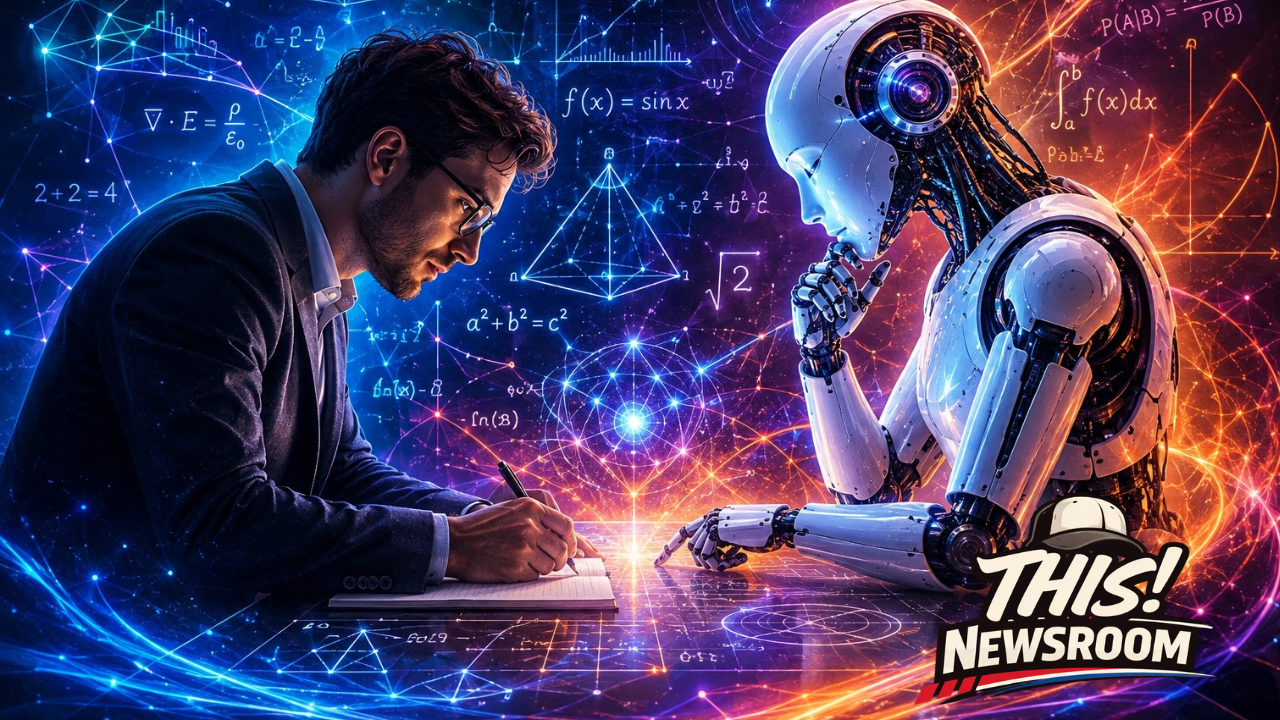
Artificial intelligence is increasingly being used to explore open mathematical problems, develop new proofs and accelerate research.
Artificial intelligence is moving beyond calculators, homework helpers and math competitions. AI systems are now helping with real math research. They can attack open problems, test ideas and even produce proofs that computers can check.
That shift could change how mathematicians make discoveries.
For decades, some of mathematics’ hardest problems survived generations of brilliant researchers. Now AI is beginning to help crack some of them.
Recent breakthroughs suggest that advanced AI models are crossing an important line. Instead of only solving math that humans already understand, they can help search for answers to problems where the solution is still unknown.
And the progress is happening fast.
AI Is Moving From Math Student to Research Partner
Until recently, large language models had a bad reputation when it came to advanced math.
They could give confident answers while making simple mistakes. Models could misuse formulas or create proofs with hidden errors.
That is changing.
Today’s leading math-focused AI systems can combine language models with other tools. These include search systems, math software and formal proof tools.
This combination is important.
Instead of simply creating a proof that looks correct, an AI can put its work into a formal math system. Software can then check each step.
The process can work like this:
AI suggests an idea → software checks it → mistakes are rejected → AI tries again.
A computer can repeat that cycle again and again.
This gives researchers a powerful new way to explore math problems.
AI Is Tackling Longstanding Math Problems
One major area of interest involves problems linked to Paul Erdős.
Erdős was one of history’s most active mathematicians. He worked on thousands of problems and left behind many questions that other researchers continued studying after his death.
Some remain open today.
Those problems are becoming a useful testing ground for AI.
Researchers can give AI systems large collections of open questions and see whether the machines can find new paths toward answers.
The results do not mean AI has suddenly mastered mathematics.
Some open problems have remained unsolved because very few people spent years studying them. Others are truly difficult.
Either way, AI changes the equation.
A human researcher has limited time and attention. A computer can test ideas around the clock.
That means thousands of overlooked math problems could receive far more attention than they ever have before.
How AI Is Reshaping Mathematics
The biggest change may not be one famous problem getting solved.
It could be speed.
A mathematician might spend days testing one possible idea. AI can help search through many options much faster.
Researchers could use these systems to find patterns, test examples and search for flaws in a theory. AI could also suggest new ways to approach a proof.
Humans would still guide the research.
But machines could handle much more of the search.
That could greatly increase what one mathematician can accomplish.
Google Is Building AI That Can Discover Better Algorithms
Google DeepMind has also been exploring this idea.
Its AlphaEvolve system combines AI models with a search process designed to find and improve algorithms.
That represents an important change in how we think about software.
Traditional software runs algorithms created by humans.
New AI systems can help search for better algorithms themselves.
Mathematics works especially well for this kind of research because many answers can be tested.
A proposed solution either meets the required rules or it does not.
That makes math an ideal testing ground for AI discovery.
Why Some Mathematicians Are Excited — and Concerned
The potential is enormous.
AI could help researchers explore many ideas at once. It can test theories quickly, search huge sets of possible proofs and check results.
But this creates another question.
What happens when humans know that an AI-generated proof is correct but do not fully understand how the machine found it?
Math has always been about more than getting the right answer.
Mathematicians want to understand why something is true.
A great proof can show links between different parts of mathematics. Those links can lead to even more discoveries.
An AI might produce a very long proof that a computer confirms as correct. Yet humans may gain little insight from it.
That difference between proving something and understanding it could become one of the biggest debates surrounding AI and mathematics.
AI Still Makes Mistakes
Despite the excitement, AI has not conquered mathematics.
Current systems still have major limits.
They can produce arguments that sound convincing but are wrong. They can miss key details or fail to notice that a question is poorly defined.
Another challenge may be even more important.
AI is not always good at deciding which questions are worth asking.
Solving a problem is only part of research.
Choosing the right problem can be just as important.
That is one reason human mathematicians remain essential.
The Future Could Be Humans and AI Working Together
The most likely future is not AI simply replacing mathematicians.
Instead, AI could become a powerful research partner.
Imagine a mathematician creating a new theory and asking AI to search millions of examples for something that disproves it.
A researcher could ask for dozens of possible ways to build a proof.
AI might also turn an informal argument into a proof that software can check.
Another system could search years of math papers for an old method that might solve a new problem.
Work that once took months could sometimes happen much faster.
That could transform the daily work of mathematicians.
Mathematics May Be Only the Beginning
These developments matter far beyond math.
Mathematics gives AI researchers an ideal place to test whether machines can make real discoveries.
The reason is simple: answers can often be checked with great care.
Other sciences are harder.
Biology needs experiments. Physics needs observations. Medicine needs clinical evidence.
Math can often provide a clear test of whether an answer is right or wrong.
If AI becomes good at creating new mathematics, the effects could spread into many other fields.
Better math could lead to better computer algorithms. New methods could improve physics, engineering, cybersecurity, economics and other sciences.
That is why this moment feels bigger than another impressive AI test.
The Bottom Line
Artificial intelligence has not “solved mathematics.” Human researchers remain better at many parts of advanced math.
Still, the direction is hard to ignore.
AI has moved from struggling with ordinary math questions to helping researchers explore problems that have remained open for years.
The next question is not simply whether AI will solve another famous problem.
The bigger question is what happens when machines can explore thousands of math problems at once, test possible answers and work alongside the world’s best researchers.
For centuries, mathematics advanced at the speed of the human mind.
AI may be about to change that speed limit.
About the Author