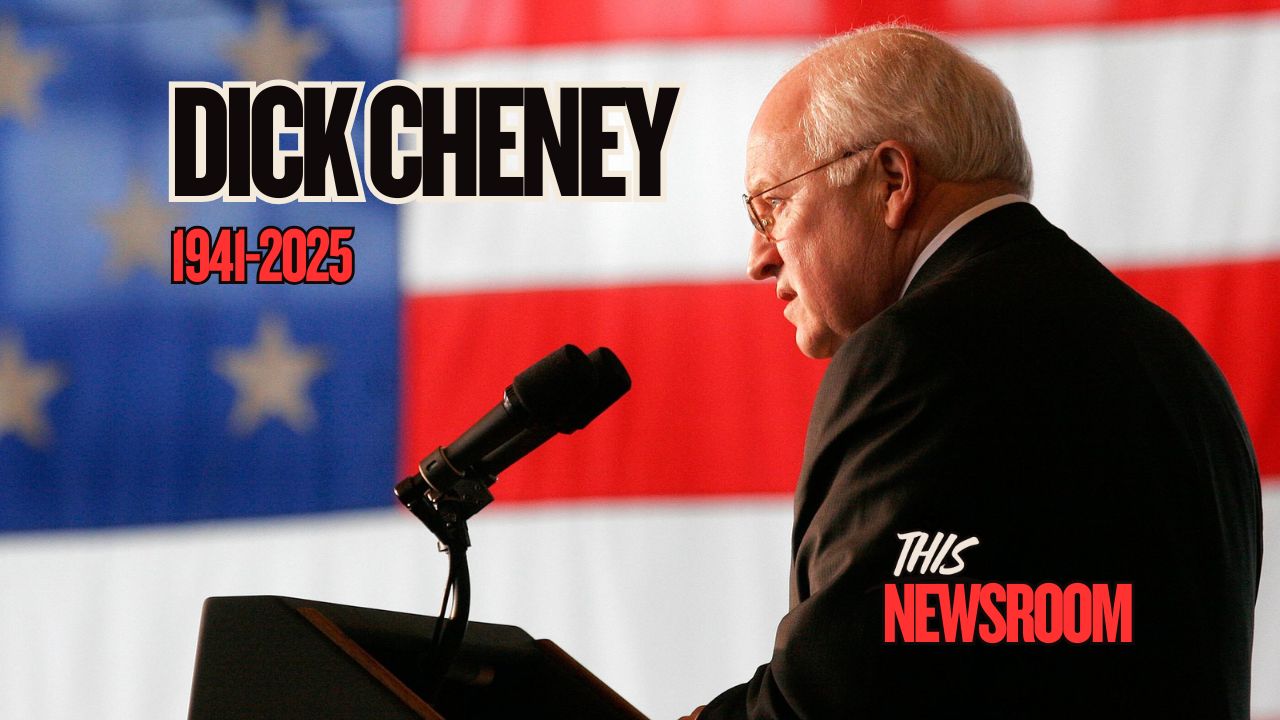
When news of Dick Cheney’s death broke early this morning, America paused.
Whether you admired or opposed him, few leaders have left a mark as deep on U.S. politics as the former vice president. Dick Cheney’s death at age 84 reminds us of a man whose influence shaped decades of national policy, war decisions, and the balance of power inside the White House.
According to AP News, Cheney passed away surrounded by family after complications related to pneumonia and cardiovascular disease.
Early Life and Political Rise Before Dick Cheney’s Death
Richard Bruce “Dick” Cheney was born on January 30, 1941, in Lincoln, Nebraska, and grew up in Casper, Wyoming. He studied at the University of Wyoming, earning bachelor’s and master’s degrees in political science before beginning a career that would span five decades.
In 1975, he became the youngest White House Chief of Staff under President Gerald Ford — a meteoric rise that established him as a pragmatic, detail-oriented strategist. You can read more about his early career at History.Defense.gov.
From Congress to the Pentagon: The Path That Defined Dick Cheney’s Legacy
Before Dick Cheney’s death, his influence had long stretched across Washington. Elected to Congress in 1979, he served six terms representing Wyoming. His legislative record reflected strong conservative values, emphasizing fiscal restraint and military readiness.
In 1989, Cheney was appointed Secretary of Defense under President George H.W. Bush, overseeing the Gulf War. The campaign’s swift victory cemented his reputation as one of America’s foremost defense thinkers.
Vice Presidency, 9/11, and the Era That Followed Dick Cheney’s Death
Serving as the 46th Vice President from 2001 to 2009 under President George W. Bush, Cheney became a central architect of the post-9/11 world.
His strong advocacy for the War on Terror, the invasion of Iraq, and expanded surveillance programs made him one of the most powerful and controversial vice presidents in U.S. history. For more insight, visit Britannica’s Cheney biography.
While many saw him as a defender of national security, critics accused him of overreach and secrecy. Yet even now, after Dick Cheney’s death, his policies continue to influence global strategy and domestic debates about executive power.
Faith, Family, and the Man Beyond the Politics
Behind the sharp elbows and political armor, Cheney was deeply committed to his family. He married his high-school sweetheart Lynne Vincent Cheney in 1964, and together they raised two daughters — Liz, who followed him into Congress, and Mary, known for her advocacy on family and equality issues.
Cheney’s faith and resilience carried him through decades of heart problems, including five heart attacks and a 2012 heart transplant. Even in his later years, he remained vocal about leadership, national defense, and the changing nature of conservatism.
“He was a great and good man who taught his children and grandchildren to love our country and to live lives of courage, honor, and kindness,”
— the Cheney family said in a public statement (AP News).
How Dick Cheney’s Death Invites Reflection
For me, writing about Dick Cheney’s death isn’t just about politics — it’s about legacy. What does a life of leadership, conviction, and controversy really mean when it ends?
As I think about it, I’m reminded of the conversations we’ve had on This With Krish Show — about faith, family, and the kind of impact we leave behind. No matter how history records him, Dick Cheney was a husband, father, and grandfather whose life tells the story of ambition, resilience, and belief in one’s purpose.
If you enjoyed this reflection, you might also like these related articles on This With Krish Show:
- Faith Conversations Are Rare — But Crucial
- Veterans Month: Honoring Those Who Served
- The Fall Bucket List Your Kids Will Actually Love
Dick Cheney’s Death and the End of an Era
Regardless of how you view his policies, Dick Cheney’s death marks the closing chapter of a generation that reshaped American leadership. He was complex — sometimes divisive, always decisive — and his story reminds us how power and principle can coexist in tension.
History will continue to debate his legacy. But for now, we remember a man who lived his convictions, served his country, and shaped the conversation about what America should be.
Rest in peace, Richard Bruce Cheney (1941–2025).
About the Author