
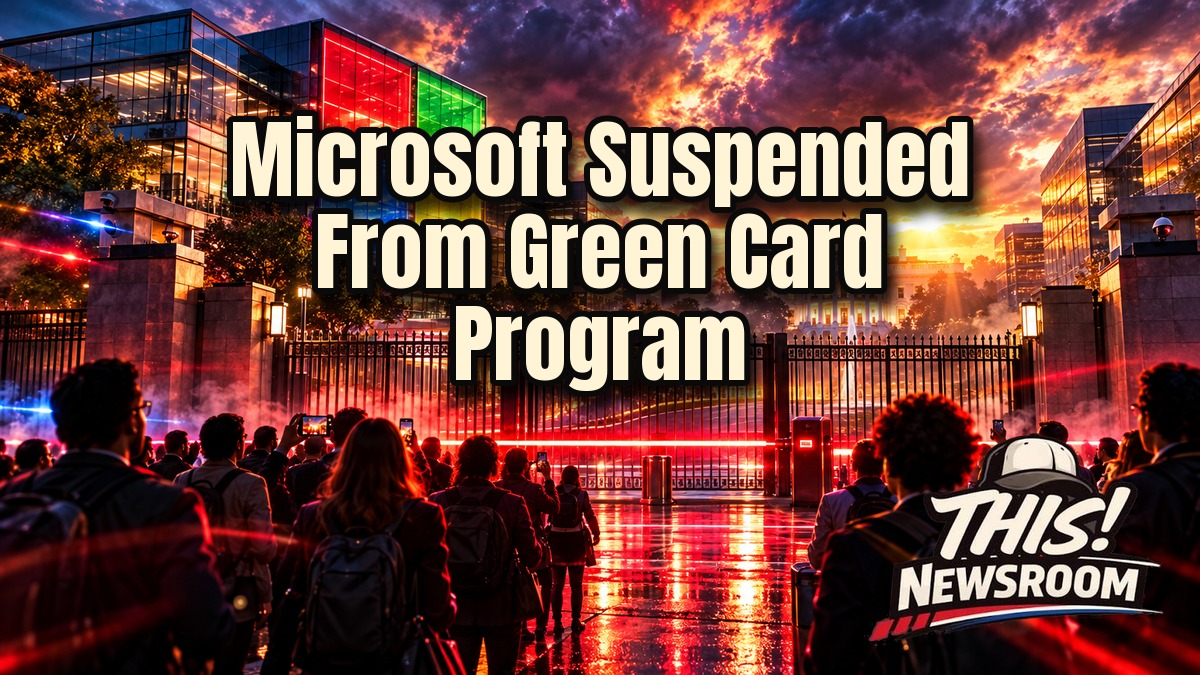
The Microsoft green card suspension is real, and it just landed on one of America’s biggest employers. Vice President JD Vance announced Thursday that the Trump administration is barring Microsoft from a key program used to sponsor foreign workers for permanent residency.
Labor Secretary Keith Sonderling joined him at a White House news conference on H-1B and J-1 visa fraud. Together they said the government is also suspending Adobe and six IT outsourcing firms, according to NBC News.
What the Microsoft green card suspension actually blocks
The program goes by PERM, short for Permanent Labor Certification. Employers use it to show the Labor Department that no qualified, willing U.S. worker is available for a job. It is a required step before filing for most employment-based green cards, as Reuters reported.
Sonderling was blunt about the effect. “We will not accept any new or process any pending permanent labor certification applications involving these companies,” he said. In other words, the line is closed, and the Microsoft PERM suspension strands people already waiting in it too.
Also on the list are Cognizant, Infosys, Tata, Wipro, HCL and Capgemini. Sonderling told reporters that Microsoft and Adobe face suspension “due to multiple active federal investigations,” per Investing.com.
Vance’s case for the Microsoft H-1B green card ban
Vance did not hold back. “There has been no company in the United States, unfortunately, that has abused the system more than Microsoft,” he said, according to Fox Business.
His numbers go like this. Microsoft laid off 6,000 American workers last year. During that time it benefited from 6,300 H-1B visas and nearly 3,000 green cards. “If you do the math, for every worker that Microsoft laid off, they replaced that worker with one and a half foreign indentured servants,” Vance said.
Here is the catch. That math is Vance’s own, and it is an allegation. Officials have made no detailed evidence of fraud public, and they have not spelled out the specific conduct behind the Microsoft green card suspension. Microsoft had not responded to requests for comment in the AP and Reuters reports.
The company has defended itself before. In 2025, Microsoft said 78% of its H-1B petitions over the prior year were extensions for existing employees. It also said its visa use and its layoffs had nothing to do with each other. That statement predates today’s announcement.
Bigger than one company
Sonderling said the named firms have requested almost 3 million foreign workers since 2009. They received more than 230,000 H-1B approvals and more than 100,000 permanent labor certifications, per CNBC.
The Labor Department also opened a J-1 visa investigation into nine U.S. universities, including Harvard, Yale, Stanford, Brown and MIT. A department official said investigators served subpoenas. Attorney General Blanche added that the Justice Department is looking at companies that favor foreign workers over Americans.
All of this came one day after the administration moved against international students’ ability to work in the country. Trump supporters have long targeted the H-1B program, arguing it undercuts American workers. Tech companies are its biggest users, and nearly three-quarters of approvals go to workers from India. The Microsoft green card suspension is the sharpest edge of that push so far. For a sense of how tangled Washington’s relationship with tech has become, see our look at Trump’s planned honors for tech’s biggest names.
Why a Microsoft permanent residency freeze is a pipeline problem
Naming one employer is unusual. Analysts at Newsquawk note that PERM suspensions have historically hit the whole program or come through audits and denials. They also say the damage lands on the long-term talent pipeline more than on near-term headcount.
Translate that for real life. Thousands of skilled workers, many already living and working in the U.S., now sit in limbo. Their employers did not give them an answer, and neither did the government. Their families wait with them. Even a narrow Microsoft permanent residency freeze ripples outward like that.
There is also a political backdrop. CNBC ties the move to the administration’s focus on immigration and foreign hiring ahead of November’s midterms. Reports also say the action targets Microsoft’s use of PERM, not CEO Satya Nadella, who was reportedly due to receive a national tech medal from Trump the same day. Nobody has confirmed that medal event. Our coverage of the first major electoral test for conservative politics shows how much the midterms are shaping the agenda.
What happens next
Vance says the suspension will last “as long as it needs to.” He added that the administration has tools to extend it indefinitely, but wants companies to change their hiring practices. So the real question is simple. What does Microsoft have to change, and who decides when it is enough?
No formal Labor Department notice or Federal Register action has surfaced yet. Expect a Microsoft response and possible legal challenges. Announcements like this sometimes come before narrower formal actions, so the fine print may look different from the headline. Whatever the outcome, the Microsoft green card suspension is already a test case for how far this administration will push against Big Tech’s hiring habits. Elsewhere, the industry is busy racing on other fronts, as Jensen Huang’s take on Meta’s AI spending shows.