
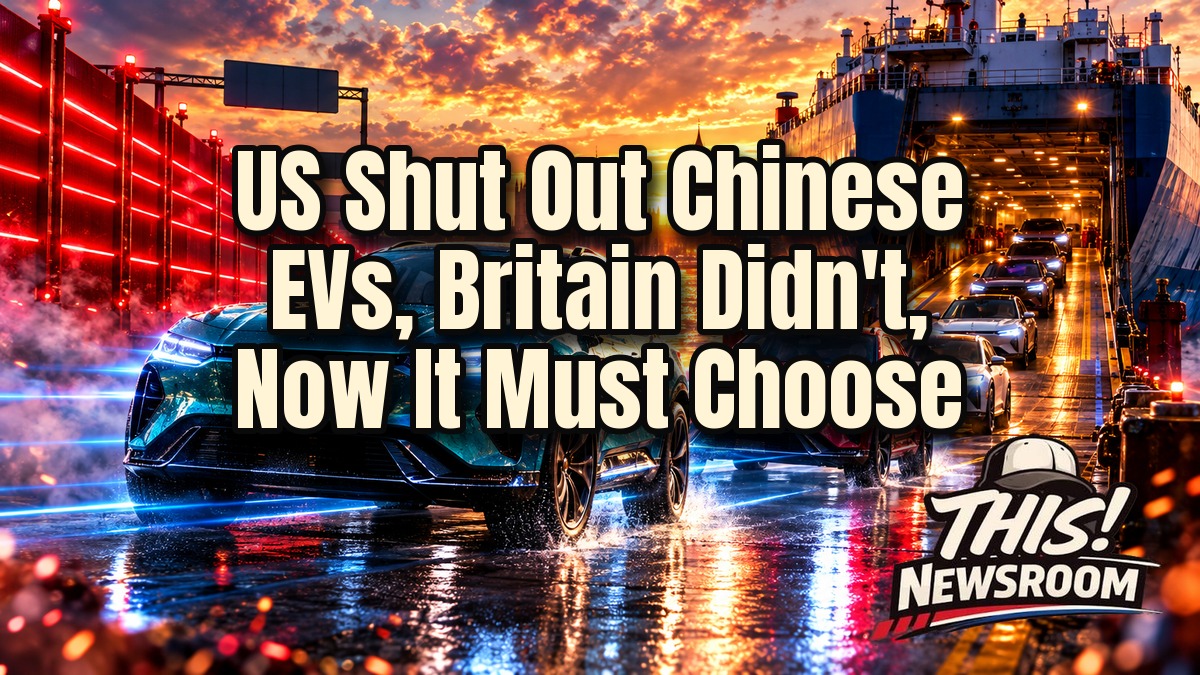
Chinese EV tariffs split the world’s big car markets in two. America slapped a wall around its showrooms, while Britain left the front door wide open. Now the UK may have to decide whether that open-door policy can survive, CNBC reported.
How Britain Became China’s Favorite Export Market
The gap between the two approaches is huge. The US has a 100% tariff on Chinese EVs, which effectively shuts them out. Britain, by contrast, charges only the standard 10% import duty, according to CNBC. The outlet calls the UK one of the largest overseas markets without extra China-specific tariffs. That makes UK Chinese car imports unusually easy compared with almost any other rich market.
Meanwhile, the EU sits in between. It has manufacturer-specific duties of up to 35.3% on Chinese EVs, stacked on top of that same 10% base. As a result, Chinese carmakers have a clear reason to push hard in Britain. Motor Trader notes they are targeting the tariff-free UK while the EU levies up to 35%. The US picture looks different again. Our look at the Supreme Court fight over Trump’s tariffs shows how unsettled American trade policy has become.
What September’s Sales Show Without Chinese EV Tariffs
September gave a striking snapshot. UK new car registrations rose 12% to 350,536, the tenth straight month of growth and the strongest September since 2017, according to AM Online’s coverage of the SMMT data. Battery-electric registrations hit a record 99,201, up 36.3% and 28.3% of the market.
BYD led the Chinese charge. It registered 20,140 cars, up 78.7% year on year, for a 5.75% share. That made it the UK’s second-largest marque behind Volkswagen. Chery also posted a record 2.79% share.
The Jaecoo 7 was September’s best-selling car overall, with 10,813 registrations. The Tesla Model 3 followed with more than 9,900, per Carwow. Other Chinese-owned names grew fast too:
- Jaecoo: 15,055 registrations, up 132%
- MG: 18,026, up 24%
- Omoda: 7,241, up 68%
- Leapmotor: 3,942, about seven times last year
Overall, newer Chinese makers took close to 20% of all new registrations, according to a syndicated UK report. Cox Automotive’s Philip Nothard put it bluntly: the influence of Chinese manufacturers is “impossible to ignore.” Without any China EV import tax beyond the standard duty, that growth is easy to explain.
Why London May Reconsider Chinese EV Tariffs
Here is the catch. CNBC says The Sunday Times reported that the UK is considering matching the EU levy. The aim would be to dodge the pain of the EU’s “Made in Europe” proposals, which could hurt British companies selling into the bloc. We could not confirm that report independently.
The government has pushed back on the idea in part. A UK spokesperson told CNBC the UK has not imposed tariffs on Chinese EVs. That is a statement of the current position, not a ruling-out of a future one.
The choice is delicate. London wants closer post-Brexit ties with Brussels. But matching the EU could invite retaliation from Beijing, CNBC says. Other carmakers are already feeling the strain of this shifting landscape, as Honda’s first annual loss in nearly 70 years shows.
Could Chinese EV Duties Really Stop the Advance?
Even new Chinese EV duties might not slow things much. Analysts told CNBC that EV duties alone may not curb China’s push. In fact, hybrid sales are surging too, and Chinese brands hold advantages in cost, supply chains and product development.
Plug-in hybrids matter here. The EU duties target EVs, yet Chinese brands lean heavily on hybrids in Britain. Chery’s Super Hybrid range made up 83.12% of its September volume. Chinese EV tariffs aimed only at battery cars could therefore leave a big loophole.
What This Means for American Drivers
Chinese EVs are effectively locked out of the US. Britain, however, is a close English-speaking test case for what open access does to a market. So far, it means record EV sales, fierce competition and a Chinese brand sitting second overall. Tariffs on Chinese electric cars may protect US showrooms, but they also keep American buyers from seeing what that competition delivers.
No date has been set for any UK decision. The next hard data point should be the SMMT’s October registrations, normally published in early November. That will show whether Britain’s Chinese car boom is still accelerating while the debate over Chinese EV tariffs heats up.