
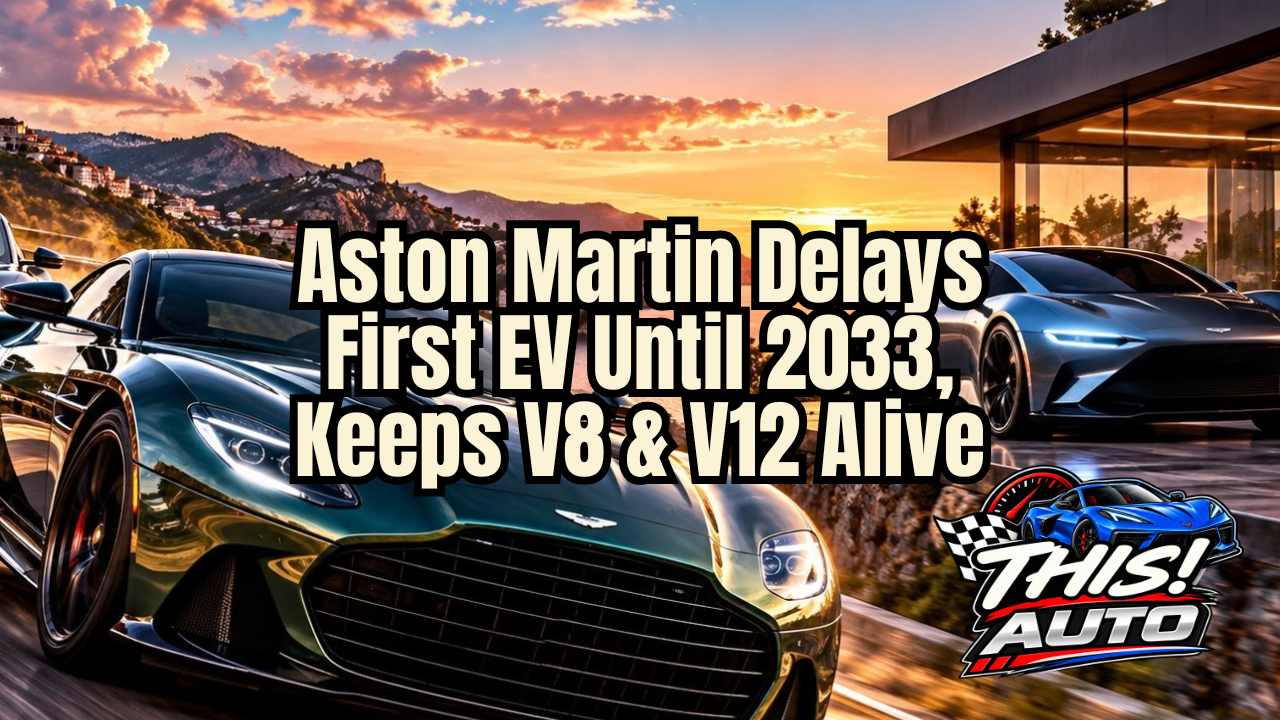
Aston Martin is pumping the brakes on its electric future — again. This time, the British luxury automaker says its first fully electric production car may not arrive until 2033, and possibly as late as 2035.
Aston Martin is taking a dramatically different approach to electrification.
CEO Adrian Hallmark says the automaker no longer has a firm launch date for its first battery-electric vehicle. Instead, the company is looking at a window between 2033 and 2035, depending on customer demand, technology and changing regulations.
That represents another major shift for a company that once expected to launch its first EV in the middle of this decade.
And for fans of Aston Martin’s roaring combustion engines, there is another important piece of news: the V8 and V12 aren’t going anywhere anytime soon.
Aston Martin’s Electric Car Keeps Getting Pushed Back
Aston Martin’s EV timeline has changed considerably over the past several years.
The company initially planned to introduce its first fully electric model in 2025. That was delayed to 2026 as Aston Martin cited weaker-than-expected demand for luxury EVs. Subsequent plans pushed the timeline farther into the decade, with Hallmark previously pointing toward 2030.
Now, even 2030 is off the table.
Hallmark told Autocar that Aston Martin’s first EV could arrive in 2033 or 2035, while specifically ruling out 2031. He said rapidly changing regulations and customer demand make committing to an exact launch date difficult.
In perhaps the clearest description of Aston Martin’s new strategy, Hallmark characterized the company as a “BEV delayer” rather than a “BEV denier.”
In other words, Aston Martin still believes electric vehicles are part of its future.
It just doesn’t believe that future needs to arrive yet.
V8 and V12 Engines Could Survive Through 2035
While many manufacturers are pouring billions into battery-electric platforms, Aston Martin intends to remain predominantly focused on internal-combustion vehicles for much of the next decade.
The company says it has developed a roadmap that could keep both its V8 and V12 engines compliant through at least 2035.
That could be welcome news for Aston Martin enthusiasts.
The sound, character and performance of large combustion engines remain a significant part of the company’s identity. Aston Martin appears unwilling to abandon that formula before its customers — or regulators — force the issue.
Hybrid technology will likely play a larger role along the way.
Hallmark indicated that Aston Martin expects additional hybridization, although he expressed little enthusiasm for plug-in hybrids because of the additional weight associated with their larger batteries.
The Lucid Partnership Is Still Alive
The delay doesn’t mean Aston Martin has abandoned the technology needed to eventually build an electric supercar or grand tourer.
Aston Martin’s agreement with Lucid remains in place, giving the British manufacturer access to Lucid’s electric powertrain and battery technology.
Aston Martin also continues working with Mercedes-Benz on powertrains and electronic systems.
Interestingly, delaying its EV could give Aston Martin an advantage.
Electric motors, batteries, charging systems and vehicle architectures are advancing quickly. Instead of spending heavily today on technology that could become outdated before its vehicle launches, Aston Martin can continue evaluating the market before making its biggest investments.
Hallmark said current EV spending remains at the research-and-study stage rather than full-scale development.
Aston Martin Is Betting on Its Customers
The decision also highlights an increasingly important question facing exotic and ultra-luxury automakers:
Do their customers actually want fully electric sports cars?
For Aston Martin, the answer apparently isn’t strong enough yet.
Former executive chairman Lawrence Stroll acknowledged in 2024 that demand for EVs among Aston Martin customers was lower than the company had previously expected.
That matters enormously for a relatively low-volume manufacturer.
Aston Martin doesn’t need to chase the same buyers as mainstream manufacturers. Its customers are purchasing emotion, design, performance and exclusivity as much as transportation.
For many of them, a screaming V12 is part of the experience.
Aston Martin Isn’t Saying Never — Just Not Yet
There is an important distinction here.
Aston Martin isn’t canceling its electric program.
It is essentially buying itself more time.
The company can continue developing combustion and hybrid vehicles while monitoring battery technology, regulations and consumer demand. When the economics and market finally make sense, its partnerships with Lucid and Mercedes-Benz give Aston Martin a path toward electrification.
But the company’s immediate future now looks decidedly old-school.
V8s. V12s. Hybrids. And gasoline-powered Aston Martins potentially running right up to 2035.
For enthusiasts worried that the industry’s electric transition would quickly silence some of the world’s most recognizable engines, Aston Martin just delivered some very good news.
The electric Aston is still coming.
You’ll just have to wait a little longer.