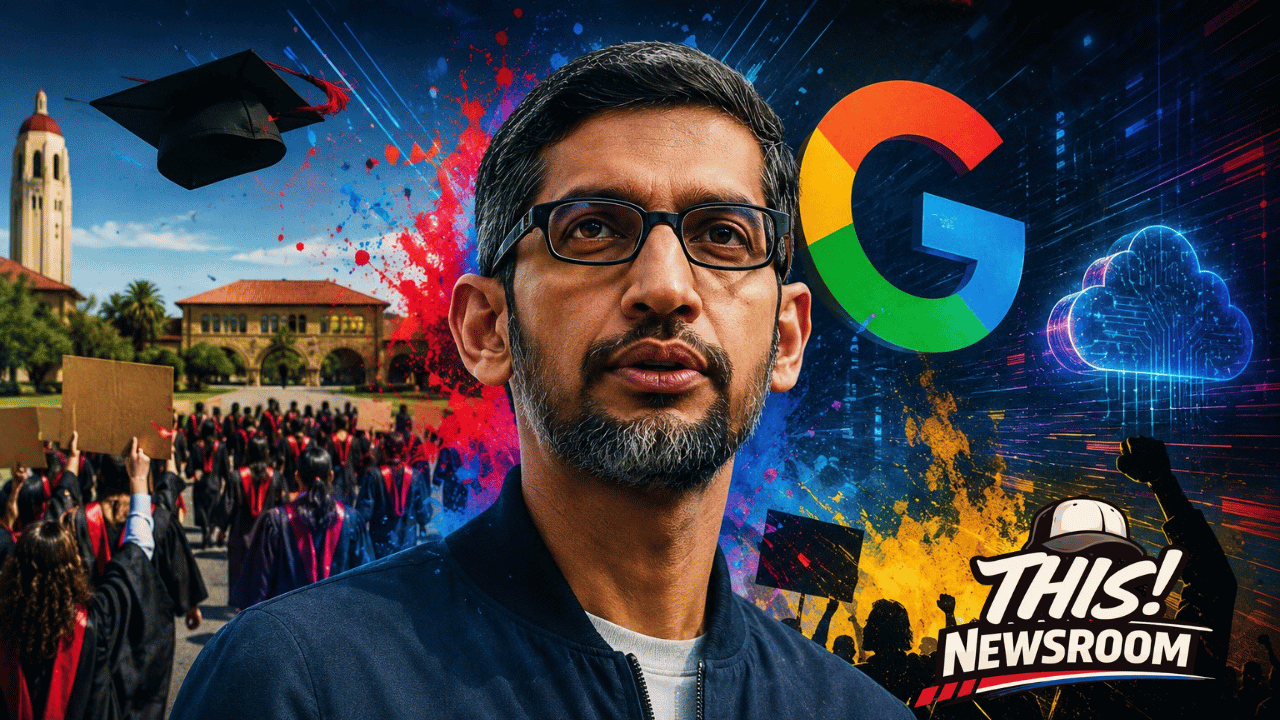
More Than 100 Stanford Students Walk Out During Google CEO Sundar Pichai's Commencement Speech
A commencement ceremony is typically a celebration of achievement, ambition, and new beginnings. However, at Stanford University, one of the most anticipated moments of graduation took an unexpected turn when more than 100 students reportedly walked out as Google CEO Sundar Pichai took the stage to deliver the commencement address.
The demonstration quickly gained attention online, sparking discussions about artificial intelligence, corporate responsibility, freedom of expression, and the increasingly complicated relationship between technology companies and higher education.
Why Did Students Walk Out?
According to reports and videos circulating on social media, the protest centered around Google’s involvement in Project Nimbus, a multibillion-dollar cloud computing and artificial intelligence agreement involving Google, Amazon, and the Israeli government.
Critics of the project argue that advanced cloud and AI technologies could potentially be used in surveillance, military operations, and other government activities they oppose. Student activists and advocacy groups have spent months calling on major technology companies to provide greater transparency regarding how their AI tools and cloud infrastructure are deployed.
As Pichai began speaking, groups of students reportedly exited the ceremony in a coordinated demonstration, drawing attention away from the traditional commencement celebration and toward broader concerns surrounding the role of Big Tech in global affairs.
A Growing Trend on College Campuses
The Stanford walkout is not an isolated event. Universities across the United States have increasingly become centers of debate regarding artificial intelligence, corporate partnerships, and geopolitical conflicts.
Students today are entering a world where AI is rapidly reshaping industries, governments, and economies. As a result, many graduates are questioning not only what technology can accomplish, but also how it should be used.
In previous decades, debates on campuses often focused on issues such as environmental policy, civil rights, and foreign wars. Today, artificial intelligence has emerged as one of the defining ethical questions of a generation.
For many students, the issue is no longer whether AI will change society. The question is whether society can guide that change responsibly.
Sundar Pichai’s Complicated Position
As CEO of Google, Pichai sits at the center of one of the most influential technology companies in human history.
Google’s products touch billions of people every day through search, Android, YouTube, Gmail, cloud computing, and now AI-powered platforms such as Gemini. The company is also investing heavily in artificial intelligence as competition intensifies against rivals including OpenAI, Microsoft, Meta, and Anthropic.
Pichai has consistently argued that AI represents one of the most important technological advancements ever created. He has often compared its impact to electricity or the internet itself.
Yet that optimism exists alongside growing concerns about privacy, misinformation, surveillance, job displacement, and military applications of AI.
The Stanford protest highlighted the difficult balancing act facing technology leaders. They are expected to drive innovation while simultaneously addressing ethical concerns about how those innovations are used.
The AI Debate Is Getting Louder
Artificial intelligence is no longer a niche topic discussed only by engineers and researchers.
Today, AI influences hiring decisions, medical diagnoses, financial services, education, cybersecurity, transportation, and national security. Governments around the world are racing to establish regulations while companies continue deploying increasingly powerful systems.
Supporters argue that AI has the potential to solve major global challenges, improve productivity, and unlock economic growth on an unprecedented scale.
Critics worry that insufficient oversight could lead to unintended consequences, ranging from privacy violations to mass job disruption and increased government surveillance capabilities.
The Stanford walkout reflected this broader tension.
For some students, the protest was a statement about accountability. For others, it was an example of political activism intersecting with academic events. Regardless of perspective, the demonstration succeeded in bringing attention to questions that are becoming increasingly difficult to ignore.
Silicon Valley’s New Reality
For decades, technology companies were largely viewed as engines of innovation and economic opportunity. Today, many of those same companies face intense scrutiny from employees, consumers, governments, and activists.
Google, in particular, has experienced internal and external protests over issues ranging from AI development and military contracts to privacy concerns and workplace policies.
The result is a new reality for Silicon Valley: technological breakthroughs are no longer judged solely by their capabilities. They are increasingly evaluated through ethical, political, and societal lenses.
A Graduation Moment That Became Something Bigger
Whether one agrees with the protesters or not, the Stanford walkout underscores a significant shift in how younger generations view technology and corporate power.
Commencement speeches traditionally focus on innovation, leadership, and the future. Ironically, the demonstration during Pichai’s appearance may have highlighted the very future graduates are inheriting—a world where technology, ethics, politics, and public accountability are deeply intertwined.
As artificial intelligence continues its rapid expansion, moments like this are likely to become more common. The debate is no longer just about building powerful tools. It is about determining who controls them, how they are used, and what responsibilities come with that power.
And for the next generation entering the workforce, those questions may prove just as important as the technology itself.
About the Author