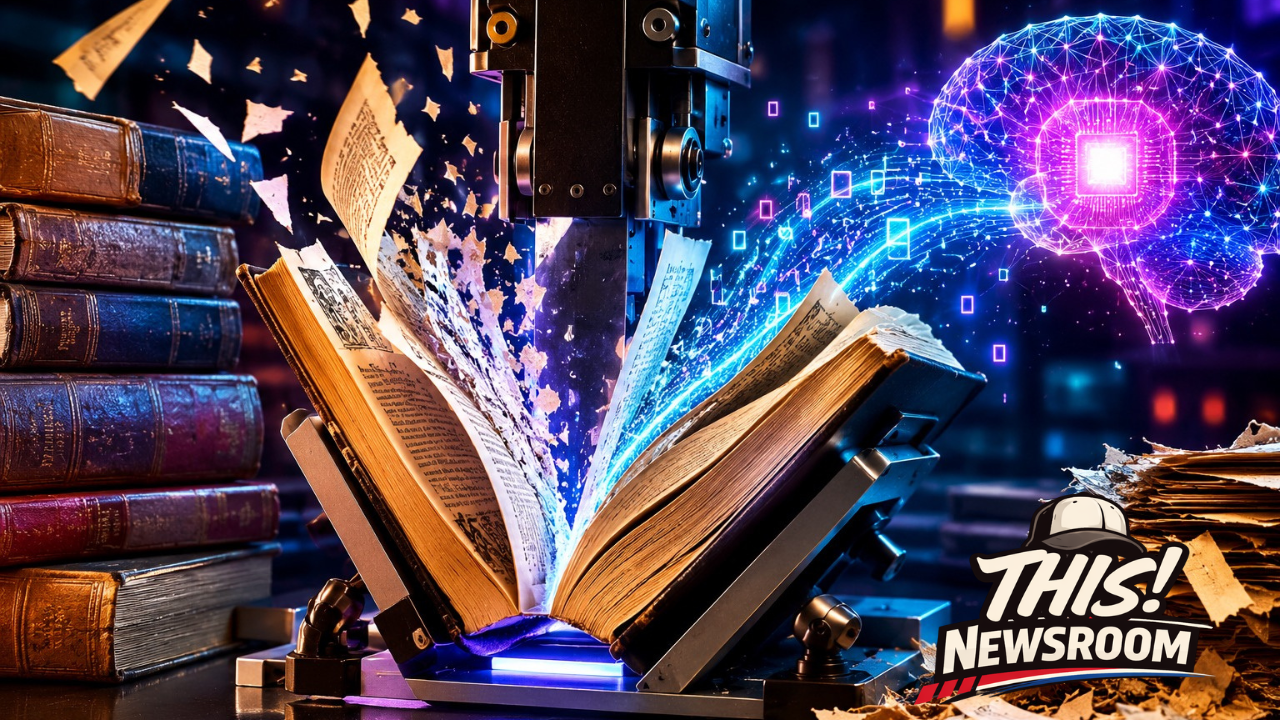
Rare books are increasingly being digitized for AI training, raising concerns about preservation, copyright, and the future of historical collections.
Artificial intelligence companies are in a race for data, and that race is leading to an unexpected casualty: books.
According to reports circulating online and confirmed by multiple industry sources, some AI firms and digitization companies are purchasing thousands of physical books—including rare and out-of-print editions—cutting the bindings off, scanning every page, and then destroying the originals once the digital copy has been created.
For collectors, librarians, and historians, it’s raising an uncomfortable question: Are we preserving knowledge—or destroying history to do it?
Why Are AI Companies Destroying Books?
Training today’s most advanced AI models requires enormous amounts of text.
While millions of books already exist in digital form, countless older publications have never been digitized. Some are long out of print, while others exist only in university libraries, private collections, or specialty bookstores.
To scan these efficiently, companies often use a process called destructive scanning.
Rather than photographing each page individually, technicians remove the book’s spine so every page can pass through a high-speed scanner. Once digitized, the loose pages are frequently recycled or discarded because rebinding them would be expensive and time-consuming.
For common books, the process isn’t new. Libraries and archives have used similar techniques for years.
What’s drawing criticism is when the same process is applied to rare, collectible, or historically significant books.
The Race for Better AI
The AI boom has created an unprecedented demand for high-quality written material.
Books offer something that internet content often doesn’t:
- Carefully edited language
- Long-form reasoning
- Historical context
- Specialized knowledge
- Higher-quality writing than much of today’s web
That makes printed books incredibly valuable as potential AI training material.
The more diverse the training data, the better AI systems generally become at understanding language, history, science, literature, and technical subjects.
Why Pre-2022 Books Matter
Many researchers and collectors believe books published before the explosion of generative AI in late 2022 represent a snapshot of entirely human-created writing.
These works are free from AI-generated text that is increasingly appearing online.
As more internet content becomes AI-assisted, older books are becoming even more valuable because they provide models with authentic human language patterns rather than content potentially written by other AI systems.
Preservation or Destruction?
Supporters argue that destructive scanning actually preserves knowledge.
Once digitized, a book can be searched instantly, archived indefinitely, and made available to researchers around the world without handling fragile originals.
Critics counter that a digital copy is not the same as the original artifact.
Collectors point out that first editions, annotated volumes, historical bindings, handwritten notes, and physical characteristics all carry cultural and historical significance that cannot be fully captured in a scan.
Once those originals are destroyed, they’re gone forever.
The Legal and Ethical Debate
The practice also intersects with ongoing legal battles surrounding AI training data.
Authors, publishers, and media organizations continue to challenge whether copyrighted works can legally be used to train commercial AI systems without permission or compensation.
While purchasing a physical book gives ownership of that copy, it doesn’t automatically grant rights to reproduce or use the contents for every purpose.
Courts around the world are still determining where those legal boundaries lie.
The Bigger Picture
Artificial intelligence depends on humanity’s accumulated knowledge—but how that knowledge is gathered is becoming just as important as the technology itself.
As AI development accelerates, companies face growing pressure to balance innovation with cultural preservation.
The debate isn’t simply about scanning books.
It’s about deciding whether the pursuit of smarter machines should come at the expense of irreplaceable pieces of human history.
For now, the conversation is likely to intensify as AI companies continue searching for the data needed to build the next generation of intelligent systems.
About the Author