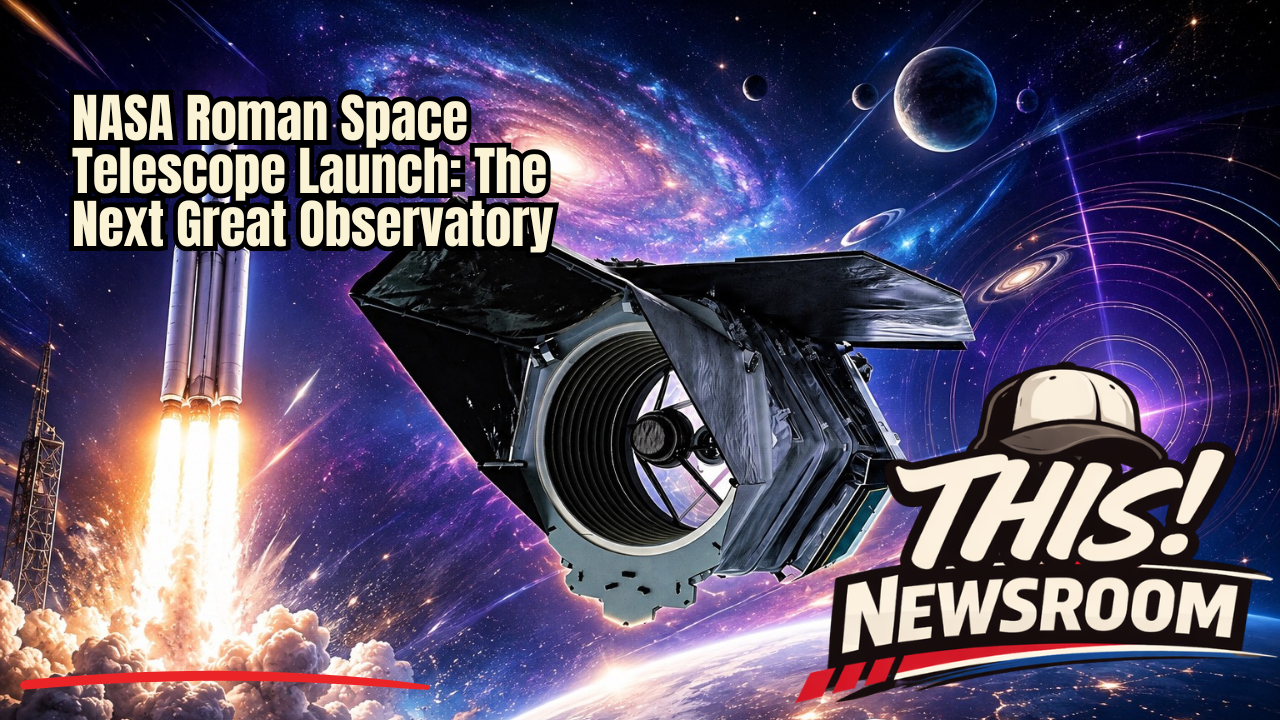
NASA’s Nancy Grace Roman Space Telescope will give astronomers an enormous new view of the universe as scientists investigate dark energy, dark matter and worlds beyond our solar system.
NASA is preparing to send its next major space observatory into the cosmos, and this one could fundamentally change how scientists understand the universe.
The Nancy Grace Roman Space Telescope is currently scheduled to launch August 30, 2026, aboard a SpaceX Falcon Heavy rocket from Launch Complex 39A at Kennedy Space Center in Florida. NASA lists liftoff for 7:26 a.m. EDT, although launch schedules can still change as teams move through final preparations.
Roman isn’t simply another telescope.
It has been designed to investigate some of the biggest unanswered questions in modern astronomy: What is dark energy? How is dark matter distributed across the universe? How common are planets around other stars? And what else is hiding in the enormous cosmic landscape that previous telescopes could only examine piece by piece?
And NASA plans to attack those questions by giving astronomers something they haven’t had at this scale before: an extraordinarily wide view of space.
Think Hubble — But With a Much Bigger View
The easiest way to understand Roman is to compare it with the legendary Hubble Space Telescope.
Hubble transformed astronomy by producing incredibly detailed observations of relatively small portions of the sky.
Roman takes a different approach.
NASA says Roman’s field of view will be at least 100 times larger than Hubble’s, allowing it to survey enormous regions of the universe while maintaining impressive astronomical detail. Over its mission, Roman could potentially measure light from a billion galaxies.
That combination of scale and detail could turn Roman into something of a cosmic census taker.
Instead of scientists examining relatively narrow slices of the universe, Roman will repeatedly survey massive areas of space.
And that matters enormously when you’re searching for things that are rare, distant or difficult to detect.
Roman Is Going After Dark Energy
One of Roman’s biggest assignments involves one of science’s biggest mysteries.
The universe isn’t simply expanding.
Its expansion appears to be accelerating.
Scientists use the term dark energy to describe whatever is driving that acceleration, but exactly what dark energy is remains one of the fundamental unanswered questions in physics.
Roman will survey huge numbers of galaxies and measure how cosmic structures have changed over time.
By mapping galaxies across enormous distances, astronomers hope to better understand how the universe expanded throughout its history — potentially providing new clues about the nature of dark energy.
Roman will also study the distribution and gravitational effects of dark matter, the invisible material believed to provide much of the underlying structure around which galaxies form.
NASA says the telescope’s enormous surveys will allow researchers to study how galaxies form, cluster and evolve while tracing dark matter’s influence across the cosmos.
It Could Discover Thousands of New Worlds
Roman isn’t only looking at galaxies billions of light-years away.
It’s also going planet hunting.
NASA expects the observatory to discover thousands of exoplanets — planets orbiting stars beyond our solar system.
One of Roman’s most powerful techniques will be gravitational microlensing.
When one star passes almost perfectly in front of another from our perspective, the gravity of the foreground star bends and magnifies the background star’s light. If planets orbit the foreground star, they can leave tiny signatures in that magnified light.
By watching dense regions of the Milky Way, Roman could detect planetary systems that would be extremely difficult to discover using other techniques.
That means our picture of the galaxy’s planetary population could become dramatically clearer.
Roman Will Even Try to Directly See Exoplanets
Roman carries another fascinating piece of technology: the Coronagraph Instrument.
Normally, directly photographing a planet orbiting another star is incredibly difficult because the star is overwhelmingly brighter than the planet.
Imagine trying to photograph a firefly sitting beside a massive spotlight from miles away.
Roman’s coronagraph is designed to suppress the star’s light so astronomers can study the much fainter objects surrounding it.
NASA describes the instrument as a technology demonstration that could directly observe exoplanets and planet-forming disks.
The technology could also help pave the way for future observatories designed to directly characterize Earth-like worlds.
Roman Is Heading Nearly One Million Miles From Earth
After launch, Roman won’t remain in orbit close to Earth.
The observatory will travel approximately one million miles away to the Sun-Earth Lagrange Point 2, better known as L2.
If that location sounds familiar, there’s a reason.
The James Webb Space Telescope also operates around L2.
The region provides an excellent environment for astronomy because the telescope can maintain a relatively stable orientation while keeping the Sun and Earth on the same general side of the spacecraft.
Roman’s primary mission is planned for approximately five years, with NASA listing a goal of operating for as long as 10 years.
NASA Is Moving Faster Than Expected
One of the most remarkable parts of Roman’s story may actually be its schedule.
NASA says the telescope is heading toward launch roughly nine months ahead of schedule.
That’s not something you hear every day when talking about massive government space projects.
By late July, technicians had loaded approximately 290 gallons of hydrazine fuel into the spacecraft. Then in August, engineers began integrating Roman with hardware that will ultimately connect the observatory to Falcon Heavy.
The next major steps include encapsulating the telescope inside Falcon Heavy’s protective payload fairing and moving it to SpaceX’s facilities at Launch Complex 39A for final rocket integration.
If everything continues according to plan, Roman will leave Earth on August 30.
Hubble, Webb and Roman Will Each Have Different Superpowers
Roman isn’t replacing Hubble.
And it isn’t replacing James Webb.
Instead, these telescopes are increasingly becoming complementary pieces of humanity’s astronomical toolkit.
Hubble has delivered extraordinary high-resolution observations for decades.
Webb can peer incredibly deep into the infrared universe.
Roman’s superpower will be scale.
Its huge field of view means astronomers will be able to identify interesting galaxies, exploding stars, black holes, planets and other phenomena across enormous areas of the sky.
Researchers can then potentially use observatories such as Webb to investigate particularly interesting discoveries in greater detail.
Roman becomes the cosmic explorer.
Webb becomes the cosmic microscope.
Together, the possibilities become extraordinary.
A New Era of Astronomy Is About to Begin
There are moments in science when a new instrument doesn’t simply give researchers better answers.
It gives them entirely new questions.
Hubble did that.
James Webb is doing it right now.
Roman could be next.
Its ability to repeatedly photograph enormous portions of the universe means astronomers aren’t completely certain what it will discover.
That’s arguably the most exciting part.
Roman was built to investigate dark energy, dark matter and distant planets.
But history tells us that revolutionary telescopes often become famous for discoveries nobody anticipated when they were designed.
On August 30, another one of those instruments is scheduled to leave Earth.
And once the Nancy Grace Roman Space Telescope opens its enormous window onto the universe, we may start seeing the cosmos in a way humanity simply never has before.
THIS NEWSROOM | Science • Space • Technology
Launch dates and times remain subject to change as NASA and SpaceX complete final mission preparations.
Sources: NASA Roman Space Telescope mission page · NASA Roman launch countdown · NASA Roman launch preparations
About the Author