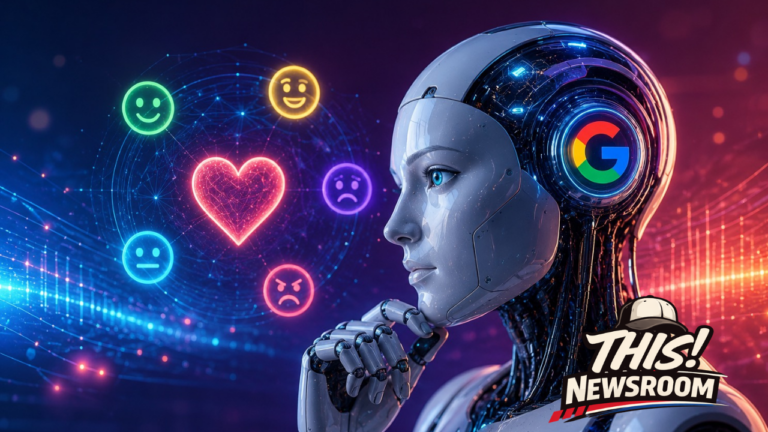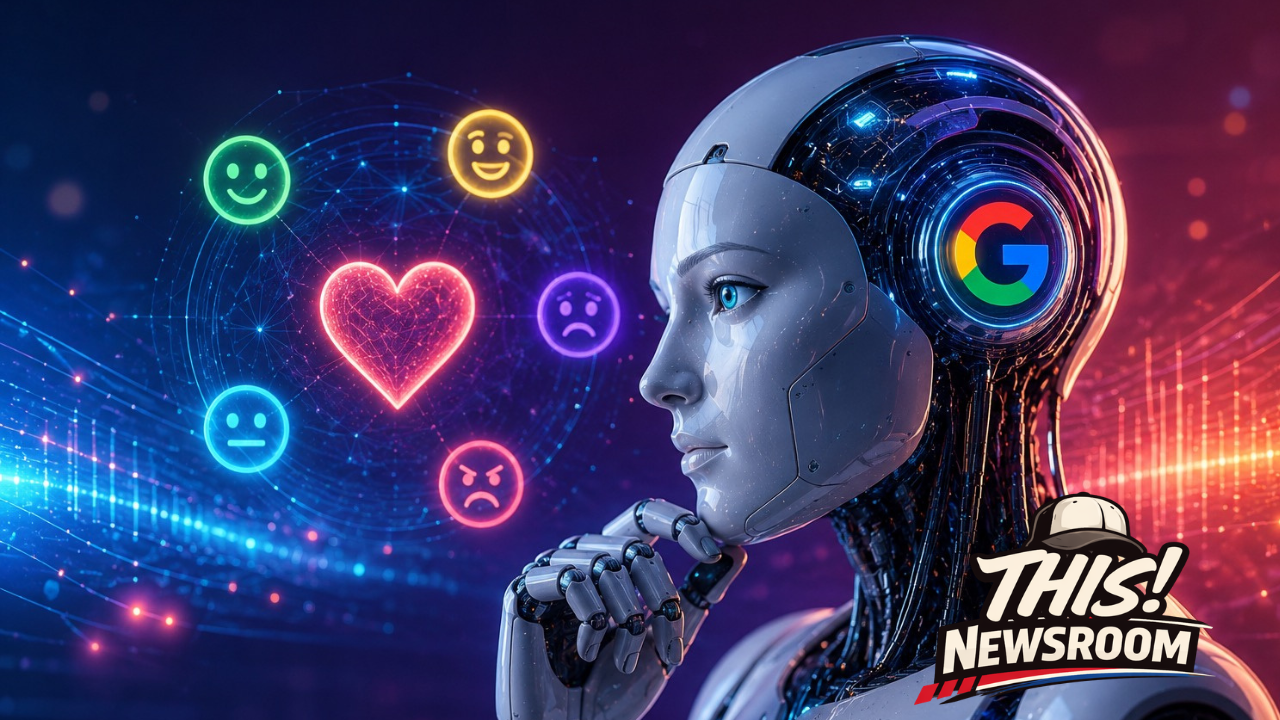
Emotionally responsive AI could allow future humanoid robots to simulate facial expressions, tone, posture and other human-like behaviors.
A viral post making the rounds online claims Google has filed a patent for robots capable of simulating emotions and responding to humans with changes in tone, posture and facial expressions.
It sounds like another giant leap toward humanoid robots that can laugh with us, comfort us and perhaps even appear to care about us.
There’s just one problem: the Google attribution appears to be misleading.
A review of publicly searchable patent records does show extensive work on robots and AI systems that simulate emotional behavior. However, the specific idea spreading online cannot currently be verified as a newly filed Google patent.
And that distinction matters.
Robots That “Feel” Are Absolutely Being Developed
The underlying technology is very real.
Patent records going back decades describe robots designed to represent simulated emotional states such as happiness, sadness, anger and fear. Some systems use facial expressions. Others change their physical movements, voices or behavior based on what they detect from a human.
One patent describes a robot recognizing information about a user’s posture, gestures, movement or emotional state. The robot can then determine an emotional response and alter its physical movement accordingly.
In other words, we’re already well beyond robots simply following mechanical commands.
The emerging goal is to make machines behave in ways humans instinctively understand.
But Robots Aren’t Actually “Feeling” Anything
This is the important part.
When researchers talk about a robot being “happy,” “sad” or “angry,” they generally aren’t claiming the machine experiences those emotions the way a person does.
The emotion is simulated.
Software can assign the robot an internal emotional state and then translate that state into visible behavior. A “happy” robot might move energetically, raise its head or use a warmer voice. A “sad” robot might move slowly or lower its posture.
One patent specifically describes an “emotion state engine” that allows a robot to simulate characteristics including happy, sad, angry and cautious behavior. The purpose is partly practical: emotional cues can make a robot’s actions easier for humans to understand and potentially increase engagement.
That’s emotional expression, not necessarily emotional experience.
And the difference is enormous.
AI Is Also Learning the Subtle Parts of Human Communication
The technology becomes even more interesting when you move beyond traditional robotics.
AI developers are increasingly working with what researchers call paralinguistic information — all the communication happening beyond the literal words someone says.
Think about it.
You can say:
“I’m fine.”
But your tone might communicate something completely different.
AI systems can potentially analyze voice, facial expressions, gestures and other contextual signals. They can then generate responses containing their own simulated nonverbal cues.
A Microsoft patent application published in 2025, for example, describes AI-generated paralinguistic information being converted into facial expressions, body language and gestures for avatars and robotic interfaces. It also describes adjusting characteristics of synthesized speech such as tone, volume, speed, pitch and pauses.
That is remarkably close to the futuristic scenario described in the viral post.
It just isn’t evidence that Google recently invented it.
Imagine What This Means for Humanoid Robots
This technology could dramatically change how people interact with machines.
Picture a household robot noticing that you’re frustrated.
Instead of responding in the same cheerful voice it always uses, it could lower its voice, slow its movements and change its facial expression.
A healthcare robot could appear reassuring around an anxious patient.
A teaching robot could become more enthusiastic when a child solves a difficult problem.
A customer-service robot could recognize anger and deliberately soften its tone.
None of those behaviors require the robot to actually experience compassion, excitement or concern.
They only require it to recognize human signals and generate an appropriate emotional performance.
That may be enough to dramatically change how humans perceive machines.
The Uncomfortable Question: Will We Care If the Emotion Is Fake?
This may become one of the biggest psychological questions of the robotics era.
Humans naturally anthropomorphize things.
We name our cars. We talk to pets as though they understand every sentence. People already say “please” and “thank you” to digital assistants and chatbots.
Now imagine a humanoid robot looking directly at you, changing its facial expression and saying:
“I can tell you’re having a difficult day.”
Your rational brain may know that software generated the response.
Your emotional brain may react differently.
That’s where simulated emotion becomes much more powerful than another robotics feature.
It becomes part of the relationship between humans and machines.
There Are Real Risks
The same technology that makes robots more comforting could also make them more persuasive.
If an AI system understands when you’re frightened, excited, lonely, frustrated or vulnerable — and can adjust its behavior accordingly — companies and regulators will eventually have to confront difficult questions.
Should a robot always disclose that its emotions are simulated?
Should machines be allowed to intentionally form emotional attachments with children?
What about elderly people?
Could emotionally responsive AI be used to sell products?
Could a robot intentionally display disappointment to influence someone’s behavior?
And who decides what an AI system’s “personality” should be?
These aren’t science-fiction questions anymore.
The underlying technologies needed to create emotionally expressive machines already exist in various forms.
The Bigger Story Is More Interesting Than the Viral Headline
So, did Google suddenly patent robots that have feelings?
Based on the publicly searchable evidence we could verify, that specific viral claim should be treated cautiously.
But the broader technological trend is absolutely real.
Researchers and technology companies have been developing systems that recognize human emotion, maintain simulated emotional states and translate those states into facial expressions, speech characteristics, gestures and physical movement.
The robots aren’t necessarily learning how to feel.
They’re learning how to convince humans that they understand feelings.
And that could ultimately be far more consequential.
Because the next major breakthrough in robotics may not be teaching a machine how to walk like us.
It may be teaching it how to make us feel like it understands us.
This Newsroom | Faith. Family. Freedom. At the center of truth.
About the Author