Apple may be preparing camera-equipped AirPods designed to bring visual awareness and AI capabilities to Siri.
Apple may have just spoiled one of its biggest upcoming wearable products — inside its own software.
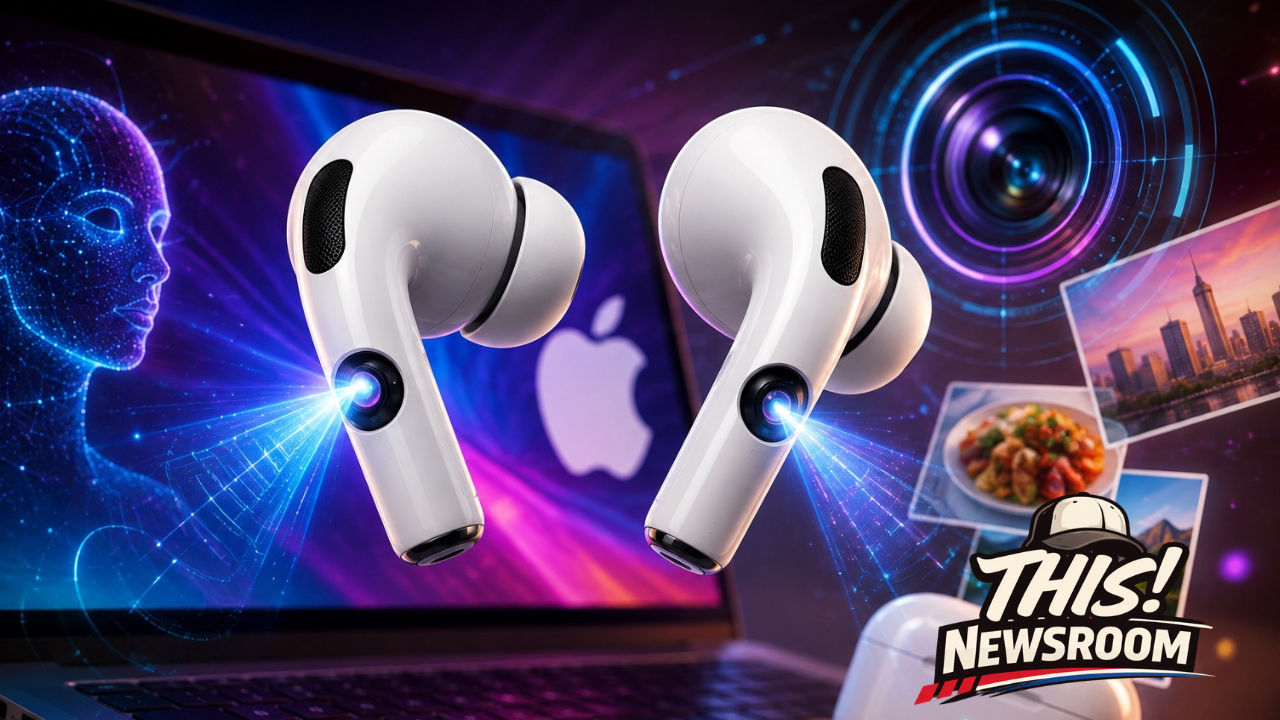
A video discovered in a release candidate of macOS Tahoe 26.7 appears to show an unreleased pair of AirPods equipped with tiny cameras or visual sensors. The footage has quickly spread online, adding fuel to months of reports that Apple is preparing AirPods capable of giving Siri something it has never really had before:
Eyes.
And if the leaked footage is legitimate, Apple’s next major AirPods upgrade may have much less to do with music.
The Leak Apparently Came From Apple’s Own Software
According to reports from The Verge and other technology outlets, the video was discovered within a pre-release version of macOS Tahoe 26.7. It appears to demonstrate AirPods working with Apple’s Visual Intelligence technology.
That makes this particularly interesting.
This isn’t simply another blurry prototype photographed somewhere in Apple’s supply chain. The material reportedly surfaced inside Apple software.
In the demonstration, a user appears to interact with a book while Siri uses visual information from the surrounding environment. The AirPods shown in the footage resemble Apple’s current Pro-style earbuds, although their stems appear modified to accommodate the additional hardware.
Apple has not officially announced the product.
Wait — Why Would AirPods Need Cameras?
Because Apple apparently isn’t trying to turn AirPods into tiny GoPros.
Previous reporting indicates that the sensors are primarily intended to help Siri understand what is happening around the person wearing them.
Bloomberg reported in May that Apple’s camera-equipped AirPods had reached late-stage development, with prototypes approaching a near-final design. The concept centers on cameras observing the user’s surroundings and feeding contextual information into Apple’s AI systems.
Other reports have described the hardware as infrared cameras or sensors rather than conventional smartphone-style cameras.
Imagine looking at something and simply asking:
“Siri, what is that?”
Or walking through an unfamiliar city and receiving contextual navigation without constantly staring at your phone.
You could potentially look at ingredients on a kitchen counter and ask what you can cook. Apple could also eventually use visual context for accessibility, navigation, object recognition and other hands-free AI experiences.
The AirPods effectively become another set of sensors for your personal AI assistant.
This Could Be Apple’s Answer to AI Glasses
The bigger story isn’t really AirPods.
It’s the race to build the device that eventually comes after the smartphone.
Meta has already demonstrated that glasses can become an effective platform for cameras, microphones and artificial intelligence. Meanwhile, Apple has been developing several AI-focused wearable concepts.
Bloomberg reported earlier this year that Apple was accelerating work on smart glasses, camera-equipped AirPods and a wearable pendant as part of a broader push into AI hardware.
Camera-equipped AirPods could give Apple an interesting shortcut.
Millions of people already wear AirPods every day.
There is no new behavior to teach consumers.
Put them in your ears, talk to Siri and suddenly your assistant could potentially understand not only what you’re saying — but the physical environment surrounding you.
That could dramatically change how useful Siri becomes.
Then Comes the Privacy Question
Of course, putting cameras into something as small and common as earbuds immediately creates another conversation:
How do people around you know when they’re being observed?
That concern has already surfaced following the leak. Reports indicate the footage sparked criticism and questions about surveillance and covert recording.
Previous reporting suggests Apple’s cameras aren’t designed primarily for shooting traditional photos or videos. Instead, they’re expected to collect visual information for Siri and Visual Intelligence.
Reports have also suggested Apple could include an indicator light showing when visual information is being processed or transmitted.
But perception matters.
Someone standing across from you can’t necessarily tell whether a tiny sensor is analyzing an object, identifying a restaurant or recording their face.
Apple will have to explain that distinction extremely clearly if this product reaches consumers.
When Could Camera AirPods Actually Launch?
That’s where things get complicated.
Reports throughout 2026 have pointed toward different timelines.
Earlier reporting suggested Apple’s camera-equipped AirPods could arrive in 2027. More recent reporting, however, has identified what appears to be another internal version that could potentially arrive sooner. MacRumors and 9to5Mac reported earlier this month that Apple has been developing separate camera-AirPods projects, with one version potentially positioned for release before the end of 2026.
The appearance of what looks like a promotional demonstration inside macOS will inevitably increase speculation that Apple is getting closer.
Still, until Apple announces the hardware, its name, specifications, price and launch date remain unconfirmed.
AirPods May Be Becoming an AI Device
For years, AirPods have primarily been headphones.
Apple gradually added noise cancellation, spatial audio, hearing-related capabilities and deeper integration with the rest of its ecosystem.
Cameras would represent something fundamentally different.
AirPods would no longer simply deliver information to your ears.
They could begin collecting contextual information from the physical world around you and using AI to interpret it.
That turns an earbud into a wearable computing platform.
And perhaps that’s the most important part of this leak.
The next battle in artificial intelligence isn’t just about which company builds the smartest chatbot.
It’s about which AI can understand your world without requiring you to pull a phone out of your pocket.
Apple may believe the answer has been sitting in millions of people’s ears all along.
THIS NEWSROOM TAKE
Camera-equipped AirPods sound ridiculous for about five seconds.
Then you start thinking about what they could actually do.
Navigation. Translation. Accessibility. Object recognition. Contextual reminders. Shopping information. Visual search. Hands-free Siri conversations.
Suddenly, the idea becomes much bigger than headphones.
But Apple has an enormous challenge ahead: convincing everyone standing around an AirPods wearer that they’re not secretly being recorded.
If Apple solves the privacy problem and makes Visual Intelligence genuinely useful, AirPods could quietly become one of the company’s most important AI products.
The smartphone put a computer in everyone’s pocket.
The next computing revolution may involve removing it from our hands altogether.
About the Author