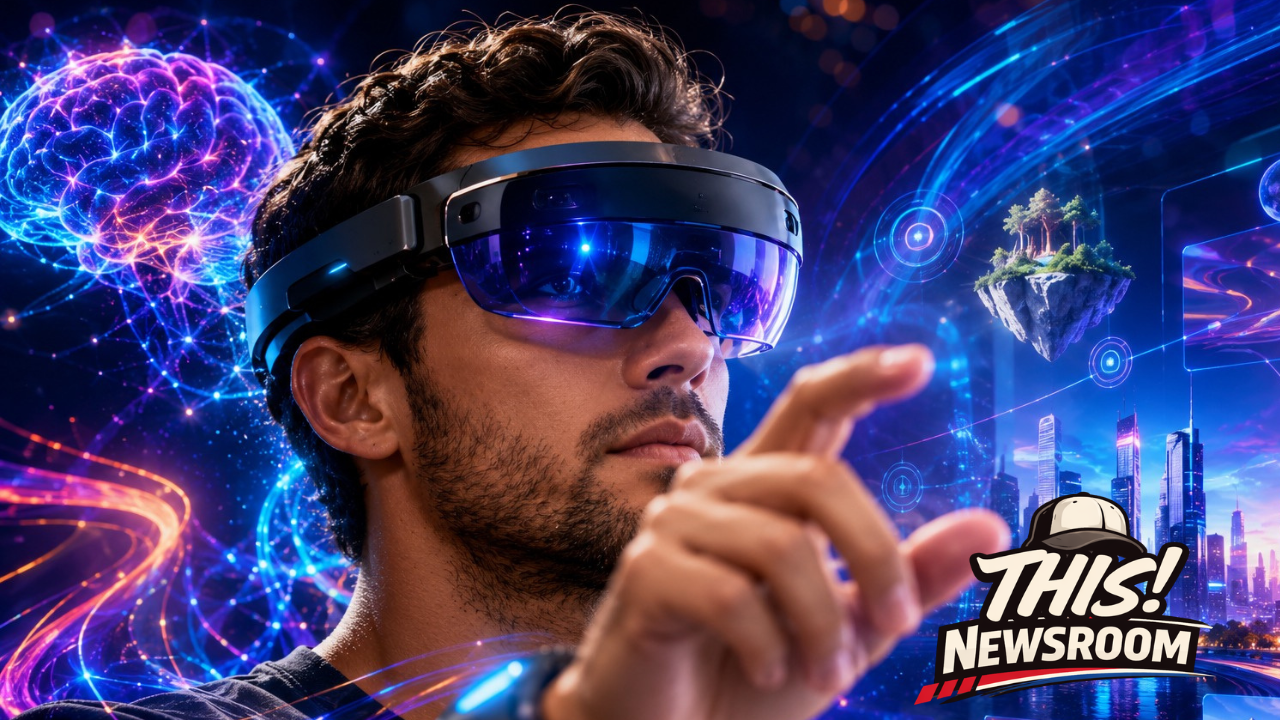
Emerging neural and neuromuscular interfaces could dramatically change how people interact with augmented and virtual reality.
Imagine putting on a pair of augmented-reality glasses, looking at something in front of you and controlling the digital world without reaching for a phone, keyboard or traditional controller.
It sounds like science fiction.
But technologies being developed around brain-computer interfaces, neuromuscular sensing and extended reality are pushing human-computer interaction much closer to that future.
There is one important catch: the viral claim that Meta has simply invented technology that can “read your thoughts” needs context.
Meta is actively developing interfaces capable of translating signals generated by the human body into computer commands. However, that is very different from a device secretly listening to everything happening inside your mind.
Meta Wants to Replace the Mouse and Keyboard
For decades, computers have required humans to adapt to them.
We type on keyboards. We move mice. We tap screens. We speak to voice assistants.
The next generation of computing could reverse that relationship.
Meta has spent years researching new ways for humans to interact with augmented and virtual reality. One of its most significant projects involves surface electromyography, or sEMG.
The technology uses electrodes worn around the wrist to detect tiny electrical signals generated when the nervous system activates muscles.
Machine-learning systems can then interpret those signals and translate them into digital commands.
That means a person might eventually control an interface using incredibly subtle movements — potentially before those movements are easily visible to someone standing nearby.
Is Meta Actually Reading Your Brain?
Not exactly.
This distinction matters.
Meta’s publicly demonstrated wrist technology is primarily detecting neuromuscular activity, not opening a window into someone’s private stream of consciousness.
The company’s research explains that wrist-based sEMG measures electrical signals associated with muscle activity and a person’s intended physical actions. Those signals can then be interpreted by machine-learning models.
So the technology isn’t currently listening to you think:
“I wonder what I’m having for dinner tonight.”
Instead, think of it more like your nervous system sending a command to your hand — and a computer learning to recognize that command.
That is still remarkable.
Meta demonstrated an EMG wristband alongside its Orion augmented-reality glasses prototype, allowing users to perform actions such as swiping, clicking and scrolling while keeping their arm comfortably positioned. Meta has said future applications could potentially include manipulating AR objects and writing messages with minimal physical effort.
But True Brain-Computer Interfaces Are Also Advancing
The larger technology industry is exploring something even more ambitious.
Patents and research across the brain-computer-interface field describe systems capable of measuring brain activity and translating recognizable patterns into computer instructions.
Some patent filings describe extended-reality systems in which brain-activity signals could theoretically be analyzed to recognize a thought, mental condition or intention and then use that information to control an XR application.
That could eventually create interfaces where traditional controllers become unnecessary.
Look at an object.
Think about selecting it.
The computer recognizes the relevant signal.
The action happens.
We’re not at the science-fiction version of that experience yet, but researchers are clearly working toward much more direct connections between humans and computers.
Meta’s Bigger AR Strategy
This technology makes considerably more sense when viewed alongside Meta’s enormous investment in wearable computing.
Meta’s Reality Labs has been developing AR glasses, VR headsets, artificial intelligence, computer vision and new human-computer interfaces simultaneously.
Project Aria is another piece of that puzzle.
Meta’s Aria Gen 2 research glasses combine cameras, sensors, machine learning and computer vision to help researchers develop technologies involving machine perception, contextual AI and robotics.
Put all of these technologies together and the potential future becomes clearer.
Your glasses could understand what you’re looking at.
AI could understand the context around you.
A wrist interface could recognize what you’re trying to do.
And eventually, more advanced neural interfaces could provide another method of controlling the system.
The smartphone could begin disappearing from the equation.
The Computer Interface Could Become Invisible
That’s potentially the biggest story here.
The technological revolution isn’t necessarily about creating another gadget.
It’s about eliminating the interface.
The keyboard disappeared when smartphones popularized touchscreens.
Physical buttons increasingly gave way to gestures.
Voice assistants introduced spoken commands.
Now companies are experimenting with interfaces based on gaze, gestures, muscle signals and neural activity.
Eventually, interacting with a computer could feel less like operating a machine and more like simply expressing an intention.
That could fundamentally change AR and VR.
Instead of holding controllers while wearing a headset, users could navigate virtual environments through combinations of eye movements, tiny finger gestures and other biological signals.
There Are Huge Privacy Questions
There is also another side to this future.
Our smartphones already contain extraordinarily personal information.
But biological and neural data could represent an entirely different category of privacy.
If future devices can recognize increasingly sophisticated signals associated with intention, attention or mental state, questions about ownership and protection become unavoidable.
Who owns that data?
Where is it processed?
Is it stored?
Can it be used for advertising?
Can applications access it?
Could governments request it?
Could employers use it?
And perhaps most importantly: where does user input end and private thought begin?
Those questions may eventually become as important as the technology itself.
Accessibility Could Be Transformational
There is also enormous potential for good.
Brain-computer and neuromuscular interfaces could fundamentally change computing for people with disabilities.
BCI technologies have already been explored as ways for people with mobility or communication limitations to interact with computers without conventional physical controls. Patent literature describes systems translating recognized neural patterns into actions including selecting interface elements, scrolling or typing.
For someone who cannot reliably use a keyboard, touchscreen or mouse, that isn’t simply a futuristic convenience.
It could provide an entirely new level of independence.
The Bottom Line
The viral phrase “Meta can read your mind” makes for an incredible headline.
Reality is more complicated — and arguably more interesting.
Meta has demonstrated technology that can detect electrical signals associated with neuromuscular activity and convert them into digital commands. The broader technology industry is simultaneously researching more direct brain-computer interfaces capable of interpreting certain patterns of brain activity.
That doesn’t mean someone can put on Meta glasses today and have Facebook secretly transcribe every thought running through their head.
But the direction of computing is unmistakable.
We went from keyboards…
to touchscreens…
to voice…
to gestures…
and now toward biological signals.
The ultimate interface may not be something we hold at all.
It may simply be us.
This Newsroom will continue following developments in artificial intelligence, augmented reality, wearable computing and the rapidly evolving race to build the next generation of human-computer interfaces.
About the Author