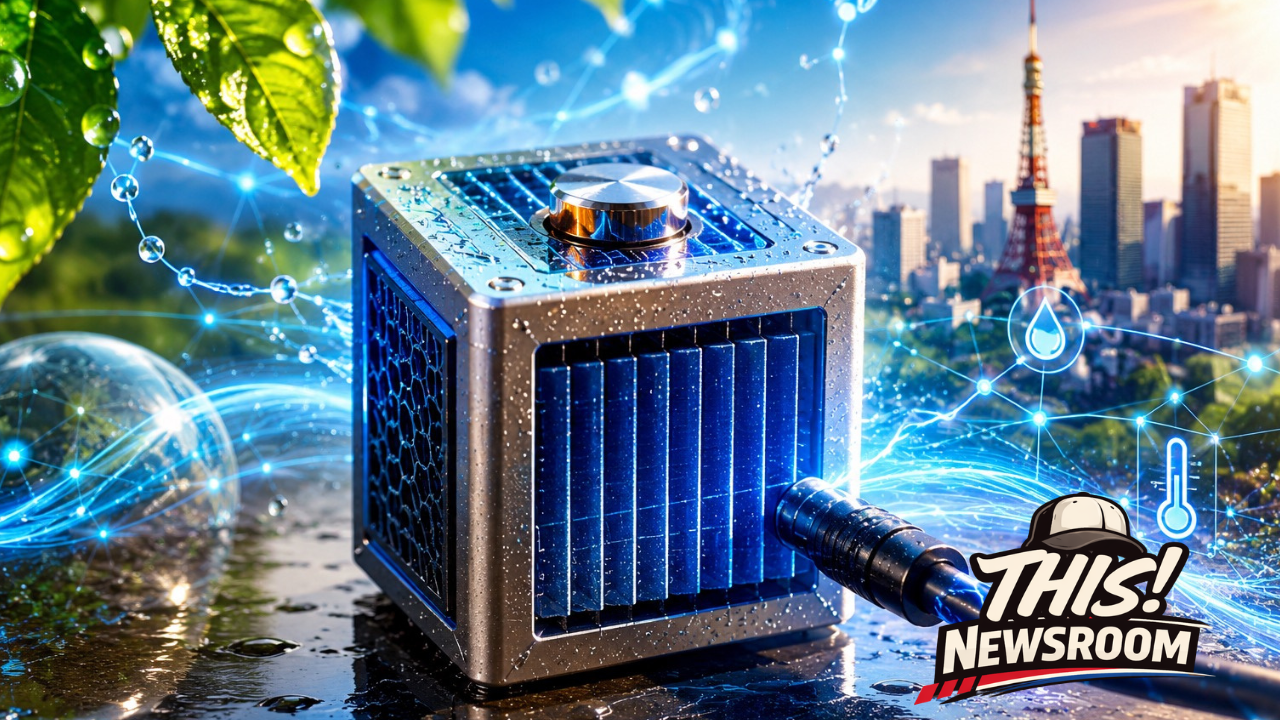
Researchers in Japan are advancing hygroelectric technology designed to harvest small amounts of electricity from changes in atmospheric humidity.
Imagine a tiny sensor tucked underneath a bridge, inside a factory control panel or deep in an agricultural field.
There’s no convenient electrical outlet. Sunlight may never reach it. And replacing thousands — or eventually millions — of tiny batteries would be expensive and time-consuming.
Researchers in Japan believe part of the solution could be floating around us already:
Humidity.
Scientists at Japan’s National Institute of Advanced Industrial Science and Technology, better known as AIST, have developed an improved hygroelectric cell capable of generating electricity from changes in moisture in the surrounding air.
And unlike some viral posts suggesting Japan has suddenly invented a device that can power electronics simply by “running on air,” the real technology is both more nuanced — and potentially more interesting.
What Is a Hygroelectric Cell?
A hygroelectric cell is an energy-harvesting device designed to convert changes in atmospheric humidity into electrical energy.
AIST researchers have been working on the concept for years.
Their original system combines a highly moisture-absorbing electrolyte with a method of generating electricity from differences in salt concentration. One chamber is exposed to the atmosphere while another remains sealed.
As humidity changes, the exposed electrolyte either absorbs water vapor or loses water through evaporation. That changes its concentration relative to the sealed chamber.
That concentration difference creates a voltage between electrodes.
In other words, the cell isn’t magically pulling unlimited electricity out of thin air.
It is harvesting energy associated with changing humidity.
Japan Just Made the Technology Much More Useful
The idea itself isn’t brand-new.
AIST announced an earlier version of its hygroelectric cell in 2021. Researchers reported that the device could continuously produce current at the milliampere level by taking advantage of ordinary humidity fluctuations, including changes between daytime and nighttime conditions.
But there was a major problem.
Earlier cells suffered from self-discharge. Water could pass through the polymer membrane separating parts of the device, reducing the concentration difference responsible for generating voltage.
Researchers later replaced that polymer membrane with a lithium-ion-conducting ceramic solid-electrolyte membranethat prevents water from passing through.
The result was a significant improvement in output.
It Powered a Wireless Sensor for More Than Four Months
This is where the research becomes particularly interesting.
AIST says researchers connected two of the improved cells to a system that used a DC-to-DC converter and a small rechargeable lithium-ion battery.
The system powered sensors measuring temperature, humidity and atmospheric pressure and transmitted the information wirelessly every 10 minutes.
According to AIST, the demonstration continued for more than four months.
The institute described it as the world’s first demonstration of operating an electronic circuit for more than four months using electricity generated from humidity changes.
That doesn’t mean your next smartphone will charge itself from the humidity in your bedroom.
At least not yet.
But it does demonstrate something potentially much more practical.
The Real Opportunity Is the Internet of Things
Modern infrastructure is increasingly filled with tiny connected sensors.
They monitor bridges.
They monitor farms.
They track machinery.
They measure temperature, pressure, vibration and environmental conditions.
Collectively, these devices form part of the enormous Internet of Things, or IoT, ecosystem.
But every sensor needs energy.
Solar power works beautifully in many places, but not underground, underneath infrastructure or inside dark equipment enclosures. Conventional batteries eventually need replacing.
A humidity-powered energy harvester could potentially keep extremely low-power electronics operating for much longer without someone physically replacing batteries.
AIST specifically points to applications such as sensors underneath bridges and inside machine control panels — environments where sunlight isn’t necessarily available.
Humidity Has One Huge Advantage: It’s Almost Everywhere
Solar energy needs light.
Wind turbines need wind.
Vibration harvesters need movement.
Hygroelectric systems need variations in humidity.
Water vapor, meanwhile, exists throughout much of Earth’s atmosphere.
Researchers have therefore been exploring humidity as an environmental energy source because it could potentially work in locations where other forms of energy harvesting cannot.
AIST notes that its technology can generate power in many environments as long as humidity changes rather than remaining constant.
That distinction matters.
The technology doesn’t simply generate unlimited electricity because air exists around it. It relies on environmental humidity cycles.
No, This Isn’t Replacing the Power Grid
This is where social-media headlines can get ahead of the science.
A device that harvests energy from humidity sounds revolutionary — and it could become extremely useful.
But we’re talking about very small amounts of electricity intended for ultra-low-power devices, not an alternative to utility-scale electricity generation.
You aren’t powering your house with one.
You aren’t plugging your electric vehicle into one.
And you’re definitely not replacing a power plant with a box sitting outside collecting humid Texas air.
The breakthrough is about eliminating or reducing the need for conventional batteries in tiny electronics.
And when you consider how many sensors could eventually surround us, that isn’t a small accomplishment.
The Bigger Picture
We’re entering an era where computing is disappearing into everyday objects.
Sensors will increasingly live inside roads, buildings, vehicles, farms, factories, appliances and infrastructure.
The challenge isn’t simply making those sensors smaller.
It’s keeping them alive.
If devices can harvest tiny amounts of energy from their surrounding environment — sunlight, vibration, heat or even changing humidity — the idea of electronics that operate for years with little or no maintenance becomes much more realistic.
Japan’s hygroelectric research isn’t quite a battery that “runs on air.”
It’s something more scientifically precise:
A tiny power system capable of turning changes in the moisture already surrounding us into useful electricity.
And sometimes the technologies that quietly power one tiny sensor are the ones that eventually end up everywhere.
About the Author