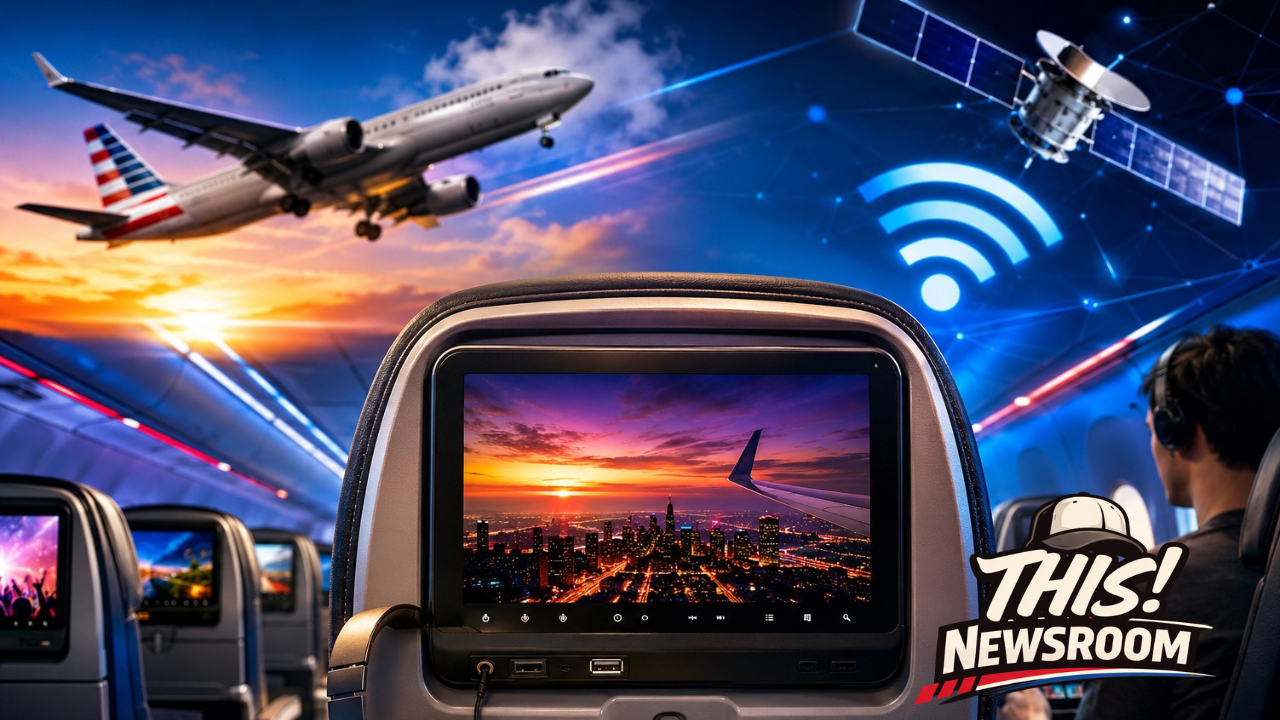
American Airlines plans a major expansion of seatback entertainment across its narrowbody fleet.
American Airlines is making a major U-turn on how passengers are entertained in the sky.
After years of betting that travelers would rather watch movies and television on their own phones, tablets and laptops, American Airlines plans to bring seatback entertainment screens to more than 800 narrowbody aircraft.
The move is part of a much larger effort to modernize American’s cabins, expand premium seating and compete more aggressively for travelers willing to spend more for a better experience.
And yes, this means the little TV in front of you is officially making a comeback.
American Airlines Reverses Its Seatback Screen Strategy
For years, American moved in the opposite direction.
The airline increasingly relied on passengers’ personal devices for entertainment on domestic flights. Travelers could connect to the aircraft’s Wi-Fi network and stream American’s library of movies and television shows directly to their own devices. American still describes personal-device streaming as the entertainment option on most flights today.
That strategy reduced the need for screens, wiring and other equipment built into every seat.
But passenger expectations have changed.
Competitors have continued investing in onboard entertainment, connectivity and upgraded cabins. At the same time, travelers increasingly expect their flight experience to feel connected from takeoff to landing.
American is responding.
More than 800 narrowbody aircraft are expected to receive seatback screens, with new Airbus and Boeing aircraft beginning to arrive with the technology in 2028. Retrofits of existing aircraft are also planned, with the broader rollout expected to stretch into the early 2030s.
These Won’t Be the Airplane TVs You Remember
American isn’t simply reinstalling yesterday’s entertainment systems.
Reports indicate the next-generation platform will include features such as:
- Large high-resolution displays
- 4K technology
- Bluetooth connectivity for personal headphones and earbuds
- USB-C charging
- Movies and television programming
- Music and games
- Interactive flight maps
- More personalized entertainment experiences
That combination could make the seatback screen less like an old airplane television and more like an integrated entertainment hub.
For families traveling with children, that could be particularly useful. Parents may no longer need to make sure every child has a charged tablet loaded with entertainment before boarding.
And for everyone else, it means your phone can remain your phone while the screen in front of you handles the movie.
American Is Also Going Big on Starlink
The screens are only one piece of American’s technology overhaul.
American previously announced plans to install Starlink internet on more than 500 narrowbody aircraft beginning in the first quarter of 2027.
Starlink’s low-Earth-orbit satellite network is designed to support activities including streaming, gaming, web browsing and real-time collaboration while passengers are in the air.
American has also been rolling out free high-speed Wi-Fi for AAdvantage members across its network.
Put everything together and American appears to be building an aircraft cabin where passengers don’t have to choose between a seatback entertainment system and fast internet.
They can have both.
More Premium Seats Are Coming, Too
There is another major part of this strategy.
American wants significantly more of its narrowbody cabin dedicated to premium seating.
The airline plans to increase premium seating from roughly 25% to about 40% of narrowbody capacity over the coming years. That includes additional first-class and extra-legroom seats.
That is a huge shift.
It also tells us that the seatback screens aren’t really an isolated entertainment decision. American is attempting to reposition the entire passenger experience.
The airline already has refreshed Airbus A319 and A320 interiors entering service with additional premium seats, larger overhead bins, updated lighting, power at every seat and redesigned cabin finishes.
Why Is American Spending So Much on the Passenger Experience?
Premium travelers are becoming increasingly important to airline economics.
According to Reuters, premium passengers represented nearly half of American’s second-quarter ticket revenue even though they accounted for roughly 30% of seats.
That creates a powerful incentive.
If passengers paying more for first class, extra legroom and other upgraded experiences are generating an outsized portion of revenue, airlines have every reason to fight for them.
American is also trying to narrow the profitability gap with major competitors including Delta and United.
The airline reported record second-quarter 2026 revenue of $16.7 billion, up 16.3% year over year, although GAAP net income for the quarter was $71 million.
Better cabins may therefore be about much more than making passengers happy.
They’re part of the business strategy.
The Great Airline Screen Debate May Be Ending
For years, airlines had a legitimate question to answer:
Why install an expensive screen in every seat when practically every passenger already carries one in their pocket?
On paper, the argument made sense.
In practice, passengers may want both.
A seatback display doesn’t consume your phone battery. It doesn’t require you to prop a device on a tray table. It allows you to watch entertainment while simultaneously texting, browsing, working or using another device.
And sometimes you simply want to stare at that moving airplane on the flight map for three hours.
Technology has also changed the equation. Faster satellite internet, Bluetooth headphones, USB-C charging and modern displays can turn the screen into part of a much larger connected ecosystem.
Don’t Expect Every American Airlines Plane to Change Overnight
There is one important catch.
This is a long-term transformation.
The new aircraft equipped with the next-generation screens are expected to begin arriving in 2028, while retrofits across the existing narrowbody fleet are expected to continue into the early 2030s.
So if you’re flying American next week, don’t board expecting a shiny new 4K display.
For several years, passengers will likely encounter a mixture of cabin configurations depending on the aircraft.
American’s own fleet information currently shows that entertainment offerings can vary by aircraft and configuration.
The Bottom Line
American Airlines spent years betting that your phone would replace the airplane TV.
Now it’s betting that travelers want the airplane TV back.
The decision to install seatback entertainment across more than 800 narrowbody aircraft — while simultaneously expanding premium seating, improving cabins and deploying Starlink — represents a significant change in strategy.
And it points toward something bigger happening across air travel.
Passengers aren’t simply buying transportation anymore.
They’re comparing Wi-Fi speed, entertainment, charging, legroom, lounges, seats and the overall experience before deciding which airline deserves their money.
For American Airlines, the message appears clear:
The battle for the passenger is moving back inside the cabin.
About the Author