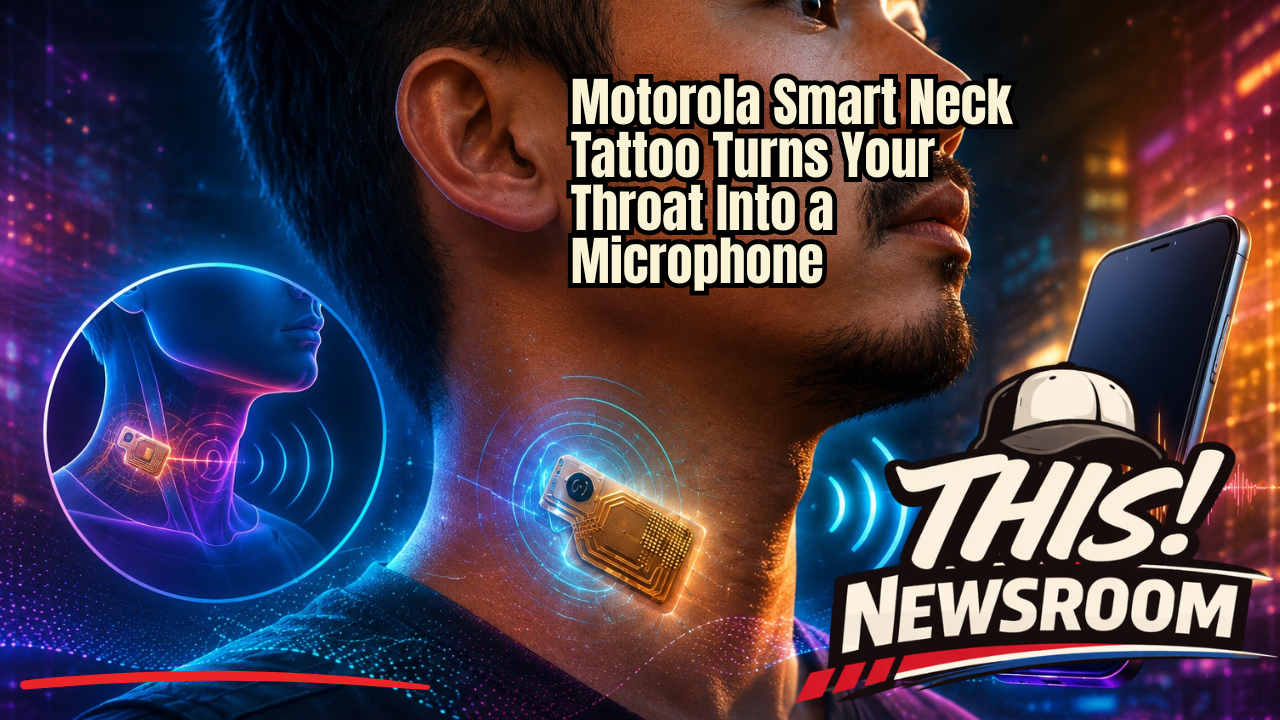
Motorola patented electronic skin technology designed to capture signals from the throat and function as a wearable microphone. But there’s an important catch behind the viral story.
Motorola once imagined a future where you might not need to hold a phone, wear earbuds or even speak directly into a microphone.
Instead, your neck could become the microphone.
A viral social media post is bringing renewed attention to a Motorola patent for an “electronic skin tattoo” designed to sit against a person’s throat and capture signals associated with speech.
And yes — the patent is real.
But there’s an important detail missing from many of the posts circulating online: this isn’t a brand-new Motorola invention. The technology traces back more than a decade.
Motorola Really Did File the Patent
Motorola Mobility filed the underlying U.S. patent application in May 2012, and it was published by the U.S. Patent and Trademark Office in November 2013 under the title “Coupling an Electronic Skin Tattoo to a Mobile Communication Device.”
The concept describes a thin electronic device that could be attached to the throat region and communicate wirelessly with a phone or other mobile device.
Motorola’s proposed system included:
- An embedded microphone
- Wireless communication hardware
- A controller and signal processor
- A power source
- NFC and potentially Bluetooth or Zigbee connectivity
- Electronics mounted on a flexible substrate
In other words, calling it a “tattoo” makes the technology sound considerably more permanent than Motorola’s documents suggest.
This wasn’t necessarily about having electronics permanently tattooed beneath your skin. The patent describes electronics on a flexible substrate applied to the body, including versions using adhesive.
Your Throat Becomes Part of the Microphone
Here’s where the idea gets fascinating.
Rather than depending entirely on sound traveling through the air toward a conventional microphone, Motorola proposed placing its electronic microphone directly around the throat.
The device could detect acoustic signals associated with the movement and fluctuations of muscle and tissue in the throat and then convert that information into a digital signal.
That signal could then be transmitted wirelessly to a mobile device.
Why bother?
Noise.
Motorola specifically described situations such as crowded streets, restaurants, stadiums and emergency environments where traditional microphones can struggle to separate someone’s voice from everything happening around them.
Because the electronic tattoo would be positioned directly against the throat, Motorola envisioned it providing an auxiliary voice signal with a better signal-to-noise ratio.
Your phone could potentially combine information from its conventional microphone with information captured from your throat to produce clearer speech.
It Could Potentially Recognize Voice Commands Too
Motorola’s patent went considerably further than simply creating a strange wearable microphone.
The system could convert incoming throat signals into digital information and compare them with predetermined patterns.
If the system recognized a particular pattern, it could trigger an action on the connected mobile device. The patent specifically describes possibilities including sending a message or ending a communication session.
Essentially, Motorola was imagining an ultra-close-range wearable voice interface years before today’s explosion of AI assistants and always-listening wearable devices.
And Then There’s the Lie Detector
This is where the patent gets especially weird.
Motorola also proposed incorporating a galvanic skin response detector.
Galvanic skin response measures changes in the electrical properties of the skin associated with physiological arousal.
Motorola’s patent suggested that someone who was nervous or potentially being deceptive could exhibit a different skin response than someone who was confident.
That doesn’t mean Motorola invented a reliable tattoo-sized lie detector — physiological stress is not the same thing as lying — but the fact that the concept appears in the patent demonstrates just how ambitious the company’s vision was.
Why Is Everyone Talking About It Again?
Because technology has finally started catching up with ideas that sounded borderline science fiction in 2013.
Flexible electronics, wearable health sensors, smart rings, AI-powered earbuds and increasingly sophisticated voice recognition have become significantly more mainstream.
Suddenly the idea of an extremely thin sensor attached to your skin doesn’t sound nearly as ridiculous as it did thirteen years ago.
But the renewed attention can also create a misleading impression.
Motorola filing a patent does not mean Motorola is preparing to release a smart neck tattoo today.
Patent applications frequently cover experimental concepts that never become commercial products. One continuation of the application lists Motorola Mobility as the original assignee and is currently shown by Google Patents as abandoned.
So don’t expect a “Moto Tattoo” announcement next week.
Still, Motorola Was Remarkably Early
The most interesting part of this story isn’t whether you’ll be sticking a microphone onto your throat tomorrow.
It’s how accurately the patent anticipated where personal technology was heading.
We increasingly interact with computers through our voices. Wearable devices continuously collect biological signals. AI systems interpret speech, movement and context. Electronics are getting smaller, thinner and increasingly integrated with the human body.
Motorola was thinking about combining many of those ideas back in 2012.
The company’s electronic tattoo envisioned a device capable of listening to your throat, communicating wirelessly with your phone, recognizing voice patterns and potentially monitoring physiological responses.
Thirteen years later, that doesn’t sound quite as impossible.
THIS NEWSROOM TAKE
The viral headline makes this sound like Motorola just patented a futuristic microphone tattoo.
That’s not quite what happened.
The patent is legitimate, but the technology is an old Motorola research concept receiving new attention, not evidence of an imminent consumer product.
Still, there’s something fascinating about opening a patent from 2012 and discovering ideas that feel more relevant in the AI and wearable-computing era than they did when Motorola originally filed it.
Smartphones put computers in our pockets.
Smartwatches put computers on our wrists.
Smart glasses are trying to put computers on our faces.
Maybe the bigger question isn’t whether we’ll eventually put computers on our skin.
It’s how long until that stops sounding strange?
About the Author