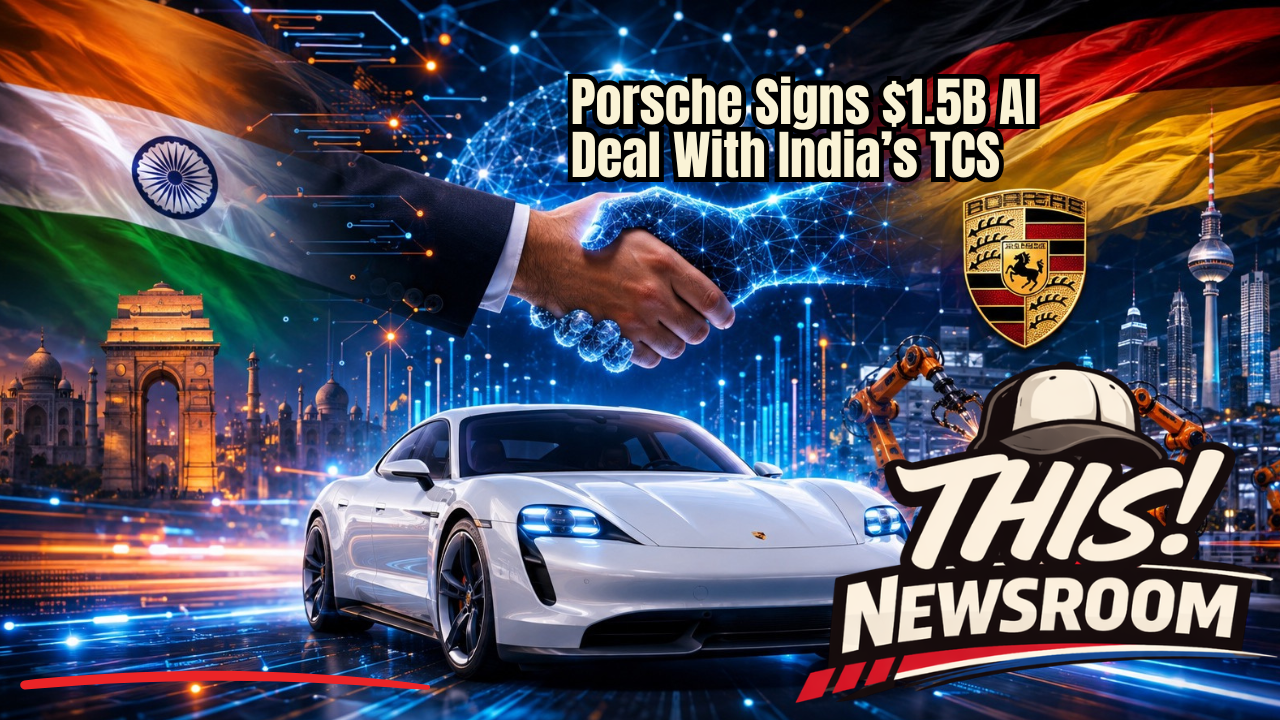
Porsche is expanding its use of artificial intelligence through a major five-year technology partnership with Tata Consultancy Services.
Porsche is making a massive bet on artificial intelligence — and it isn’t limiting AI to the dashboard.
The German sports-car maker has entered into a five-year strategic agreement with India’s Tata Consultancy Services (TCS) valued at €1.25 billion, or roughly $1.45 billion, as the companies move to deploy artificial intelligence across Porsche’s engineering, manufacturing, operations and customer experience.
And there’s another major piece of the agreement: TCS is buying Porsche’s management and IT consulting subsidiary, MHP, for €320 million — roughly $373 million.
Together, the transactions represent one of the clearest examples yet of how seriously the automobile industry is beginning to treat AI.
This isn’t simply about putting a better voice assistant inside a Porsche.
It’s about using AI to rethink how the company operates.
Porsche Wants AI Across the Entire Company
Under the partnership, TCS plans to establish a dedicated AI Mobility Centre of Excellence for Porsche.
Its mission will be to take AI concepts and turn them into secure, scalable technologies capable of operating throughout Porsche’s business.
The companies specifically identified four major areas:
- Manufacturing
- Engineering
- Business operations
- Customer experience
The partnership will also extend into areas including connected mobility, software-defined vehicles, enterprise transformation and manufacturing digitalization.
That distinction matters.
For the past several years, much of the conversation surrounding automotive AI has centered on what drivers can physically see — autonomous driving, intelligent assistants, navigation and infotainment.
Porsche’s strategy demonstrates another side of the AI revolution.
Some of AI’s biggest impacts on the automobile industry could happen before a customer ever gets inside the car.
Imagine an AI-Powered Porsche Factory
Artificial intelligence potentially changes nearly every step required to build a modern automobile.
Manufacturers can use AI systems to analyze production data, identify potential quality problems, optimize supply chains, improve factory scheduling and predict equipment failures before they shut down a production line.
Engineering teams can increasingly use AI to analyze enormous datasets and accelerate portions of development.
Customer operations can become more personalized.
And software can increasingly become part of the vehicle throughout its lifetime rather than something essentially finished when the car leaves the factory.
Porsche CEO Michael Leiters said combining Porsche’s automotive expertise with TCS’s digital technology and AI capabilities should help the automaker increase efficiency and competitiveness as mobility becomes increasingly driven by software and data.
That may ultimately be the biggest story here.
Porsche isn’t buying an AI feature. It’s building an AI infrastructure.
TCS Is Also Buying Porsche’s MHP
The partnership includes an unusual second component.
TCS, through a subsidiary, intends to acquire 100% of MHP Management- und IT-Beratung GmbH, Porsche’s Germany-based management and technology consulting business.
The enterprise value is approximately €320 million.
MHP isn’t a tiny internal Porsche technology department, either.
The consultancy employs more than 4,500 people worldwide and has expertise spanning automotive technology, AI, SAP, business transformation, manufacturing digitalization and connected mobility. It generated €742 million in revenue during calendar year 2025.
MHP is expected to retain its existing brand and continue operating as an independent consultancy following the transaction. The acquisition remains subject to regulatory approvals.
For TCS, acquiring that expertise immediately gives the Indian technology giant a significantly deeper position inside Europe’s automotive industry.
For Porsche, it provides something different: the ability to concentrate more heavily on its core automotive business while retaining a major technology partner.
Why Porsche Is Doing This Now
The timing isn’t accidental.
The global automotive business is undergoing one of its biggest transformations in decades.
Electric vehicles are changing vehicle architectures.
Software-defined vehicles are changing how cars are developed.
Chinese automakers are applying enormous competitive pressure.
Tariffs and manufacturing costs are squeezing margins.
And AI is beginning to transform virtually every layer of the business.
Porsche itself has been working to sharpen its strategic focus and reduce costs as those pressures intensify. The company described the MHP sale as another step in its broader “Sportwagenschmiede 35” strategy, designed to focus Porsche more firmly on its core business.
Rather than attempting to build every piece of the emerging AI technology stack internally, Porsche is effectively partnering with one of the world’s largest technology-services companies to help industrialize it.
India Is Becoming an Important Part of the AI Story
There’s another fascinating element to this deal.
The technology partner isn’t coming from Silicon Valley.
It’s coming from India.
Tata Consultancy Services is one of the world’s largest IT-services companies, and the Porsche agreement highlights how India’s enormous technology-services industry is positioning itself for the AI era.
TCS says its ambition is to become the world’s largest AI-led technology-services company.
And Porsche isn’t an isolated example.
Other major Indian technology companies, including Infosys, Wipro and HCLTech, have been securing large technology and AI-related agreements with Western companies as businesses move from experimenting with generative AI toward actually deploying it throughout their organizations.
That shift could create an enormous market.
Companies don’t simply need AI models.
They need someone capable of integrating those models with decades of existing software, manufacturing systems, customer databases and business processes.
That’s exactly where companies such as TCS see an opportunity.
The Car Company of the Future May Look More Like a Technology Company
For consumers, Porsche will still be Porsche.
The 911 will still matter.
Performance will still matter.
Design will still matter.
But behind those vehicles, the infrastructure required to compete is becoming dramatically more technological.
Factories are becoming intelligent.
Vehicles are becoming software platforms.
Engineering is becoming increasingly data-driven.
Customer relationships are becoming personalized.
And artificial intelligence is beginning to connect all of it.
That’s why this nearly $1.5 billion agreement deserves attention beyond Porsche enthusiasts.
We’re watching the automobile industry transition from companies that simply use technology into companies whose entire operations are increasingly built around technology.
For Porsche, the next great performance upgrade may not be another 50 horsepower.
It may be AI running quietly behind almost everything the company does.
About the Author