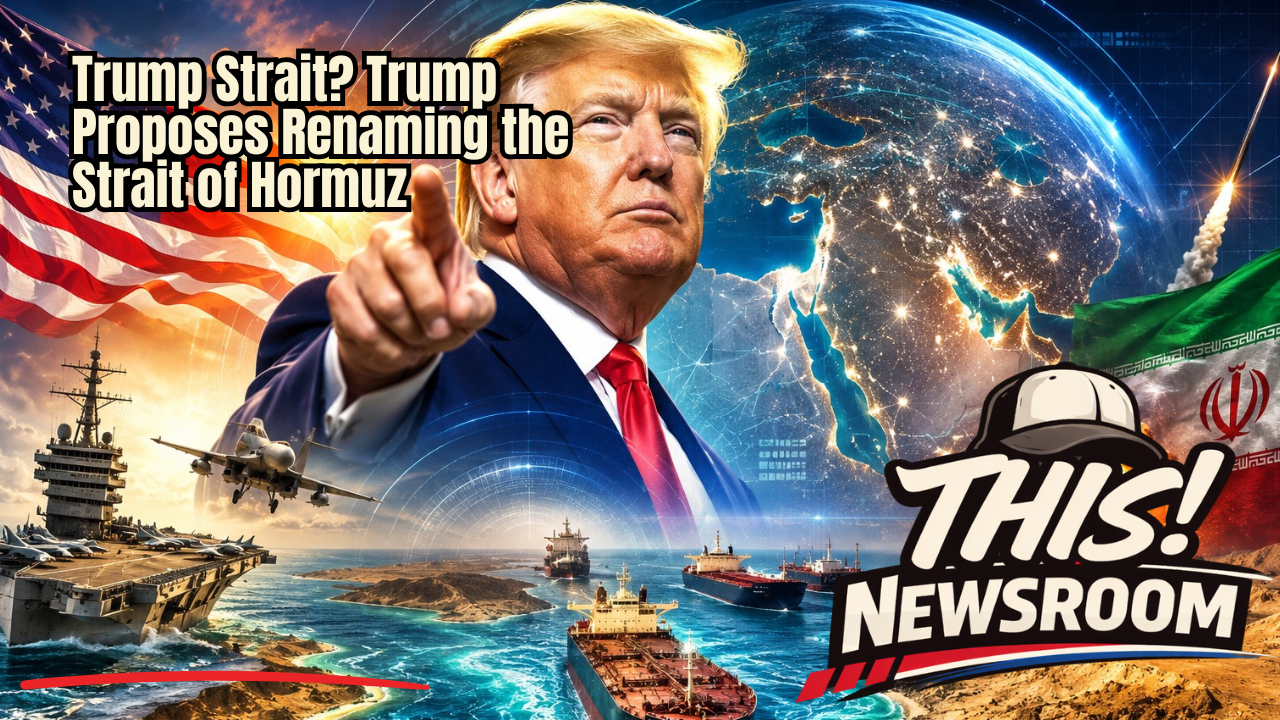
President Trump has floated calling the strategically important Strait of Hormuz the “Trump Strait” amid heightened tensions with Iran.
President Donald Trump is once again putting his name — and America’s geopolitical power — on the map.
Trump suggested Wednesday that the strategically critical Strait of Hormuz could be renamed the “Trump Strait,”making the proposal as the United States intensifies military operations around the waterway and Trump claims Washington now controls it.
The president posted the idea on Truth Social, asking whether the Strait of Hormuz should receive his name now that, in his words, the United States has it “under U.S.A. control.” He added that the newly named waterway would be “hotter” than ever.
The White House quickly joined the conversation. Its official X account shared an altered map identifying the waterway as “Trump Strait” and said the name had “a nice ring to it.”
Whether Trump intends to pursue an official naming change remains uncertain. AFP reported that hours after floating the idea, the president appeared to suggest he may not have been entirely serious.
Still, the timing makes the comment much more than another social-media moment.
Why the Strait of Hormuz Matters
The Strait of Hormuz is one of the most strategically important waterways on Earth.
Positioned between Iran and Oman, the narrow passage connects the Persian Gulf with the Gulf of Oman and ultimately the Arabian Sea. Before the current conflict, more than 20% of global oil and liquefied natural gas exports traveled through the strait, according to Forbes.
That makes disruptions there capable of affecting energy markets thousands of miles away.
Shipping through Hormuz has already faced significant disruption amid the conflict with Iran, while attacks and military activity around the waterway continue. Reports of strikes against vessels and threats to commercial shipping have added another layer of uncertainty for global energy markets.
For American consumers, the consequences can eventually appear at the gas pump, in transportation expenses and throughout supply chains.
U.S. Military Operations Intensify Around Hormuz
Trump’s proposal arrived during a renewed round of American military operations against Iranian targets.
U.S. Central Command launched strikes near the Strait of Hormuz on September 1 targeting Iranian capabilities associated with radar, missiles and threats against shipping, according to Axios.
Reuters reported that Trump said American forces destroyed equipment Iran was developing to deploy mines and attacked additional radar and missile systems around the region. The president also warned that additional strikes remained possible.
Iran, meanwhile, continues to dispute American assertions of control over the waterway.
That disagreement makes Trump’s terminology politically significant. Calling the waterway the “Trump Strait” is one thing. Establishing internationally recognized sovereignty or changing its globally accepted geographic name is something entirely different.
Can Trump Actually Rename the Strait?
Not internationally by himself.
A U.S. president can direct federal agencies to use particular geographic terminology, but that does not force foreign governments or international institutions to recognize the same name.
The National reported that presidential authority in this area effectively allows Trump to direct how the U.S. federal government refers to a location. Other countries remain free to continue calling it the Strait of Hormuz.
That distinction could become important if Trump decides to transform Wednesday’s suggestion into an official U.S. policy.
This Isn’t Trump’s First Geographic Renaming Fight
The proposal also fits a broader pattern during Trump’s second term.
On his first day back in office in January 2025, Trump moved to change the U.S. government’s designation of the Gulf of Mexico to the Gulf of America.
More recently, his administration moved to call Lake Ontario “Lake America” amid escalating trade tensions with Canada.
Now Hormuz could become the next geographic name caught up in Trump’s unconventional approach to diplomacy and political branding.
The difference is that the Strait of Hormuz sits at the center of an active military confrontation.
Oil Markets Are Watching Closely
Behind the unusual name proposal sits a far more consequential economic story.
Hormuz remains a critical artery connecting some of the world’s largest oil-producing countries with international markets. Even the possibility of prolonged disruptions can increase the geopolitical risk premium embedded in crude prices.
The renewed fighting has already contributed to upward pressure on oil.
For the White House, securing reliable passage through Hormuz therefore carries economic as well as military significance.
Higher oil prices can translate into higher gasoline and transportation costs. Those increases can eventually flow into airline tickets, shipping, manufacturing and consumer goods.
In other words, what happens in this relatively narrow stretch of water can reach household budgets around the world.
The Bigger Story Isn’t Really the Name
“Trump Strait” will understandably generate headlines.
But the more important development is the expanding struggle over who can guarantee — or disrupt — movement through one of the world’s most important maritime chokepoints.
Trump says the United States controls it.
Iran disputes that assertion.
American military forces are striking Iranian capabilities around the region, while threats against commercial vessels continue.
Meanwhile, governments, shipping companies and energy traders are trying to determine whether the latest escalation represents another temporary confrontation or the beginning of a longer period of instability.
The name on the map may make for the viral headline.
Control of the water beneath it could have consequences for the entire global economy.
This Newsroom will continue monitoring developments surrounding the Strait of Hormuz, U.S.-Iran tensions and their potential impact on oil, gasoline prices and global markets.
About the Author