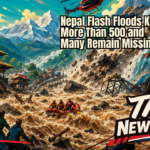
Rescue operations continue following catastrophic flash flooding across Nepal's Himalayan region.
Catastrophic Nepal flash floods have killed more than 500 people and devastated communities across the Himalayan region. Nearly 1,000 people also remain missing as rescue crews race to find survivors.
The disaster struck near the Nepal-China border on Wednesday. A massive surge of water, mud, rocks and debris rushed through mountain valleys and destroyed communities in its path.
By Friday, August 28, officials reported that the death toll in Nepal had climbed to 547. Five additional deaths occurred across the border in China’s Tibet region.
Search teams continue to comb through enormous fields of mud and debris. Meanwhile, families across Nepal and around the world are waiting for news about missing relatives.
Nepal Flash Floods Leave Widespread Devastation
The flood tore through areas along Nepal’s Bhotekoshi River in Rasuwa district. The torrent then surged downstream toward the Trishuli River.
Witnesses described an enormous wall of muddy water filled with rocks, trees and debris. The flood destroyed homes, roads and bridges as it moved through the valleys.
Scientists believe a massive ice-and-rock avalanche may have triggered the disaster.
Researchers say the avalanche likely crashed into the Lhende River and temporarily blocked the waterway. The blockage created a natural dam.
When that dam failed, the trapped water exploded downstream.
The sudden release gave communities little time to escape.
River Levels Rose Nearly 30 Feet in 30 Minutes
The speed of the flooding shows how quickly the disaster unfolded.
Data cited by The Kathmandu Post showed that the Trishuli River at Galchhi rose by as much as nine meters, or nearly 30 feet, in only 30 minutes.
Water levels at Malekhu reportedly climbed about seven meters during the same period.
Those dramatic increases sent massive amounts of water through communities downstream.
The flood swept away buildings and infrastructure. It also stranded residents as roads and bridges disappeared.
Nearly 1,000 People Remain Missing
The number of missing people remains one of the greatest concerns.
Reuters reported Friday that nearly 1,000 people remained unaccounted for following the disaster.
The Himalayan border region attracts tourists, trekkers and religious pilgrims from across the world. As a result, the missing include people from several countries.
U.S. officials also reported that approximately 90 Americans remained unaccounted for as of Friday.
Officials continue working to determine how many missing people survived or left the region without contacting authorities.
For hundreds of families, the search has become a desperate race against time.
Rescue Crews Search for Survivors
Nepal has deployed the army, police and Armed Police Force to the disaster zone.
Helicopters are helping crews reach isolated mountain communities. Emergency teams are also searching through mud, collapsed buildings and debris.
Rescuers have already pulled survivors from devastated areas. Helicopters have transported stranded residents from locations that crews cannot easily reach by road.
However, damaged infrastructure continues to complicate the operation.
Floodwaters destroyed bridges and blocked major transportation routes. Huge debris fields now cover parts of the affected river corridors.
The rugged Himalayan terrain creates another challenge for rescue crews.
Another Flood Threat Emerges Near China Border
The danger may not be over.
Authorities reported another potentially dangerous development Friday near the Nepal-China border.
A newly formed barrier lake breached and sent additional water toward the Bhotekoshi River. The development raised concerns about another downstream surge.
Chinese authorities previously estimated that the lake contained about 2 million cubic meters of water.
Officials warned that millions of additional cubic meters could flow into the area.
Nepali authorities began aerial reconnaissance efforts to assess the situation. Emergency officials also urged residents in vulnerable areas to move toward higher ground.
Authorities continue watching river levels closely.
What Caused the Nepal Flash Floods?
Scientists continue investigating the exact cause of the disaster.
Current evidence points toward a massive ice-and-rock avalanche in the Himalayas.
Satellite imagery appears to show a major avalanche about 20 kilometers northeast of the Rasuwagadhi border crossing.
Researchers believe the avalanche sent debris into the Lhende River. That debris may have blocked the river and created a temporary natural dam.
Water then accumulated behind the blockage.
When the barrier collapsed, the water surged downstream with tremendous force.
Scientists have not yet confirmed the entire sequence of events.
Did an Earthquake Play a Role?
A magnitude 4.4 earthquake struck Tibet on Wednesday morning.
Researchers have not established a connection between the earthquake and the avalanche. However, scientists will likely examine the timing as they investigate the disaster.
Determining the exact trigger could take days or weeks.
Experts will analyze satellite images, geological evidence and river data to better understand what happened.
That research could also help authorities identify similar risks elsewhere in the Himalayas.
The Himalayas Face Growing Flood Risks
The disaster highlights the dangers facing communities throughout the Himalayan region.
Thousands of glacial lakes exist across Nepal, India and Tibet.
Research cited by The Kathmandu Post identified 3,624 glacial lakes across the region. Scientists classified 47 of them as potentially dangerous, including 21 in Nepal.
Warmer temperatures can destabilize glaciers and contribute to the expansion of glacial lakes. They can also increase the risk of ice and rock failures.
However, scientists have not determined how much climate change contributed to this specific disaster.
The broader danger remains clear.
A sudden collapse high in the mountains can trigger flooding many miles downstream. In some cases, communities may have only minutes to respond.
Nepal Faces a Long Recovery
Nepal’s immediate priority remains finding survivors.
After that, the country will face a massive rebuilding effort.
Families have lost homes and loved ones. Communities have lost roads, bridges and critical infrastructure. The disaster has also damaged areas that depend heavily on tourism.
The economic impact could last for years.
For now, rescue crews remain focused on the missing.
More than 500 people have died. Nearly 1,000 remain missing. Authorities also continue monitoring the region for additional flooding.
The Nepal flash floods have become a major international humanitarian disaster.
The full scale of the tragedy may not become clear until rescuers reach isolated communities and account for those still missing.
About the Author