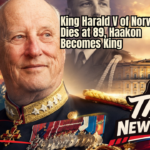
King Harald V of Norway has died at age 89 after a 35-year reign.
Norway’s longtime monarch, King Harald V, has died at age 89, bringing an end to a reign that spanned more than three decades and triggering an immediate transition to his son, King Haakon VIII.
OSLO, Norway — King Harald V of Norway died Friday, August 28, 2026, at the age of 89, according to an announcement from the Norwegian Royal Court.
The palace said Harald died peacefully at Oslo University Hospital Rikshospitalet at 6:35 a.m. local time.
His death closes a remarkable chapter in modern Norwegian history. Harald had served as king since 1991 and was Europe’s oldest reigning monarch at the time of his death.
King Harald’s Health Had Deteriorated
The announcement followed a serious decline in Harald’s health.
The Royal Court announced on August 23 that the king was receiving antibiotics for a bacterial bloodstream infection. By Thursday, August 27, palace officials described his condition as “very serious.” Crown Prince Haakon had already assumed duties as regent while his father remained hospitalized.
Queen Sonja and other members of the royal family had canceled engagements as his condition worsened.
The palace confirmed his death the following morning.
From Wartime Exile to the Norwegian Throne
Harald’s life stretched across some of the defining moments of modern European history.
Born on February 21, 1937, Harald was just a child when Nazi Germany invaded Norway in 1940. Members of the royal family fled the country, and Harald spent part of World War II living in the United States.
Decades later, he would become the country’s king.
Harald ascended the throne following the death of his father, King Olav V, in January 1991. Over the next 35 years, he helped shape a more modern and accessible Norwegian monarchy.
His personal life had already challenged royal convention.
Harald fell in love with Sonja Haraldsen, a commoner, but their relationship faced resistance because she wasn’t of royal or noble birth. Harald reportedly made clear that he would not marry anyone else.
The couple ultimately married in 1968.
Sonja became Queen of Norway when Harald took the throne.
An Olympic Athlete Before Becoming King
Harald also built an unusual sporting résumé for a future monarch.
A passionate sailor, he represented Norway at three Olympic Games — in 1964, 1968 and 1972 — and carried Norway’s flag during the opening ceremony of the 1964 Tokyo Olympics.
That connection to sports remained an important part of his public identity throughout his life.
Harald developed a reputation for being approachable and relatively informal compared with the traditional image of European royalty. Reuters described him as a reform-minded monarch whose warmth and down-to-earth personality helped him remain popular for much of his reign.
A King Who Led Norway Through Tragedy
One of the defining moments of Harald’s reign came after the July 22, 2011 terrorist attacks in Oslo and on Utøya island, which killed 77 people.
The king became an important symbol of national unity during the country’s mourning.
That ability to serve as a stabilizing figure during tragedy became a central part of Harald’s legacy.
He also increasingly spoke publicly about tolerance, inclusion and what it meant to be Norwegian as the country became more diverse.
King Haakon VIII Takes the Throne
Norway did not have to wait for a coronation or separate ceremony to receive its next monarch.
Upon Harald’s death, his son Crown Prince Haakon automatically became King Haakon VIII.
Haakon, 53, had increasingly represented the monarchy in recent years as his father’s health declined. He had served as regent on several occasions and was already performing that role during Harald’s final hospitalization.
His wife, Mette-Marit, is now Queen Mette-Marit.
Their 22-year-old daughter, Ingrid Alexandra, becomes Crown Princess Ingrid Alexandra and heir to the Norwegian throne.
King Haakon has adopted the historic royal motto “All for Norway,” continuing a tradition associated with previous generations of the royal family.
A New Era for Norway’s Royal Family
The transition arrives during a challenging period for the Norwegian monarchy.
The royal family has faced intense scrutiny in recent years involving several members of the extended family. Public support for the institution has also weakened from previous highs, meaning Haakon inherits more than simply his father’s ceremonial responsibilities.
He now faces the task of defining what Norway’s monarchy looks like for another generation.
Norway is a constitutional monarchy, meaning political authority rests with its democratically elected government and parliament. The monarch nevertheless remains an important ceremonial head of state and national symbol.
Norwegian tradition also means there will not be a British-style coronation. The royal transition instead includes constitutional and ceremonial events involving the government and parliament.
Tributes Pour In for King Harald
Tributes began arriving from across Europe and around the world within hours of Harald’s death.
Norwegian Prime Minister Jonas Gahr Støre remembered the king’s contribution to national unity, while Britain’s King Charles, Ukrainian President Volodymyr Zelenskyy, European Commission President Ursula von der Leyen and other international leaders praised Harald’s decades of service.
Royal families across Scandinavia also paid tribute to a monarch who had been one of Europe’s longest-serving heads of state.
For Norway, however, the loss is considerably more personal.
Millions of Norwegians have known only Harald as their king.
He occupied the throne through the end of the Cold War, the rise of the internet, September 11, the 2011 Norway attacks, the COVID-19 pandemic and profound social and technological changes across Europe.
Now, after 35 years under King Harald V, Norway enters a new era.
King Harald V: February 21, 1937 – August 28, 2026.
King Haakon VIII’s reign has begun.
About the Author