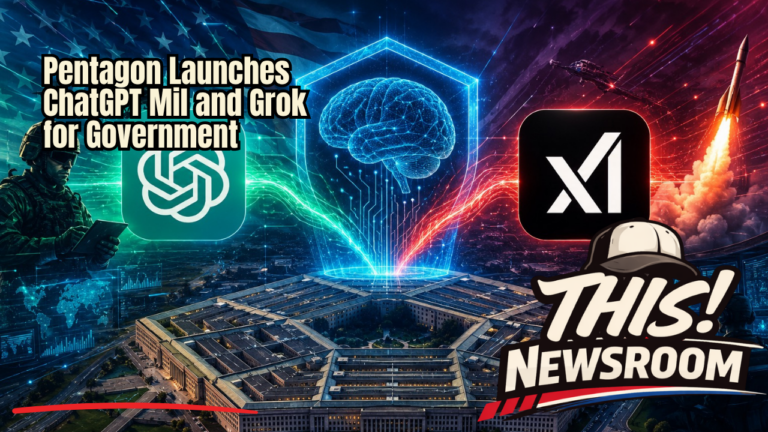
The Pentagon is expanding GenAI.mil with ChatGPT Mil and Grok for Government as generative AI becomes part of the military's daily workflow.
By This Newsroom | September 1, 2026
Artificial intelligence has officially moved deeper inside the Pentagon.
The U.S. military has added customized versions of ChatGPT and Grok to its secure government AI environment. As a result, military members and civilian personnel now have more choices for using generative AI at work.
The Pentagon calls the new systems ChatGPT Mil and Grok for Government. Both joined GenAI.mil, the Pentagon’s centralized generative AI platform, on August 31. Google’s Gemini was already available through the system.
However, this rollout goes far beyond giving government employees access to the same chatbots consumers use every day.
Instead, the Pentagon has created a protected environment for AI tools that can support sensitive government work.
What Is ChatGPT Mil?
ChatGPT Mil brings a familiar ChatGPT experience into the Pentagon’s secure technology infrastructure.
The platform includes tools for chat, files, projects and custom GPTs. In addition, the Pentagon expects to expand its capabilities over time.
Personnel can use the technology for document-heavy, unclassified military work. For example, it could assist with planning, logistics, policy and administrative tasks.
Importantly, the system can handle Controlled Unclassified Information at Impact Level 5.
Therefore, ChatGPT Mil offers something very different from simply visiting the public version of ChatGPT on a government computer.
OpenAI also says information processed through GenAI.mil remains inside the government environment. Furthermore, the company says it does not use that information to train or improve its public and commercial models.
Consequently, military personnel could use the system to analyze documents, prepare reports and review procurement materials. They could also create compliance checklists or assist with research and planning.
Grok Is Joining the Pentagon Too
ChatGPT isn’t arriving alone.
The Pentagon also added Grok for Government to GenAI.mil.
The technology comes from Elon Musk’s xAI and expands the military’s growing collection of generative AI tools.
Potential uses include acquisition research, supply-chain management and collaboration. Additionally, personnel could use Grok for other support functions that improve productivity.
The larger story, however, involves the Pentagon’s multi-model AI strategy.
Rather than relying on one artificial intelligence company, the department can provide access to several major models.
As a result, personnel may choose different AI systems depending on the task.
For example, one model might perform better for research. Another could excel at writing or analyzing large amounts of text.
That flexibility could become increasingly important as AI models develop different strengths.
Google Gemini Was Already Inside
GenAI.mil itself isn’t new.
The Pentagon launched the platform in late 2025 with Google’s Gemini as its initial AI offering.
Since then, adoption has grown quickly.
According to the Pentagon, GenAI.mil has already onboarded more than 1.7 million unique users. The broader military and civilian workforce includes roughly 3 million people.
Now, the addition of ChatGPT and Grok changes the platform significantly.
Instead of operating primarily as a single-model AI environment, GenAI.mil is becoming something closer to an internal AI marketplace.
Therefore, the question is no longer simply whether the military will use generative AI.
Increasingly, the question is which AI model personnel will use for each job.
This Doesn’t Mean ChatGPT Is Running Weapons
There is an important distinction.
The current rollout primarily targets workplace productivity and support functions. It does not mean the Pentagon has handed battlefield decisions to ChatGPT or Grok.
Instead, the immediate applications look much more familiar.
Personnel can use AI for research, writing, planning, logistics and document analysis. They can also use it for procurement and administrative work.
Still, those applications could have a major impact.
The U.S. military operates at an enormous scale. Therefore, even small productivity improvements could save significant amounts of time across the organization.
For example, AI could help personnel summarize lengthy documents in minutes. It could also accelerate research and reduce repetitive administrative work.
Ultimately, those efficiencies could allow employees to spend more time on higher-value tasks.
Why This Is Bigger Than Another Government Software Contract
For years, technology leaders have discussed how generative AI could eventually transform government.
Now, that transition is happening.
When an organization with roughly three million personnel provides secure access to several frontier AI models, artificial intelligence stops looking like an experiment.
Instead, it starts becoming part of the workplace.
Meanwhile, governments around the world continue investing heavily in AI.
They see potential applications in cybersecurity, logistics, intelligence analysis, manufacturing and research. National defense could become another major area of development.
However, deploying AI effectively will require more than access to powerful models.
Governments must also focus on security, reliability and human oversight.
The countries that successfully combine those elements could gain meaningful operational advantages.
The AI Arms Race Is Becoming an AI Infrastructure Race
There is another important part of this story.
America’s largest AI companies aren’t competing only for consumers anymore.
Increasingly, they are competing to become essential infrastructure.
OpenAI, Google and xAI are positioning their technologies for governments, corporations and other large organizations.
Meanwhile, the Pentagon’s strategy suggests it may not want a single winner.
Instead, it wants access to multiple AI platforms.
That approach could eventually become common across corporate America as well.
Large organizations may provide employees with several secure AI models. Then, workers could select the best system for each assignment.
In other words, the future of workplace AI may look less like choosing one platform and more like building an entire AI toolbox.
THIS NEWSROOM TAKE
The most important part of this announcement isn’t simply that the Pentagon now has ChatGPT.
It’s that artificial intelligence is becoming normal inside one of the world’s largest and most consequential organizations.
We’re rapidly leaving the era of asking, “Should employees use AI?”
Instead, organizations are beginning to ask, “Which AI should employees use?”
ChatGPT Mil, Grok for Government and Gemini now sit within the same Pentagon AI ecosystem.
Together, they represent a significant shift in how large institutions may approach artificial intelligence.
For the Pentagon, AI is no longer sitting outside the gates.
It’s becoming part of the daily workflow.
About the Author