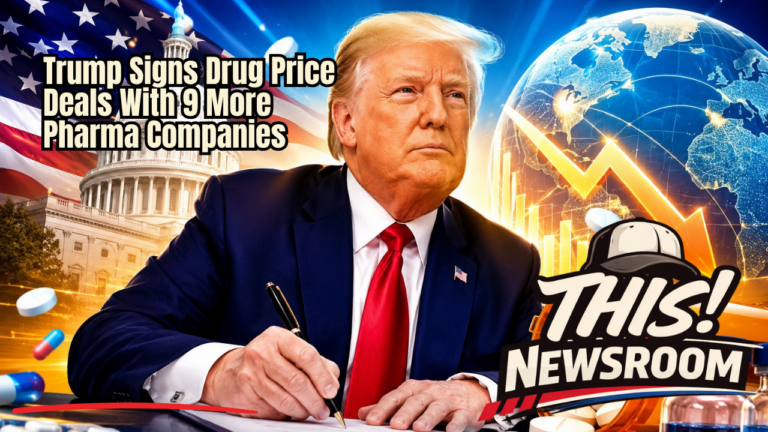
President Donald Trump is expanding his administration's push to reduce prescription-drug prices through agreements with additional pharmaceutical manufacturers.
WASHINGTON, D.C. — President Donald Trump announced a new round of agreements with nine pharmaceutical manufacturers Monday, expanding his administration’s effort to bring U.S. prescription-drug prices closer to the lower prices paid in other developed countries.
The August 31 agreements bring the number of pharmaceutical manufacturers participating in the administration’s “Most-Favored-Nation,” or MFN, pricing initiative to 26 companies, according to the White House. The administration says those companies represent approximately 89% of the branded prescription-drug market.
The nine companies joining the initiative are Alcon, Astellas Pharma, BeOne Medicines, BridgeBio, CSL, Kyowa Kirin, Sun Pharma, Teva Pharmaceuticals and UCB.
It represents another major expansion of one of Trump’s signature second-term healthcare initiatives.
What Is “Most-Favored-Nation” Drug Pricing?
The basic concept behind the policy is straightforward: Americans should not routinely pay substantially more for the same medicines than patients in other wealthy countries.
Under the administration’s MFN framework, participating manufacturers agree to provide certain U.S. purchasers with prices tied to lower prices available in other developed nations.
The latest agreements will give every state Medicaid program access to MFN pricing on products made by the nine participating companies, according to the White House. The agreements also establish MFN pricing commitments for new innovative medicines those manufacturers bring to the U.S. market.
That could affect treatments across a wide range of conditions.
The White House says medicines covered by the agreements include drugs used for hemophilia, Parkinson’s disease, macular degeneration, glaucoma, liver disease, skin conditions and several forms of cancer.
TrumpRx Is Part of the Strategy
The administration’s drug-pricing strategy extends beyond Medicaid.
Earlier this year, the White House launched TrumpRx.gov, a government platform designed to connect Americans with discounted prices on participating brand-name medicines. The program initially launched with medicines from AstraZeneca, Eli Lilly, EMD Serono, Novo Nordisk and Pfizer, with additional participating manufacturers expected to be added.
That direct-to-consumer component could be particularly significant for Americans who pay cash for medications or face high out-of-pocket costs.
Trump said Monday that the agreements announced by his administration are projected to produce more than $600 billion in savings, although the ultimate savings realized by patients, Medicaid programs and the healthcare system will depend on implementation and the specific drugs purchased.
Pharmaceutical Companies Also Commit Billions to U.S. Manufacturing
There is another major component to the agreements that goes beyond prescription prices.
The nine manufacturers have collectively committed to invest at least $19.6 billion in U.S. pharmaceutical manufacturing in the near term, according to the White House.
Several companies are also contributing active pharmaceutical ingredients to the federal government’s Strategic Active Pharmaceutical Ingredients Reserve, an effort intended to strengthen domestic medical supply chains and reduce American dependence on foreign sources during emergencies.
The combination of lower-price commitments and domestic investment ties the administration’s healthcare policy to its broader manufacturing and trade agenda.
But How Much Will Americans Actually Save?
That’s the question that ultimately matters.
While the administration is promoting the agreements as a major breakthrough, important details about individual contracts and exactly how savings will flow through the healthcare system have not all been made public.
Reuters reported that details surrounding several of the agreements remain limited. Critics have also questioned how much of the decline in prescription-drug costs can specifically be attributed to the MFN agreements versus other factors, including competition and previously enacted Medicare drug-price negotiations.
The pharmaceutical industry has also pushed back against tying American prices directly to prices negotiated by foreign governments, arguing that such policies can affect investment and pharmaceutical innovation.
That means the success of Trump’s program ultimately won’t be measured by the number of companies signing agreements.
It will be measured at the pharmacy counter.
26 Drugmakers Are Now Participating
The latest announcement nevertheless demonstrates how quickly the administration has expanded the program.
Earlier MFN agreements included some of the biggest names in global pharmaceuticals. By April, the administration had reached its 17th agreement, with Regeneron joining the program.
Now nine additional manufacturers have signed on, taking the total to 26.
For millions of Americans frustrated by the price of prescription medicine, that is an important development — but one that deserves to be watched closely as the actual discounts reach Medicaid programs and consumers.
The administration has set an ambitious goal: make Americans stop paying dramatically higher prices for medicines than patients overseas.
With nearly nine-tenths of the branded drug market now represented in its agreements, the White House can argue that its MFN initiative has moved from an experiment involving a handful of manufacturers into a significant part of federal drug-pricing policy.
The next test is whether Americans see the difference in their wallets.
The Bottom Line
Trump’s latest agreements add nine pharmaceutical manufacturers, bringing the MFN program to 26 companies covering roughly 89% of the branded drug market. The deals extend discounted pricing to state Medicaid programs, establish pricing commitments for future medicines and come alongside at least $19.6 billion in announced U.S. manufacturing investment.
For the administration, it’s another significant step in its attempt to restructure how America pays for prescription drugs.
For patients, however, the most important number isn’t 26 companies or billions of dollars in projected savings.
It’s the number on the prescription receipt.
About the Author