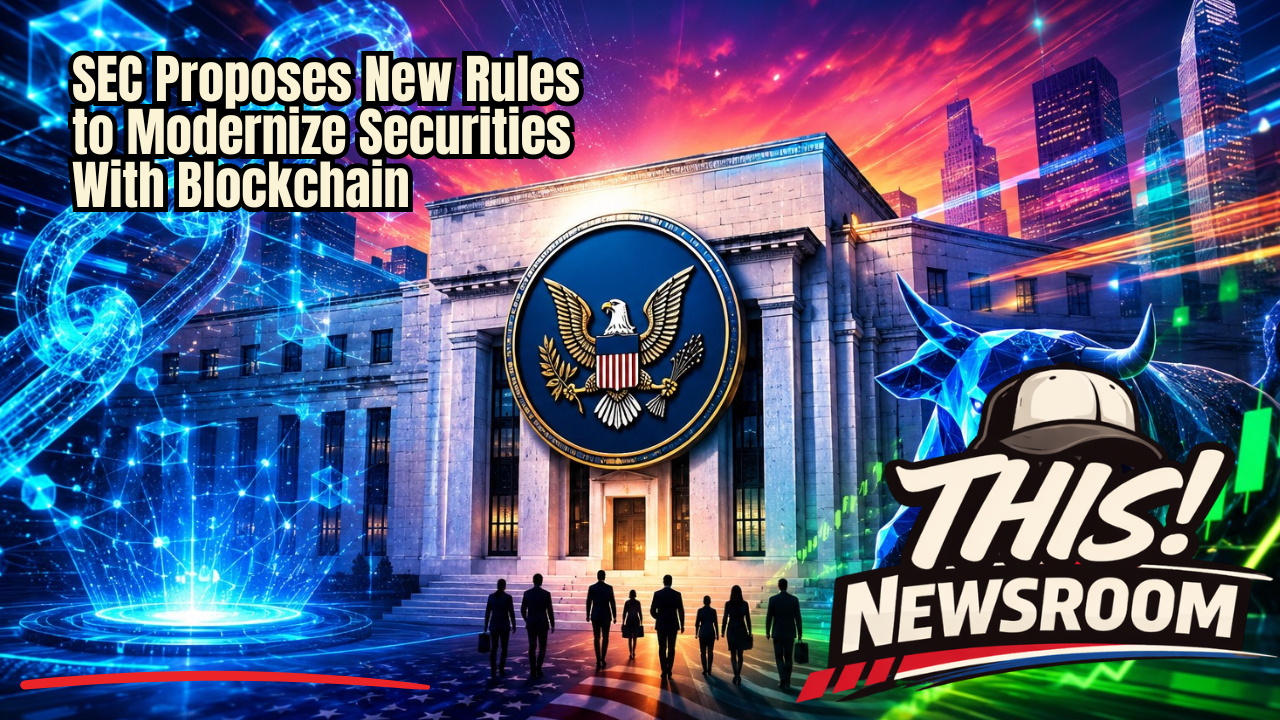
The SEC is proposing updated securities rules that recognize blockchain technology as Wall Street explores tokenized assets and digital financial infrastructure.
The U.S. Securities and Exchange Commission is moving to modernize a decades-old piece of America’s financial infrastructure, proposing new rules that explicitly recognize electronic communications, digital recordkeeping and blockchain technology.
The proposal targets registered transfer agents, firms that operate largely behind the scenes but perform a critical function in financial markets. They maintain ownership records, process transfers and help ensure securities move correctly between issuers and investors.
The SEC says many of the rules governing these firms have not received a substantive overhaul since the late 1970s and early 1980s.
Now, the agency wants the regulatory framework to catch up with the technology transforming financial markets.
“This proposal would streamline and modernize the Commission’s rules to reflect transfer agents’ current processes and operations, including the use of electronic communications and blockchain technology in connection with securities offerings and the transfer of shares,” SEC Chairman Paul S. Atkins said.
That reference to blockchain could prove particularly significant.
Why Transfer Agents Matter
Most investors rarely think about transfer agents.
However, they form an important part of the infrastructure connecting public companies, shareholders, brokers and the broader securities settlement system.
Transfer agents help maintain accurate records of who owns securities. They also facilitate transfers and perform other administrative functions necessary for markets to operate.
The problem is that the rules governing those activities were largely written for another era.
SEC Commissioner Mark Uyeda noted that roughly four decades have passed since the Commission last significantly updated its transfer-agent framework. Meanwhile, electronic records, online communications and new financial technologies have fundamentally changed the industry’s operations.
The SEC’s proposal would amend existing rules and forms, introduce new requirements and eliminate at least one existing rule.
Blockchain Enters the Regulatory Conversation
The biggest headline may be the SEC’s explicit recognition of blockchain.
Blockchain technology can create digital records of ownership and facilitate the transfer of assets without relying entirely on traditional recordkeeping systems.
In financial markets, that opens the door to tokenized securities.
A tokenized security essentially represents a traditional security through a crypto asset or blockchain-based record. The underlying investment may still represent something familiar, such as stock, but ownership can be recorded or represented through a crypto network.
Earlier this year, SEC staff described tokenized securities as financial instruments where ownership records are maintained, at least partly, through one or more crypto networks.
The concept is no longer theoretical.
The SEC has already handled exchange proposals involving securities traded in tokenized form. Meanwhile, financial institutions and exchanges around the world are experimenting with blockchain-based trading and settlement systems.
Could Stocks Eventually Move Onchain?
That is where this story becomes much larger than a technical regulatory update.
Commissioner Hester Peirce raised the question directly when discussing the proposal: What happens to transfer agents as securities move onchain?
She also questioned whether traditional requirements should evolve to recognize identifiers such as digital-wallet addresses rather than relying exclusively on names and physical addresses.
Those questions point toward a potential transformation of market infrastructure.
Today’s securities markets involve layers of brokers, clearing organizations, custodians, transfer agents and settlement systems.
Blockchain technology could potentially automate portions of that infrastructure.
Instead of ownership information passing through numerous databases, a blockchain-based system could maintain a shared digital record.
The technology could eventually support faster settlement, greater automation and new forms of trading. However, regulators would still need to address investor protection, cybersecurity, operational resilience, privacy and market integrity.
The SEC’s Broader Crypto Shift
The transfer-agent proposal isn’t happening in isolation.
On August 18, the SEC proposed a separate framework called Regulation Crypto Assets, designed to create clearer rules for certain investment contracts involving crypto assets.
That proposal includes registration exemptions for some crypto-related offerings and a conditional safe harbor addressing when a crypto asset would no longer remain subject to an investment contract.
Earlier in 2026, the SEC also issued guidance explaining how federal securities laws apply to certain crypto assets and transactions.
Taken together, the developments suggest a broader regulatory transition.
Rather than treating blockchain and crypto exclusively as technologies operating outside conventional finance, regulators increasingly have to determine how they fit inside the existing financial system.
Tokenization Could Become a Major Wall Street Trend
Tokenization could ultimately extend far beyond cryptocurrencies.
Stocks, bonds, funds, real estate interests and other financial assets could potentially exist as blockchain-based tokens.
That does not necessarily mean traditional exchanges or financial institutions disappear.
Instead, blockchain could become another technological layer underneath them.
The London Stock Exchange Group, for example, recently announced plans involving tokenized UK shares and a new 24-hour trading venue expected to launch in 2027, subject to regulatory approval.
The important distinction is that tokenization is not the same thing as cryptocurrency speculation.
A tokenized share can still represent a regulated financial instrument. Blockchain simply changes how that ownership may be recorded, transferred or settled.
What This Could Mean for Investors
For everyday investors, nothing changes immediately.
The SEC has issued a proposal, not a final rule.
The agency’s transfer-agent proposal was issued September 1 under file number S7-2026-30. A public comment period will remain open for 60 days following publication in the Federal Register.
Still, the direction deserves attention.
If regulators establish rules that allow blockchain infrastructure to coexist with conventional securities markets, tokenization could accelerate rapidly.
Investors could eventually encounter markets with longer trading hours, faster settlement and financial products that seamlessly move between traditional and blockchain-based infrastructure.
The changes would likely happen gradually rather than overnight.
The Bigger Picture
For years, one of the central debates surrounding blockchain was whether traditional finance would eventually adopt the technology.
That question may be changing.
The more relevant question now could be how much of traditional finance eventually moves onto blockchain infrastructure.
The SEC’s latest proposal doesn’t put the stock market onchain tomorrow. It does something more fundamental: it acknowledges that regulations written roughly four decades ago need to accommodate a financial system increasingly shaped by electronic records, digital communications and blockchain.
Wall Street’s blockchain era may not arrive with Bitcoin replacing the stock market.
It could arrive much more quietly — with the infrastructure underneath stocks, bonds and other securities gradually becoming digital, programmable and potentially onchain.
And that could ultimately represent one of blockchain technology’s most consequential applications yet.
Sources
SEC — Transfer Agent Rules proposal
SEC — Announcement on modernizing transfer-agent rules
SEC — Statement on Tokenized Securities
SEC — Regulation Crypto Assets proposal
About the Author