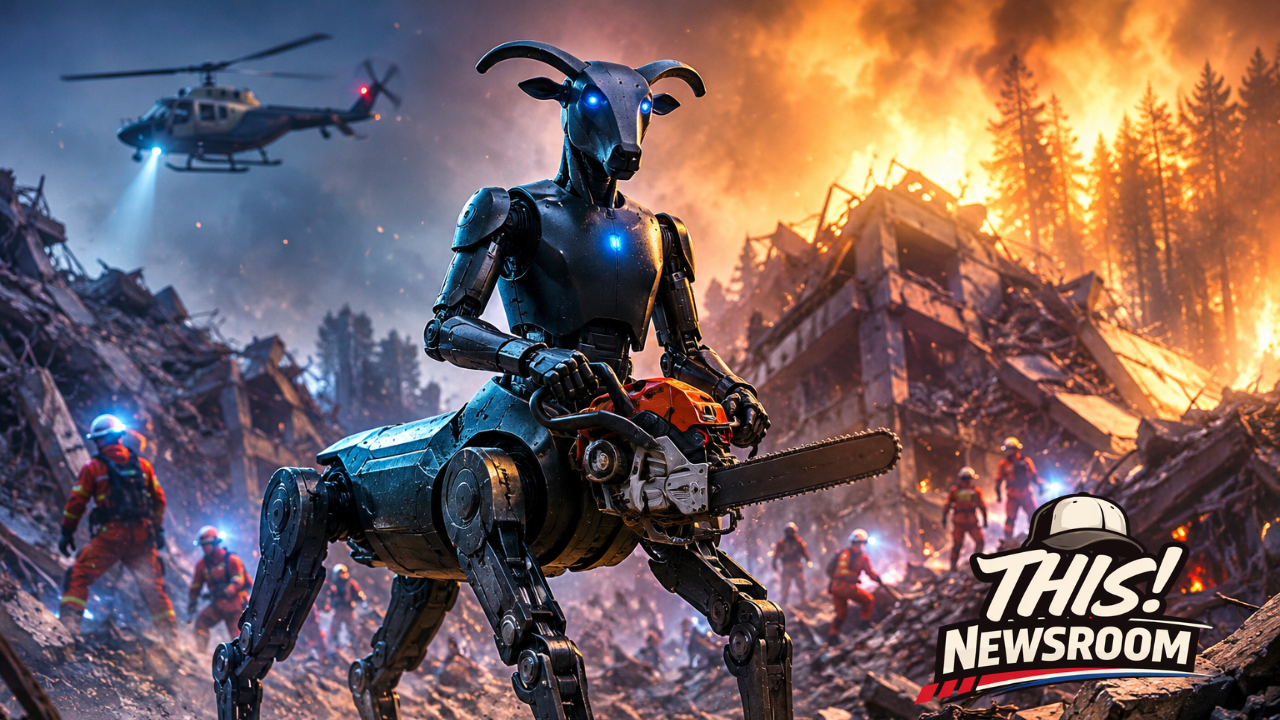
Satyress' ThreeHalves robot is designed to help emergency responders operate safely in hazardous environments.
When disaster strikes, first responders often have to make impossible decisions—enter dangerous terrain or risk leaving survivors behind. A new robotic platform under development by U.S.-based startup Satyress hopes to change that.
Dubbed ThreeHalves, the machine combines the upper body of a humanoid robot with the stability and mobility of a four-legged robotic platform, creating what many are calling a real-world “centaur robot.”
Designed for Places Humans Shouldn’t Go
Unlike traditional wheeled robots that struggle over rubble or humanoid robots that can lose balance in unstable environments, ThreeHalves is designed specifically for extreme conditions.
Its intended missions include:
- Searching collapsed buildings after earthquakes
- Assisting firefighters during wildfires
- Operating in chemically contaminated areas
- Exploring unstable industrial accident sites
- Supporting search-and-rescue teams in hazardous terrain
The four-legged base allows it to navigate uneven ground while maintaining stability, while the humanoid upper body can manipulate tools designed for humans.
Why a Centaur Design?
Rather than attempting to perfectly imitate human walking, Satyress chose a hybrid approach.
The lower body provides:
- Superior balance
- Greater carrying capacity
- Better endurance over rough terrain
Meanwhile, the humanoid torso enables the robot to:
- Operate power tools
- Open doors
- Move debris
- Handle equipment already used by emergency crews
The combination gives responders a machine capable of both mobility and dexterity.
Built for Dangerous Jobs
One image released by the company shows the robot carrying a chainsaw—highlighting one of its intended use cases.
Instead of sending firefighters into unstable forests immediately after a blaze or rescue workers into collapsing structures, robots like ThreeHalves could perform the initial assessment, clear obstacles, or remove hazards before humans enter.
That could significantly reduce injuries among emergency personnel.
Part of a Bigger Robotics Trend
ThreeHalves joins a growing wave of specialized robots entering real-world service.
Recent advances include:
- Warehouse robots capable of autonomous logistics
- Humanoid manufacturing assistants
- Robotic firefighters
- Search-and-rescue drones
- AI-powered disaster mapping systems
Rather than replacing people, many of these systems are being designed to work alongside human teams in environments that are too dangerous or physically demanding.
Still in Development
The robot remains under development, and many technical details—including deployment timelines, payload capacity, operating duration, and autonomous capabilities—have not yet been publicly disclosed.
Even so, the concept demonstrates how robotics is moving beyond factory floors into some of society’s most challenging and life-saving applications.
If ThreeHalves performs as envisioned, tomorrow’s disaster response teams may include an entirely new kind of first responder—one that’s part human, part quadruped, and built to go where people simply can’t.
Source: Satyress (ThreeHalves development information) and publicly released project materials.
About the Author