OpenAI Says AI Solved an 80-Year-Old Math Problem
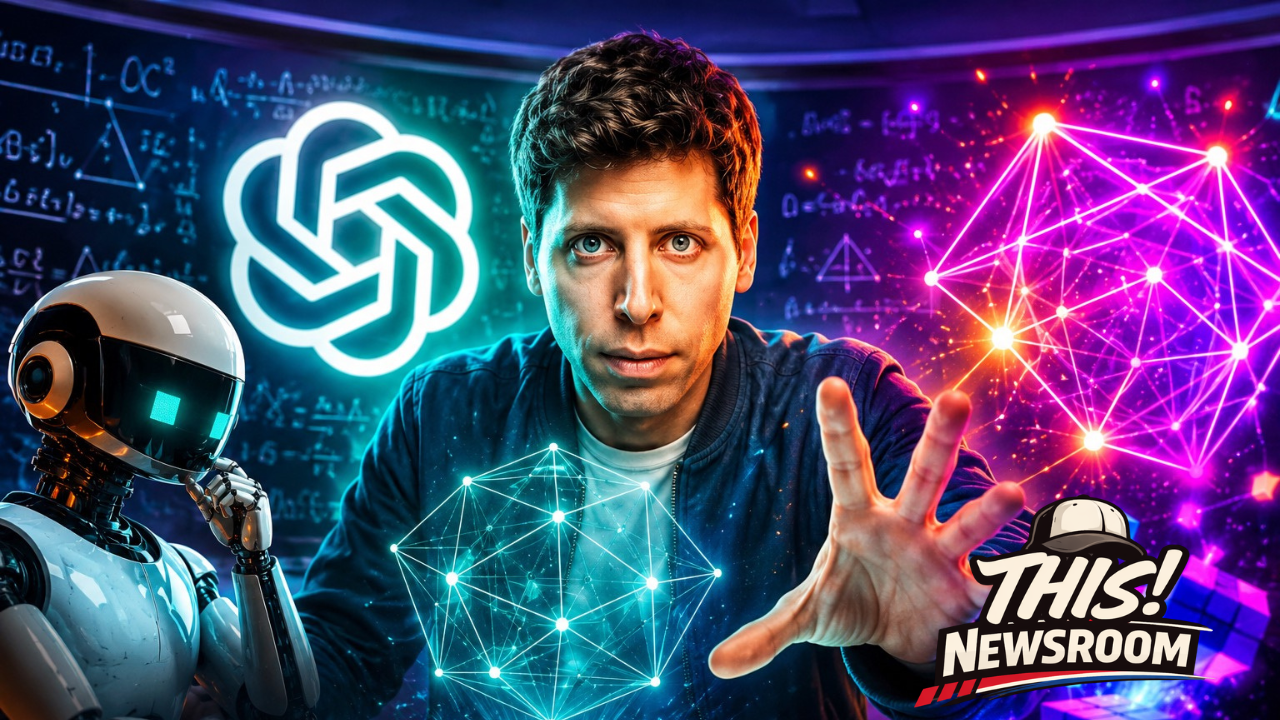
Artificial intelligence may have just crossed another major milestone. According to reports circulating online, an internal OpenAI model reportedly helped solve a complex mathematical problem in discrete geometry that has challenged researchers since 1946. If verified by the broader mathematics community, this could become one of the most significant examples yet of AI contributing to real scientific discovery rather than simply generating text or images.
The claim immediately sparked intense debate across the technology world. Some experts see it as a breakthrough moment similar to AI beating grandmasters in chess or solving protein folding. Others remain cautious, arguing that mathematical proofs require rigorous peer review before the world can celebrate.
Still, the implications are massive.
What Problem Did AI Supposedly Solve?
The reported breakthrough centers around a long-standing problem in discrete geometry, a branch of mathematics focused on geometric structures made from distinct or separate objects. These problems often involve patterns, dimensions, optimization, and relationships between shapes and spaces.
The challenge dates back roughly 80 years and reportedly involved a conjecture mathematicians had struggled to fully prove since the mid-20th century. OpenAI allegedly used one of its advanced internal reasoning models to generate proof strategies and computational insights that helped researchers reach a solution.
While details remain limited, the discussion online suggests the AI did not simply “guess” the answer. Instead, it may have identified novel relationships and logical pathways humans had not previously explored.
That distinction matters.
Modern AI systems increasingly excel at pattern recognition, but mathematics requires layered reasoning, abstraction, and proof verification. If AI genuinely contributed meaningful original reasoning, it could reshape how future research gets done.
Why This Is a Big Deal
For years, critics argued that AI models were essentially advanced autocomplete systems. They could mimic knowledge but not truly reason.
Stories like this challenge that narrative.
If AI systems can assist with unsolved mathematics, scientists may eventually use them to accelerate discoveries in fields such as:
- Physics
- Medicine
- Engineering
- Climate science
- Cryptography
- Material science
Complex problems that once took decades could potentially shrink into years or even months with AI-assisted research.
This also pushes the conversation beyond chatbots and content generation. The future of AI increasingly appears tied to scientific collaboration.
The Skepticism Is Still Real
Not everyone is convinced.
Mathematics operates on proof, precision, and peer validation. Researchers across the academic world will likely spend significant time reviewing the claims before accepting them as legitimate.
AI-generated proofs can also introduce subtle logical errors. In recent years, several AI systems have produced convincing but flawed mathematical reasoning. That means human mathematicians still play a critical role in verification.
There is also the question of transparency. OpenAI has not publicly released every detail behind its most advanced models, which leaves some researchers uneasy about reproducibility and independent validation.
In other words, excitement is high, but so is caution.
AI Is Moving Faster Than Most People Realize
Whether this specific claim holds up long term or not, one thing is undeniable: AI development is accelerating rapidly.
Over the past few years, artificial intelligence has evolved from generating funny images and writing emails to assisting programmers, creating films, designing products, and now potentially contributing to frontier-level mathematics.
That pace has many industries scrambling to adapt.
Tech companies continue pouring billions into AI infrastructure because they believe these systems may eventually become foundational tools for nearly every profession. Education, finance, healthcare, and research institutions are already beginning to restructure around AI integration.
And this latest story only fuels the belief that we are still in the early innings.
What Happens Next?
The next step will likely involve peer review and deeper scrutiny from mathematicians around the world. If the proof withstands examination, OpenAI’s role in the discovery could become a landmark moment in AI history.
If flaws emerge, the event still demonstrates how close AI systems are getting to higher-order reasoning tasks once considered uniquely human.
Either way, the conversation has changed.
The question is no longer whether AI can assist humans creatively or operationally. The question is how far AI can push into discovery, innovation, and scientific reasoning itself.
And honestly, that might be the part that makes people the most uncomfortable.
About the Author