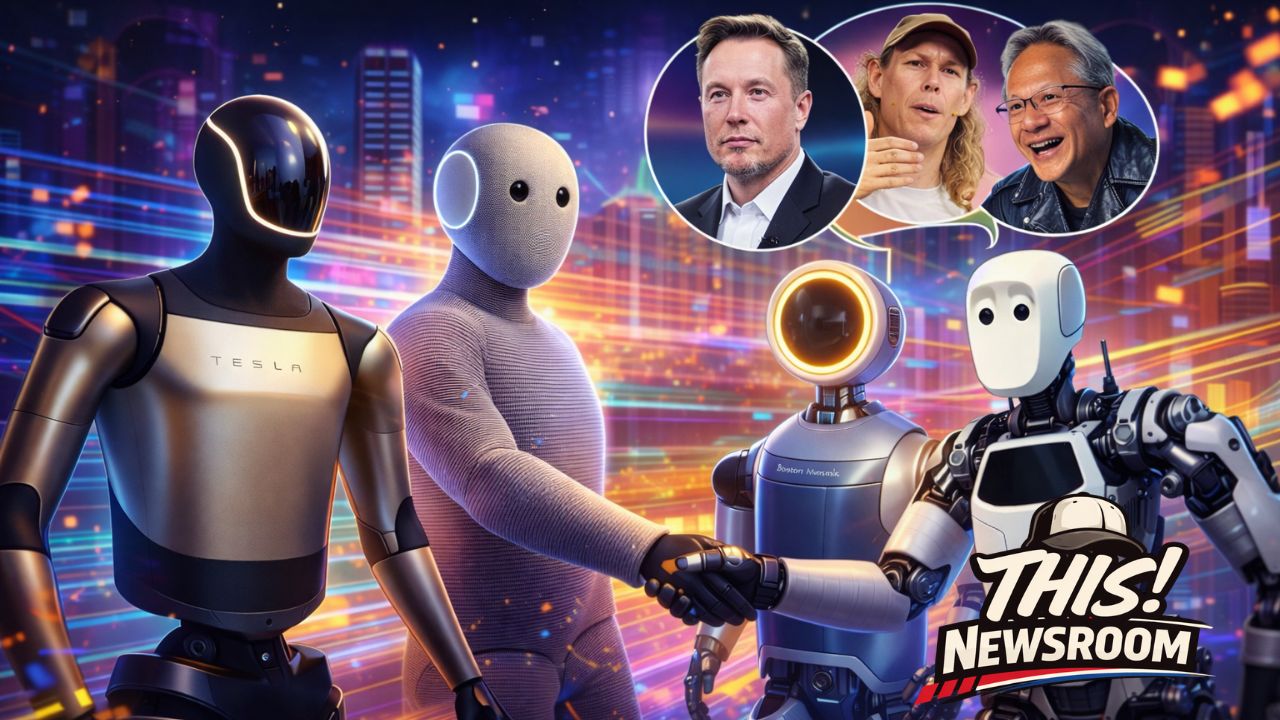
The $10 Trillion Robotics Revolution: Tesla, Boston Dynamics and AI Robots Leading the Future
The robotics revolution is no longer a distant idea. Instead, it is happening right now. Across the world, companies are building humanoid robots that can walk, learn, and work alongside humans. As a result, experts now believe the robotics industry could grow into a $10 trillion global market.
Artificial intelligence, advanced sensors, and machine learning are accelerating this shift. Consequently, robots are moving beyond factories and entering warehouses, hospitals, and even homes.
Several companies are leading this transformation. Most notably, Tesla, Boston Dynamics, Apptronik, and 1X Technologies are developing the next generation of humanoid robots.
Let’s take a closer look at the companies driving the robotics revolution.
1X Technologies: Bringing Robots Into the Home
First, Norwegian robotics company 1X Technologies is pushing robots into everyday life. The company designed its humanoid robot NEO to operate inside homes and human environments.
Unlike traditional industrial robots, NEO focuses on helping people with daily tasks. For example, the robot can assist with household chores, carry objects, and support elderly residents.
Investors have taken notice. As a result, the company recently reached an estimated $10 billion valuation.
Furthermore, 1X continues to refine its AI systems to improve safety and reliability. Ultimately, the company hopes to make home robots as common as smartphones.
Tesla’s Optimus: The Most Ambitious Robot Project
Meanwhile, Tesla is taking an even bigger swing at the robotics market.
Tesla CEO Elon Musk introduced the humanoid robot Optimus as part of the company’s long-term vision. Tesla believes its expertise in artificial intelligence and manufacturing gives it a major advantage.
Initially, Optimus will work in Tesla factories. For instance, the robot can perform repetitive or dangerous tasks that currently require human labor.
However, Musk has hinted at a much bigger future. Eventually, Tesla hopes to deploy humanoid robots in homes, offices, and service industries.
Tesla currently carries a market valuation of roughly $1.56 trillion. Therefore, if Optimus succeeds, the robot could become one of the company’s most valuable products.
Apptronik: Solving the Global Labor Shortage
At the same time, Texas-based robotics company Apptronik is developing humanoid robots designed for the workforce.
Its flagship robot, Apollo, targets industries that face severe labor shortages. In particular, warehouses, logistics centers, and manufacturing plants struggle to fill physically demanding jobs.
Apollo robots aim to solve that problem.
For example, these machines can lift packages, move inventory, and assist human workers. Because of this, companies can increase efficiency without replacing entire workforces.
Apptronik currently carries an estimated valuation of around $5 billion.
Moreover, the company continues to expand partnerships with major logistics and technology firms.
Boston Dynamics: The Robotics Pioneer
Meanwhile, Boston Dynamics remains one of the most advanced robotics companies in the world.
For years, the company has pushed the limits of robotic movement and intelligence. Its humanoid robot Atlas can run, jump, balance, and manipulate objects with incredible precision.
As a result, Boston Dynamics has built a reputation for producing some of the most capable robots ever created.
The company’s robots already serve several industries, including:
• Construction
• Manufacturing
• Industrial inspection
• Research and defense
Boston Dynamics currently holds an estimated valuation of around $25 billion.
Why Robotics Could Become a $10 Trillion Industry
Several major trends are fueling the robotics boom.
First, global labor shortages are increasing. Many developed countries now face aging populations and declining birth rates. Consequently, businesses are searching for automated solutions.
Second, artificial intelligence is improving rapidly. AI allows robots to understand environments, recognize objects, and perform complex tasks.
Third, automation increases efficiency. Companies can lower costs and improve productivity by using robotic workers.
Finally, consumer robotics is expanding. Robots are starting to appear in homes, hospitals, restaurants, and retail environments.
Together, these trends are driving massive investment in robotics technology.
The Future: Robots Everywhere
The robotics revolution is still in its early stages. However, progress is accelerating quickly.
Within the next decade, humanoid robots could appear in:
• Warehouses
• Hospitals
• Restaurants
• Construction sites
• Private homes
As technology improves, robots will likely become faster, cheaper, and more capable.
Therefore, the robotics industry could soon rival the automotive or smartphone markets.
Final Thoughts
The race to build humanoid robots has officially begun.
Companies like Tesla, Boston Dynamics, Apptronik, and 1X are investing billions of dollars to lead the next technological revolution.
Eventually, robots may become common coworkers in industries across the world.
One thing is clear: the robotics revolution is already underway.
About the Author