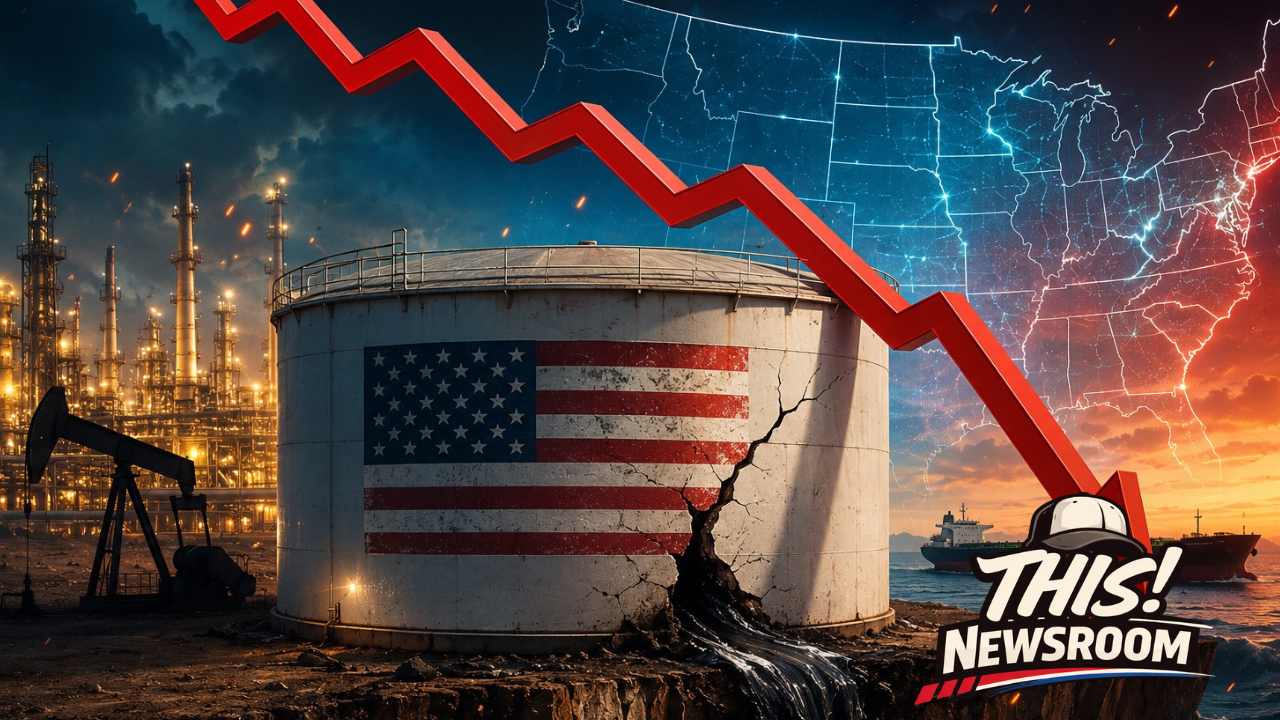
The U.S. Strategic Petroleum Reserve has fallen below 300 million barrels, reaching its lowest level in more than four decades.
America’s emergency oil stockpile has fallen below a threshold the country has not seen in more than four decades.
The U.S. Strategic Petroleum Reserve, better known as the SPR, dropped to approximately 298.7 million barrels, its lowest level since 1983, according to the latest federal data and reporting on the reserve.
That makes the viral claim circulating on social media — including the post pictured above — essentially true.
But the headline alone does not explain why the reserve is falling, how serious the situation is, or what it could eventually mean for American families.
What Is the Strategic Petroleum Reserve?
Think of the SPR as America’s emergency savings account — except instead of cash, it holds crude oil.
Created following the energy crises of the 1970s, the reserve allows the federal government to release oil during severe supply disruptions. The crude is stored primarily in massive underground salt caverns along the Gulf Coast.
For decades, Washington has viewed the stockpile as an important national-security buffer against wars, hurricanes, embargoes and other events capable of interrupting the global flow of oil.
At its historical peak, the SPR held more than 700 million barrels.
Today, it holds less than half that amount.
The SPR Just Fell Below 300 Million Barrels
The latest decline is significant.
The reserve dropped by roughly 6.1 million barrels in the most recent reported week, leaving approximately 298.7 million barrels in storage.
For perspective, EIA historical data show the SPR was still being built rapidly during 1983. It held roughly 300.6 million barrels in January of that year and continued climbing throughout the year.
In other words, the United States has essentially returned to an SPR inventory level last experienced when Ronald Reagan was president, Return of the Jedi was arriving in theaters and the modern commercial internet did not yet exist.
Why Is America’s Oil Reserve Falling?
The immediate reason is straightforward: the government has been releasing emergency barrels.
The latest drawdowns have occurred amid major disruptions to global oil markets associated with the continuing conflict involving Iran and interruptions to Middle Eastern energy supplies.
Before the current conflict escalated, the SPR reportedly contained roughly 415 million barrels.
That means well over 100 million barrels have disappeared from the reserve in a matter of months.
Earlier this summer, the reserve had already fallen to 349.2 million barrels by early June.
By July 10, it had dropped to approximately 316.5 million barrels.
Now it is below 300 million.
The trajectory matters almost as much as the headline number.
Why the Strait of Hormuz Matters
A major reason Washington maintains an emergency petroleum reserve is precisely the kind of geopolitical disruption currently affecting the Middle East.
The Strait of Hormuz represents one of the world’s most important energy chokepoints. Oil and petroleum products from major Gulf producers normally move through the narrow waterway on their way to global markets.
When that flow becomes threatened or disrupted, the consequences can ripple rapidly through energy markets.
Recent uncertainty surrounding the strait has already contributed to substantial volatility in crude prices. Brent crude recently climbed roughly 5% in a single session amid fading hopes for a quick reopening and resolution of the conflict.
That is where America’s shrinking emergency reserve becomes particularly important.
Does This Mean America Is Running Out of Oil?
No.
This distinction is critical.
The Strategic Petroleum Reserve is not America’s entire oil supply.
The United States remains one of the world’s largest oil producers. Commercial companies also maintain hundreds of millions of barrels of crude oil in private inventories.
In fact, commercial U.S. crude inventories jumped by approximately 17.4 million barrels to 424.4 million barrelsduring the week ending August 7, according to EIA data reported Wednesday.
So the United States is not remotely close to “running out of oil.”
The concern is different.
America’s emergency cushion is getting considerably smaller.
Why a Smaller SPR Still Matters
Imagine having $50,000 in emergency savings and then gradually reducing that account to $20,000.
You’re not broke.
You still have income.
You still have assets.
But if another major emergency arrives, you have fewer resources available to absorb the shock.
The same basic principle applies here.
A hurricane could disrupt Gulf Coast production and refining.
Another geopolitical conflict could interrupt additional global supplies.
Major infrastructure damage could affect pipelines, refineries or shipping routes.
And another unexpected international crisis could send crude prices sharply higher.
The lower the SPR falls, the less emergency oil Washington has readily available to respond.
What Could This Mean for Gas Prices?
This is where the story becomes relevant to almost every American household.
Oil prices eventually influence gasoline, diesel, airline fuel, transportation expenses and shipping costs.
Higher transportation expenses can then work their way into the price of groceries, manufactured products and countless other goods.
That doesn’t mean an SPR decline automatically causes gasoline prices to rise.
Oil prices depend on a complicated combination of global production, demand, refinery capacity, inventories, geopolitical risk and financial markets.
However, a smaller emergency reserve gives policymakers less flexibility if another severe supply shock occurs.
And with geopolitical uncertainty already elevated, that vulnerability deserves attention.
There Is Another Important Number: 200 Million Barrels
The headline inventory is approximately 299 million barrels, but not every barrel is necessarily equally available during an emergency.
Reuters reported Thursday that only around 200 million barrels may currently be considered accessible, amid broader concerns about the world’s ability to withstand months of continued oil-market disruption.
That doesn’t mean the remaining oil has vanished.
It highlights an important reality: emergency reserves aren’t simply giant tanks where every barrel can instantly enter the market.
Infrastructure, withdrawal capabilities, crude type, transportation and refinery compatibility all matter.
Global Emergency Inventories Are Being Tested Too
This isn’t exclusively an American problem.
International Energy Agency countries have already released hundreds of millions of barrels as governments attempt to offset disruptions to global supply.
Reuters reports that the IEA has released approximately 400 million barrels, while roughly 1.5 billion barrels remain across participating reserves. However, the amount immediately accessible through government-controlled inventories is considerably smaller.
That makes the duration of the current disruption increasingly important.
Emergency reserves work extremely well as bridges.
They become more difficult to rely upon when the bridge needs to stretch indefinitely.
Can the United States Refill the SPR?
Yes — but rebuilding hundreds of millions of barrels doesn’t happen overnight.
The federal government can purchase crude when market conditions are favorable and gradually replenish the reserve.
There is also an economic calculation involved.
Buying when oil prices are relatively low can potentially save taxpayers money. Trying to aggressively refill the reserve while global prices are elevated could prove considerably more expensive.
Physical infrastructure creates another limitation. Oil has to be purchased, transported and injected into storage facilities at manageable rates.
Rebuilding the SPR could therefore become a multiyear project rather than something Washington can accomplish in a few months.
The Bigger Picture
The SPR falling below 300 million barrels does not mean gas stations are about to run dry.
It does not mean America has run out of oil.
And it does not guarantee another immediate surge in gasoline prices.
What it does mean is that one of America’s most important energy-security buffers has shrunk to a level not seen since 1983.
That deserves attention — particularly while the global energy system is simultaneously dealing with war, disrupted shipping routes, refinery vulnerabilities and geopolitical uncertainty.
America has enormous domestic energy resources and substantial commercial inventories.
But emergency reserves exist for the moments when everything else goes wrong.
And right now, the country’s emergency oil savings account is considerably thinner than Americans have been accustomed to seeing.
The Bottom Line
The social-media headline is real: the U.S. Strategic Petroleum Reserve has fallen below 300 million barrels and is sitting at its lowest level since 1983.
For the average American, there is no reason to panic or rush to the gas station.
The bigger question is what happens next.
If global oil flows stabilize, Washington could eventually begin the long process of rebuilding its emergency stockpile.
If disruptions persist — or another major supply crisis emerges before the SPR can recover — the United States will be confronting that next emergency with a much smaller cushion.
And in an increasingly unpredictable global energy market, that may ultimately be the most important part of this story.
About the Author