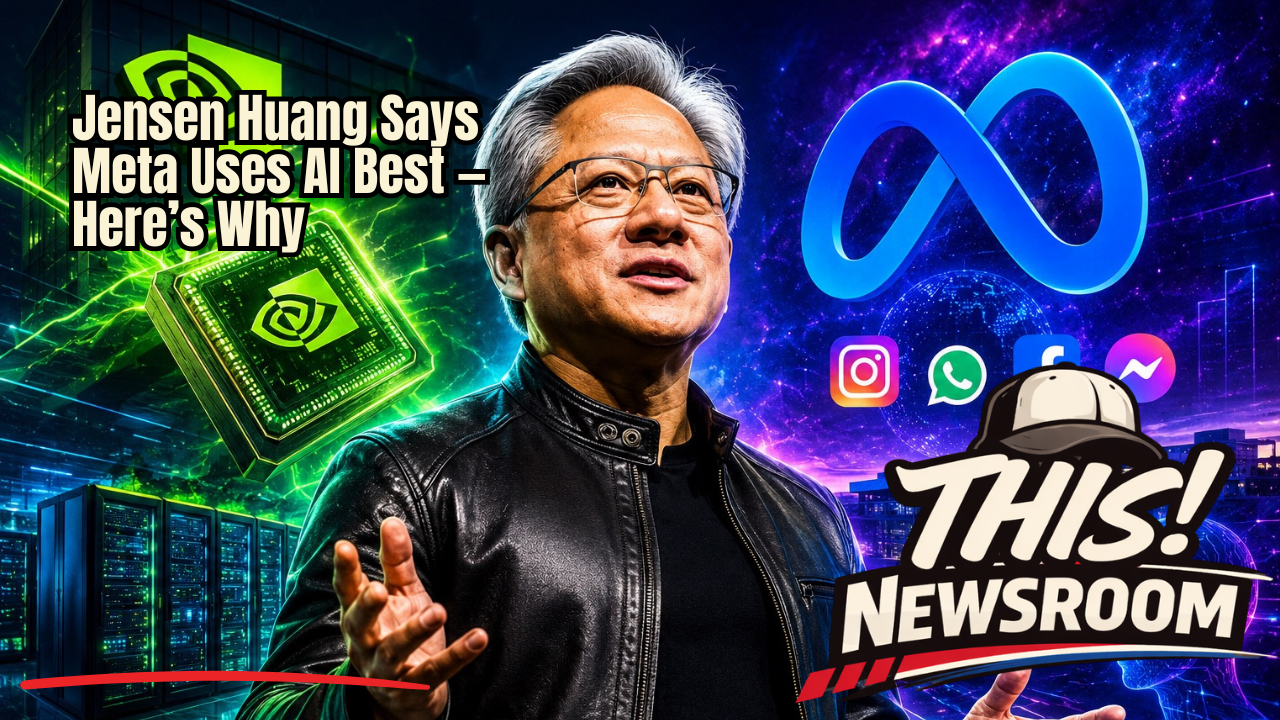
Nvidia CEO Jensen Huang has praised Meta’s ability to deploy artificial intelligence at enormous scale as the company dramatically expands its AI infrastructure.
Meta has spent years trying to convince Wall Street that its enormous artificial intelligence investments will eventually pay off.
Now, the company is getting a major vote of confidence from one of the most influential people in AI.
Nvidia CEO Jensen Huang has offered unusually strong praise for Meta’s deployment of artificial intelligence. In fact, Nvidia and Meta announced a long-term infrastructure partnership earlier this year, with Huang saying that “no one deploys AI at Meta’s scale.”
The praise matters because Nvidia sits at the center of the global AI boom. Its processors power much of the infrastructure being built by Meta, Microsoft, Alphabet, Amazon and the rapidly growing universe of AI companies.
More importantly, Meta isn’t simply experimenting with AI anymore.
It’s rebuilding the company around it.
Meta Is Already Using AI Where It Makes Money
The biggest difference between Meta and many companies chasing the AI boom is that Meta already has an enormous ecosystem where artificial intelligence can immediately be deployed.
That ecosystem includes Facebook, Instagram, WhatsApp, Threads, advertising, recommendation engines, content discovery and Meta AI.
Rather than relying exclusively on a future standalone AI product to justify its spending, Meta can use AI to improve products already serving billions of people. As a result, the company has opportunities to monetize artificial intelligence throughout its existing business.
That strategy appears to be producing results.
Meta reported second-quarter 2026 revenue of $60.8 billion, up 28% year over year. Meanwhile, advertising impressions across its Family of Apps increased 14%, while the average price per advertisement climbed 12%. Meta’s platforms also averaged approximately 3.6 billion daily active people during June.
CEO Mark Zuckerberg summed up the strategy in the earnings announcement: AI is accelerating Meta’s existing business while simultaneously powering its next generation of products.
That’s an important distinction.
Unlike an AI startup, Meta doesn’t necessarily need consumers to suddenly start paying $20 a month for an AI chatbot. Instead, if AI makes Instagram more engaging, Facebook recommendations better and Meta’s advertising system more effective, the technology can generate enormous financial value inside businesses the company already dominates.
The Price Tag Is Staggering
Of course, there is another side to the story.
Meta is spending an almost unbelievable amount of money.
The company now expects 2026 capital expenditures of between $130 billion and $145 billion, including principal payments on finance leases. By comparison, that’s up dramatically from the $72.22 billion Meta spent in 2025.
That money is flowing into Nvidia GPUs and other AI hardware, massive data centers, servers, networking equipment, energy infrastructure, AI researchers, model training and inference capacity.
Additionally, Meta is investing heavily in its broader superintelligence ambitions.
During the second quarter alone, the company spent approximately $31.08 billion on capital expenditures.
However, that level of investment has consequences.
Free cash flow dropped to just $784 million during the second quarter, while costs and expenses jumped 55% year over year. Consequently, investors reacted negatively after the earnings report as concerns grew over how quickly Meta can generate returns from its enormous AI infrastructure investment.
This is no longer a side project.
Instead, it has become one of the largest infrastructure bets in corporate history.
Meta Is Building the Factories of the AI Era
Perhaps the easiest way to understand Meta’s strategy is to stop thinking about AI purely as software.
Increasingly, the AI race looks like an infrastructure race.
Companies capable of acquiring GPUs, securing electricity, constructing data centers and operating enormous computing clusters will have capabilities smaller competitors simply cannot reproduce.
For example, Meta recently announced a venture with BlackRock to develop a new AI data center campus in El Paso, Texas.
The project is expected to provide 1 gigawatt of compute capacity and represents an investment of more than $10 billion from Meta. Furthermore, the company expects to begin bringing capacity online in 2028.
Meta has also emphasized that it prefers designing and operating much of its own AI infrastructure rather than depending entirely on third-party providers.
In other words, Zuckerberg doesn’t want Meta simply renting access to the AI revolution.
He wants the company to own a significant portion of the machinery powering it.
Why Nvidia Loves Meta’s AI Strategy
There is, naturally, an obvious reason Nvidia would be enthusiastic about Meta’s AI ambitions.
Meta is an enormous Nvidia customer.
Under the companies’ multi-year strategic partnership, Nvidia technology will be deployed throughout Meta’s AI-optimized data center infrastructure for training, inference and its existing businesses.
Nevertheless, Huang’s praise is still significant.
Nvidia works with essentially every major player in artificial intelligence. Therefore, the company has unusual visibility into how AI systems are being built and deployed across the industry.
When Nvidia’s CEO highlights Meta’s ability to deploy AI at massive scale, it’s worth paying attention.
Meta also possesses something extremely valuable in the AI race: distribution.
A startup can create an incredible AI model and still face the difficult challenge of attracting hundreds of millions of users. By contrast, Meta already has billions.
An improvement to Instagram’s recommendation system, for instance, can potentially reach users almost immediately. Similarly, an improvement to Meta’s advertising algorithms can affect millions of advertisers.
Meanwhile, an AI assistant integrated across WhatsApp, Facebook and Instagram could achieve distribution that most standalone AI companies can only dream about.
Ultimately, that may be Meta’s biggest advantage.
But Wall Street Has Seen This Movie Before
Investors have good reason to remain skeptical.
After all, Meta has made enormous futuristic bets before.
The company’s multibillion-dollar investment in the metaverse generated tremendous excitement before eventually becoming one of Wall Street’s biggest concerns.
AI, however, looks fundamentally different because it is already affecting Meta’s core advertising and recommendation businesses.
Even so, investors still want evidence that spending hundreds of billions of dollars on computing infrastructure will generate returns large enough to justify the investment.
Meta also faces a particularly interesting challenge because, unlike Microsoft, Amazon and Google, it doesn’t currently operate a giant public-cloud business capable of easily renting excess computing capacity to outside customers.
Therefore, Meta’s bet is more dependent on its own ecosystem.
The upside could be enormous.
At the same time, so could the risk.
Zuckerberg Is Betting on Personal Superintelligence
Meta’s ambitions extend far beyond improving Instagram advertisements.
Increasingly, Zuckerberg has positioned the company’s AI strategy around what he calls personal superintelligence — highly capable AI systems designed to assist individual users across everyday life.
As part of that vision, Meta intends to distribute advanced AI systems broadly while developing personal AI agents capable of reaching billions of people and businesses.
If that strategy works, the company could eventually control an extraordinarily powerful combination of AI models, infrastructure, devices, social networks, messaging and advertising.
Most importantly, Meta already has billions of users connecting those pieces together.
That helps explain why the company appears willing to spend so aggressively today.
The AI War Is Becoming a Scale War
The first phase of the generative AI boom was largely about models.
At the time, the questions were straightforward: Who had the smartest chatbot? Who could generate the best images? Which company could build the biggest model?
Now, however, the next phase may be about something much larger.
Who can deploy AI everywhere?
That’s where Meta becomes especially dangerous.
Google has Search, YouTube and Android. Microsoft has Windows, Office and Azure. Amazon has AWS and its enormous commerce ecosystem. Apple, meanwhile, has billions of devices.
Meta brings Facebook, Instagram, WhatsApp, Threads and one of the most sophisticated advertising platforms ever created.
Consequently, the companies that win AI may not simply be the ones that build the smartest models.
Instead, they may be the companies capable of putting those models in front of billions of people — and then turning those interactions into opportunities for AI to learn, improve and generate economic value.
Meta already has that distribution machine.
Now Zuckerberg is building the computing infrastructure behind it.
The This With Krish Take
Jensen Huang’s praise of Meta shouldn’t be interpreted as proof that Zuckerberg has already won the AI race.
We’re nowhere close to knowing who wins.
Still, Meta may have an advantage that’s being underestimated.
The company doesn’t have to invent an entirely new business for AI to matter.
Artificial intelligence can make its existing advertising machine smarter. At the same time, it can improve recommendations, increase engagement and power assistants inside WhatsApp.
Beyond that, AI can transform Instagram, strengthen future smart glasses and support an entirely new generation of wearable devices.
Crucially, every improvement can potentially be distributed across an ecosystem serving billions of people.
Therefore, the staggering $130 billion to $145 billion Meta expects to spend on capital expenditures this year is more than an AI investment.
It’s a bet on what the next generation of the internet looks like.
At this point, the question isn’t whether Meta is spending enough to compete. That part has been answered.
Instead, the real question is whether Zuckerberg can turn one of the biggest infrastructure spending programs in technology history into one of the biggest competitive advantages in technology history.
If Huang is right about how effectively Meta is already deploying AI, Zuckerberg’s enormous bet may be considerably further along than it looks.
THIS Newsroom | This With Krish
Faith. Family. Freedom. At the center of truth.
About the Author