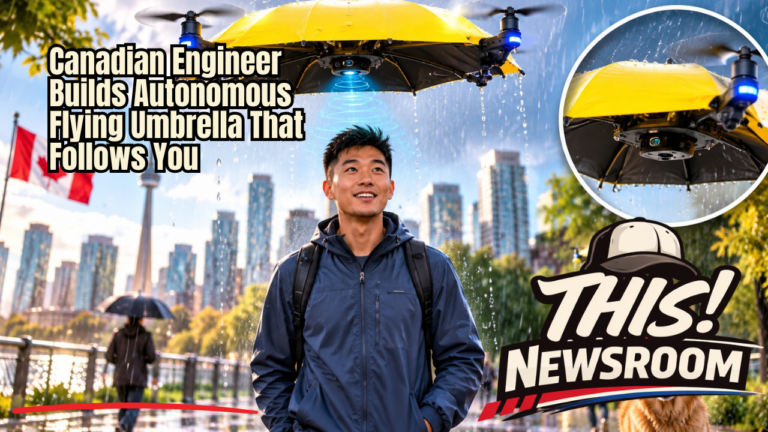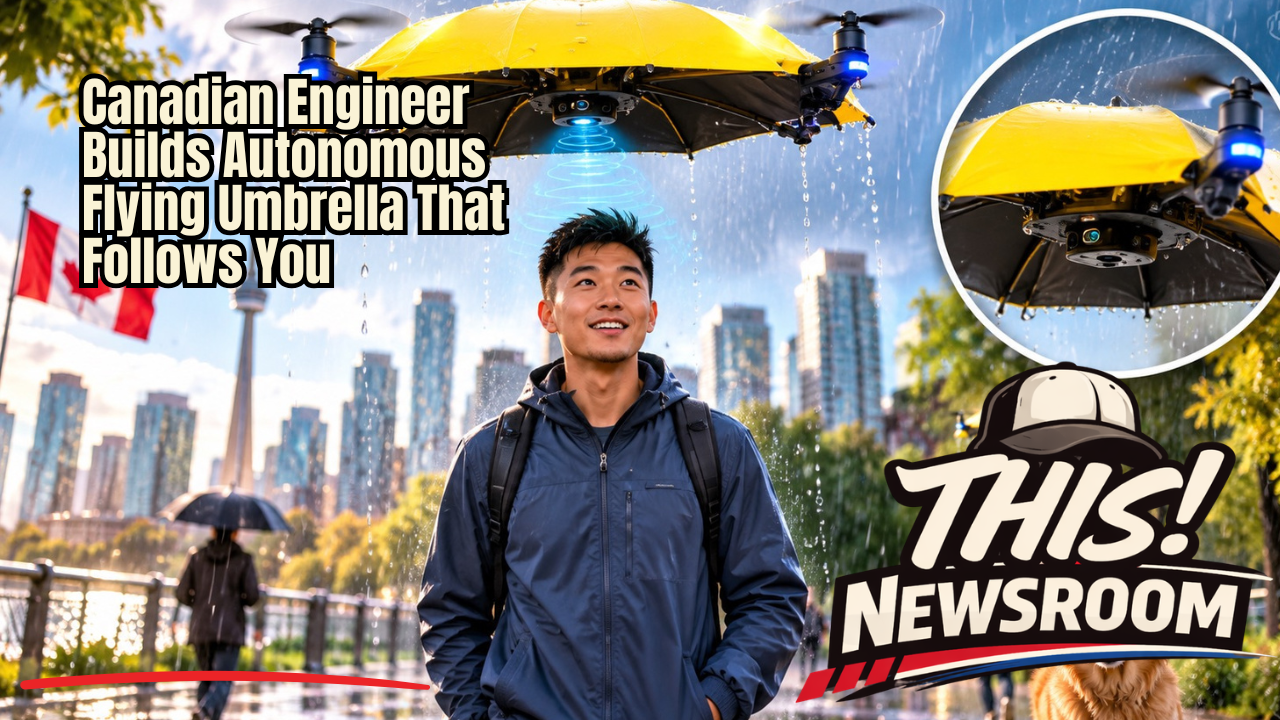
An autonomous flying umbrella demonstrates how drone technology could turn an everyday object into a hands-free personal robot.
Imagine walking through a rainstorm without holding an umbrella. A bright yellow canopy flies above you instead, automatically tracking your movements and adjusting its position as you walk.
Canadian engineer and maker John Tse has built exactly that.
Tse, creator of the I Build Stuff YouTube channel, developed an autonomous flying umbrella that can hover above its user and follow them without a remote control. The prototype combines a quadcopter, depth-sensing technology, onboard computing and custom-built components.
The result turns one of the world’s simplest everyday objects into a surprisingly sophisticated personal robot.
How John Tse’s Autonomous Flying Umbrella Works
The concept starts with something familiar: drone technology.
Four motors and propellers provide lift while a time-of-flight depth camera underneath monitors the person below. The camera measures depth and helps the system determine where the user stands relative to the aircraft.
A Raspberry Pi processes that information and communicates with the flight controller. From there, the system continually adjusts the drone’s position to keep the umbrella above the person as they move.
Custom 3D-printed components and lightweight materials help support the unusual design.
The result looks deceptively simple.
You walk, and the umbrella follows. There’s no handle to carry and no second person piloting the aircraft.
Flying Umbrella 2.0 Takes the Idea Further
Tse has experimented with the flying umbrella concept before.
His earlier version demonstrated that he could get an umbrella airborne, but the project still required manual control. Flying Umbrella 2.0 tackles a much more difficult engineering challenge: autonomous tracking.
That difference matters.
Getting an umbrella into the air presents a drone-engineering problem. Teaching that aircraft to recognize a moving person, track their location and remain positioned above them turns the project into an autonomous robotics experiment.
That capability also makes the invention far more interesting than simply attaching an umbrella to a quadcopter.
Battery Life Remains a Major Challenge
Don’t throw away your traditional umbrella just yet.
The current prototype reportedly stays airborne for only about 10 to 15 minutes on a single battery charge. That’s enough time for a demonstration or a short walk, but it falls far short of what most people would expect from an everyday umbrella.
Weather creates another challenge.
Umbrellas catch wind by design, while drones depend on maintaining stability. Strong gusts could therefore make controlling the aircraft considerably more difficult.
Rain adds another layer of complexity. Motors, electronics, sensors and batteries all have to operate reliably while the device flies through wet conditions.
Safety also matters. Rapidly spinning propellers hovering above pedestrians would require significant safeguards before a device like this could become an everyday consumer product.
For now, Tse’s invention works best as an experimental proof of concept rather than a replacement for the umbrella sitting in your closet.
Why the Flying Umbrella Is Bigger Than Staying Dry
The most fascinating part of Tse’s project may have very little to do with rain.
Instead, the autonomous flying umbrella demonstrates what individual creators can now build with increasingly accessible technology.
Affordable cameras, small computers, consumer drone components, 3D printing and sophisticated software have lowered the barrier to experimenting with autonomous machines.
Only a few years ago, projects involving computer vision and autonomous tracking often required access to expensive equipment or specialized laboratories. Today, independent engineers and makers can experiment with many of those same concepts using commercially available components.
Tse’s invention provides an especially visual example because everyone immediately understands the problem he wants to solve.
People have carried umbrellas in roughly the same way for generations.
His experiment asks a wonderfully simple question:
What if the umbrella carried itself?
Could Personal Flying Robots Become the Next Big Thing?
Thousands of autonomous umbrellas probably won’t start buzzing above city sidewalks tomorrow.
However, the technology behind this experiment points toward something much larger.
Small autonomous machines that recognize and follow individual people could eventually carry equipment, provide lighting, transport cameras, assist workers or perform other tasks while staying close to their users.
Warehouses already rely heavily on autonomous robots. Companies continue experimenting with delivery drones, robotic assistants and increasingly capable computer-vision systems.
Personal robotics could represent another step in that evolution.
Rather than designing every robot around a warehouse, factory or vehicle, engineers could build smaller autonomous machines designed to work alongside individual people.
Tse’s flying umbrella offers a playful glimpse at what that future might look like.
The THIS Newsroom Take
Is a flying umbrella more complicated than simply holding a $20 umbrella?
Absolutely.
Does the average person need four propellers, computer vision and a Raspberry Pi hovering overhead just to avoid getting wet?
Probably not.
Yet that’s almost beside the point.
Some of technology’s most interesting experiments begin when someone takes an absurd-sounding idea and decides to find out whether it can actually work. Tse did exactly that with the autonomous flying umbrella.
Traditional umbrellas still dominate when it comes to battery life, simplicity and price. Tse’s invention wins in another category entirely: imagination.
More importantly, the project demonstrates how quickly robotics technology continues to move from specialized laboratories into the hands of independent creators.
AI, computer vision, inexpensive sensors and autonomous machines will likely become increasingly intertwined with everyday life. Nobody knows whether that future includes umbrellas flying above our heads.
For now, John Tse has at least proved that it can.
About the Author