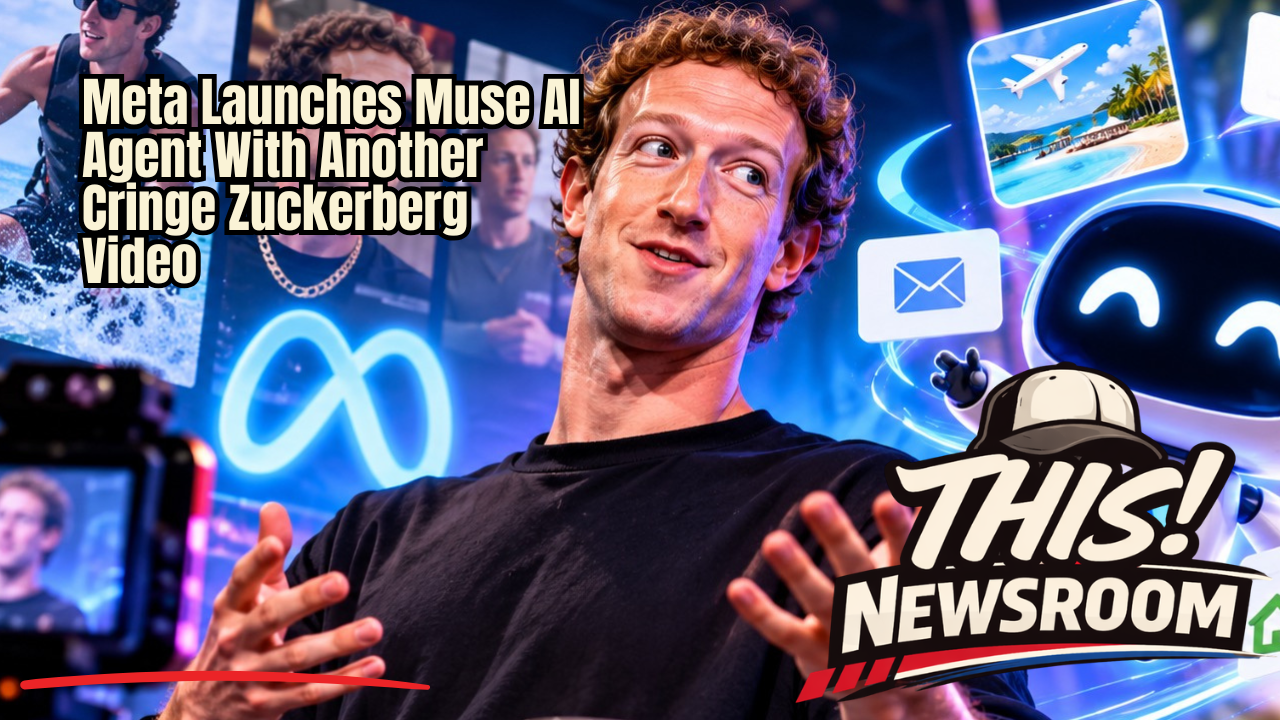
Meta launches Muse, its new personal AI agent, as Mark Zuckerberg continues the company’s aggressive push into consumer artificial intelligence.
Meta has officially launched Muse, its new personal AI agent designed to do considerably more than answer questions. Naturally, Mark Zuckerberg helped introduce it with another highly produced video reminding everyone that the Meta CEO’s transformation from hoodie-wearing programmer to tech-industry action hero remains very much underway.
The video is polished. Zuckerberg looks confident. His wardrobe feels carefully casual.
And yes, somehow it is still just slightly cringe.
But underneath the increasingly cinematic Zuckerberg presentation style sits a product that could become one of Meta’s most significant artificial intelligence launches yet.
Muse represents Meta’s attempt to move beyond the chatbot era and into the emerging world of AI agents capable of actually doing things for you.
Rather than simply telling you how to book a vacation, Muse can potentially help book it.
It could send an email instead of only drafting one.
Give it a grocery task and, eventually, it could potentially help purchase the groceries too.
Unlike the Metaverse pitch of several years ago, this is technology people may understand immediately.
What Exactly Is Meta Muse?
Meta describes Muse as a personal AI agent capable of working on a user’s behalf across different services and applications.
The company launched Muse in the United States on September 8, making it available through a dedicated Muse application and through WhatsApp.
Meta currently limits the service to adults 18 and older.
Muse runs on Muse Spark, which Meta calls its most capable AI model for agentic work.
The distinction between an AI agent and the chatbots most consumers know is important.
Chatbots largely wait for instructions.
Agents take those instructions and attempt to execute tasks.
Tell Muse that you’re planning a vacation, for example, and the system could potentially research flights, compare hotels, organize an itinerary and make reservations.
Ask it to help launch a small business and Muse could assist with planning, coordinating tasks, filling out forms and interacting with services across the web.
That is a considerably bigger ambition than asking an AI chatbot to summarize an article.
Meta Wants Muse Working for You 24/7
Zuckerberg has increasingly described Meta’s AI strategy around something he calls “personal superintelligence.”
The idea is relatively straightforward.
Rather than keeping the most powerful artificial intelligence inside large corporations or research laboratories, Zuckerberg envisions individuals using extremely capable personal AI systems that continuously work on their behalf.
Muse may offer Meta’s clearest consumer product yet for pursuing that vision.
Zuckerberg has described a future where personal agents understand users’ goals, relationships, careers, finances, hobbies and home lives while helping manage those areas around the clock.
Which sounds incredible.
It also requires an almost comical amount of trust in Meta.
And Meta knows that.
The Privacy Question Is Impossible to Ignore
An AI assistant that sends emails, accesses calendars, buys things and interacts with connected services creates major security questions.
For that reason, Meta has made privacy and security a central part of the Muse pitch.
Meta says each Muse operates inside its own dedicated Muse Secure VM, essentially giving the agent a separate virtual computer hosted in the cloud.
The company says the system can securely store credentials without exposing passwords or payment information directly to Muse.
Meta also uses a separate AI system called Sentinel to evaluate what Muse wants to do before allowing certain actions to reach the internet.
For sensitive activities, such as making a purchase or sending certain communications, Muse can require user approval.
An activity history also lets users review what the agent has done.
Meta says it won’t share conversations and information stored within Muse’s virtual machine with its advertising systems. Users can also disconnect connected services or opt out of having certain interactions used for AI training.
Later this year, Meta plans to introduce a Muse Confidential VM, where user-controlled encryption would add another layer of protection.
Those safeguards could become one of the biggest factors determining whether Muse succeeds.
Trusting an AI agent is one thing.
Trusting a Meta AI agent with your email, shopping, payments and personal life is another entirely.
Security Will Be One of the Biggest Tests
Muse’s development reportedly wasn’t completely smooth.
Reports indicate that Meta delayed an earlier version of the product while engineers worked on additional security improvements. Internal testing reportedly uncovered concerns involving connectivity, sensitive information and access boundaries.
Meta says the product now meets its privacy and safety requirements, while also acknowledging that AI systems can still make mistakes.
That tension will define the entire AI-agent industry.
As these systems become more useful, they need greater access.
Greater access also makes their mistakes more consequential.
That is the tradeoff consumers will have to consider.
Muse Could Be Meta’s Best Shot at Catching the AI Leaders
Meta has spent enormous amounts of money trying to establish itself as one of the dominant companies in artificial intelligence.
The company reorganized much of its AI operation around Meta Superintelligence Labs, recruited high-profile talent and steadily expanded its AI model ecosystem.
Meta has also pushed deeper into image generation, video generation, smart glasses and consumer AI.
Muse turns those investments into something much easier for consumers to understand:
An AI that does stuff.
That pitch may prove far more compelling than another benchmark chart showing which model scored a few percentage points higher on an obscure reasoning test.
Meta also has one advantage virtually nobody else in AI can easily duplicate:
Distribution.
Facebook, Instagram, WhatsApp and Messenger collectively give Meta access to billions of potential users.
Muse already works through WhatsApp, while Meta continues expanding AI capabilities across its wider ecosystem.
If Meta eventually integrates a capable personal agent deeply across Instagram, WhatsApp, Facebook and wearable devices, competitors will have a difficult time ignoring Muse.
And Then There Is the Zuckerberg Video
Of course, no modern Meta announcement would apparently be complete without Zuckerberg starring in another aggressively polished lifestyle video.
The Meta CEO has spent the last several years undergoing one of Silicon Valley’s more fascinating image transformations.
Gone are the days when every appearance seemed to involve the same gray T-shirt.
Now we get chains, MMA training, wakeboarding, expensive watches, futuristic glasses, ranch content and enough dramatic camera work to make you wonder whether Ridley Scott quietly joined Meta’s communications department.
Muse continues that evolution.
Zuckerberg undoubtedly looks more comfortable on camera than he did a decade ago.
Still, every new launch video carries that unmistakable feeling of a billionaire trying extremely hard to demonstrate just how relaxed he is.
It’s awkward.
It’s entertaining.
And increasingly, it has become part of the Meta brand.
Cringe Video. Potentially Massive Product.
The easiest reaction would be to laugh at another Zuckerberg product video and move along.
Doing that would probably miss the bigger story.
AI agents are quickly becoming one of the most important battlegrounds in technology.
OpenAI, Anthropic, Google, Meta and other companies are pushing toward systems capable of operating computers, interacting with websites and completing tasks instead of merely generating answers.
Muse puts Meta directly into that race.
Unlike some of Zuckerberg’s previous futuristic bets, consumers don’t need a virtual-reality headset or a lengthy explanation of the Metaverse to understand why an AI assistant that handles annoying tasks might be useful.
The real question isn’t whether Muse can produce impressive demonstrations.
It’s whether people trust it enough to hand over the keys.
Once an AI assistant can access your inbox, calendar, shopping accounts and other personal services, it stops feeling like another chatbot.
It starts becoming part of your life.
Apparently, Mark Zuckerberg would like to personally explain that future to us through another cinematic video.
A little cringe?
Absolutely.
Potentially a very big deal?
Also absolutely.
THIS NEWSROOM
Faith, family and freedom. At the center of truth.
About the Author