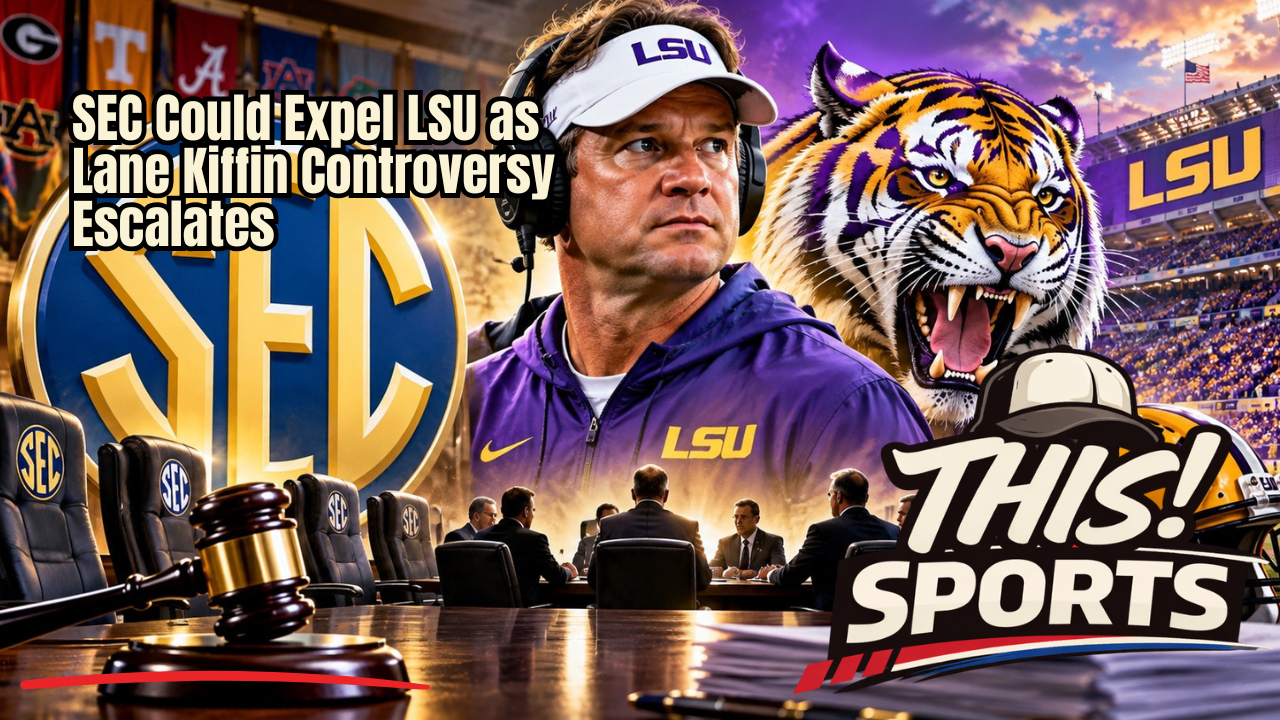
The dispute between LSU and the SEC has escalated into a potentially historic fight over conference membership.
The standoff between LSU and the Southeastern Conference has gone from a bizarre college-football eligibility fight to something almost unimaginable: one of the SEC’s founding members could potentially be kicked out of the conference.
The SEC has scheduled a meeting of its university presidents and chancellors for Thursday, September 10, where conference leaders are expected to consider terminating LSU’s membership. The extraordinary escalation comes amid the ongoing legal battle over LSU’s attempt to add former NFL players to its football roster.
And somehow, Lane Kiffin managed to throw gasoline on an already raging fire.
SEC Is Now Seriously Discussing Expelling LSU
According to court filings reported Tuesday, the SEC amended its federal lawsuit against LSU and is seeking legal protection allowing conference leadership to conduct Thursday’s meeting without interference from the university.
Under the SEC’s governing rules, terminating a member institution requires approval from two-thirds of the conference’s presidents and chancellors.
That makes this substantially more than social-media speculation.
LSU has been part of the SEC since the conference was founded in 1933. Removing the Tigers would represent one of the most consequential conference moves in modern college athletics.
The dispute centers on LSU’s pursuit of Dae’Quan Wright and Zxavian Harris, two players who previously spent time with NFL organizations after their college careers. Both are seeking another season of college eligibility amid broader litigation surrounding the NCAA’s eligibility rules.
The SEC adopted its own rule prohibiting member schools from putting former professional players on their rosters.
LSU has challenged that position.
And the courts have complicated everything.
LSU Won a Major Court Battle
A Louisiana judge recently blocked enforcement of the SEC restriction, potentially clearing a path for LSU to use the players.
But LSU ultimately chose not to put Wright or Harris on the roster for its season-opening game against Clemson.
Kiffin acknowledged before the game that he believed the players deserved an opportunity to compete, but said he also had to consider the larger interests of LSU while the legal situation remained unresolved.
LSU didn’t exactly need the reinforcements.
The Tigers demolished Clemson 51-10 in Kiffin’s LSU debut.
Then Kiffin delivered the line that immediately went viral.
“Imagine If We Had Pro Players”
LSU led Clemson 31-3 at halftime when Kiffin finished his television interview, started walking away and then returned to the microphone.
His message:
“Imagine if we had pro players.”
It was an unmistakable reference to the controversy surrounding LSU’s roster.
After the game, Kiffin didn’t exactly retreat from the comment.
Asked about it, he responded that LSU and he were already taking so much criticism that there wasn’t much additional backlash left to fear.
Now that joke has become part of a much bigger institutional fight.
The SEC’s amended complaint points to concerns over LSU’s institutional control and Kiffin’s public posture as the league argues that the relationship between the conference and one of its most recognizable programs has deteriorated.
LSU Still Hasn’t Used the Former NFL Players
One important distinction is getting lost in some of the social-media reaction:
LSU did not actually use Wright or Harris against Clemson.
The university deliberately kept the players off the roster despite obtaining a favorable ruling in Louisiana.
That means the current showdown isn’t simply about LSU secretly fielding ineligible players.
It is increasingly about who has the authority to determine eligibility and enforce conference rules when those rules collide with court decisions.
And that distinction could become enormously important.
College Football’s Eligibility System Is Colliding With the Courts
The underlying dispute originates with changes surrounding NCAA eligibility.
Players from the 2022 class and others have pursued litigation seeking additional eligibility, arguing they deserve treatment comparable to athletes benefiting from newer eligibility standards. Some of those athletes pursued professional opportunities before their eligibility questions were resolved.
That creates a scenario college football was never really designed to handle.
What happens when a player leaves college, signs with an NFL organization, fails to establish an NFL career and then successfully argues in court that he still possesses college eligibility?
The SEC’s answer has essentially been: professional experience should end college eligibility.
LSU’s position challenges the conference’s ability to impose that restriction when courts say otherwise.
The disagreement has now become bigger than two players.
The SEC Could Be Setting a Massive Precedent
There are legitimate arguments on both sides.
The SEC has an obvious interest in preventing college football from becoming a revolving door where athletes can move between professional and college competition. Conference members also want uniform rules so one program cannot gain an advantage unavailable to everyone else.
LSU can counter that conferences shouldn’t be able to deny athletes eligibility that courts have determined they may possess.
Then there is the elephant in the room.
College athletes already participate in a landscape involving NIL compensation, revenue sharing and increasingly professionalized roster management.
The traditional line separating “college athlete” from “professional athlete” isn’t nearly as clean as it once was.
LSU has simply pushed that contradiction to its most extreme conclusion.
Thursday Could Become One of the Biggest Days in SEC History
Whether the SEC actually has the votes — or ultimately the appetite — to expel LSU remains the enormous question.
Threatening expulsion is one thing.
Actually removing LSU is another.
The Tigers are one of the most valuable and recognizable brands in college athletics, with enormous television audiences, championship history and deep cultural importance to the SEC.
Expulsion would also create immediate questions surrounding LSU’s schedule, television agreements, postseason eligibility and future conference affiliation.
But the fact that conference presidents are even preparing to discuss LSU’s membership illustrates how far this fight has traveled.
A dispute over two football players has become a battle involving conference authority, NCAA eligibility rules, state and federal courts, player rights and the increasingly blurry definition of amateur athletics.
And standing right in the middle of all of it is Lane Kiffin.
Because of course he is.
This Is Bigger Than LSU
The most important part of this story may ultimately have nothing to do with whether Wright or Harris ever play a snap for LSU.
College athletics is entering an era in which conferences and the NCAA increasingly find their rules challenged in court.
If LSU successfully defeats the SEC’s restrictions, other programs — and athletes — will notice.
If the SEC successfully enforces its rules or goes as far as removing LSU, conferences could establish a dramatically different precedent for their authority over member institutions.
Either outcome could reshape college football.
For now, LSU remains in the SEC.
But Thursday’s meeting suddenly carries consequences that would have sounded almost absurd only weeks ago.
One of the SEC’s original members could be fighting for its place in the conference — while Lane Kiffin continues doing what Lane Kiffin does best: winning football games and creating absolute chaos around them.
About the Author