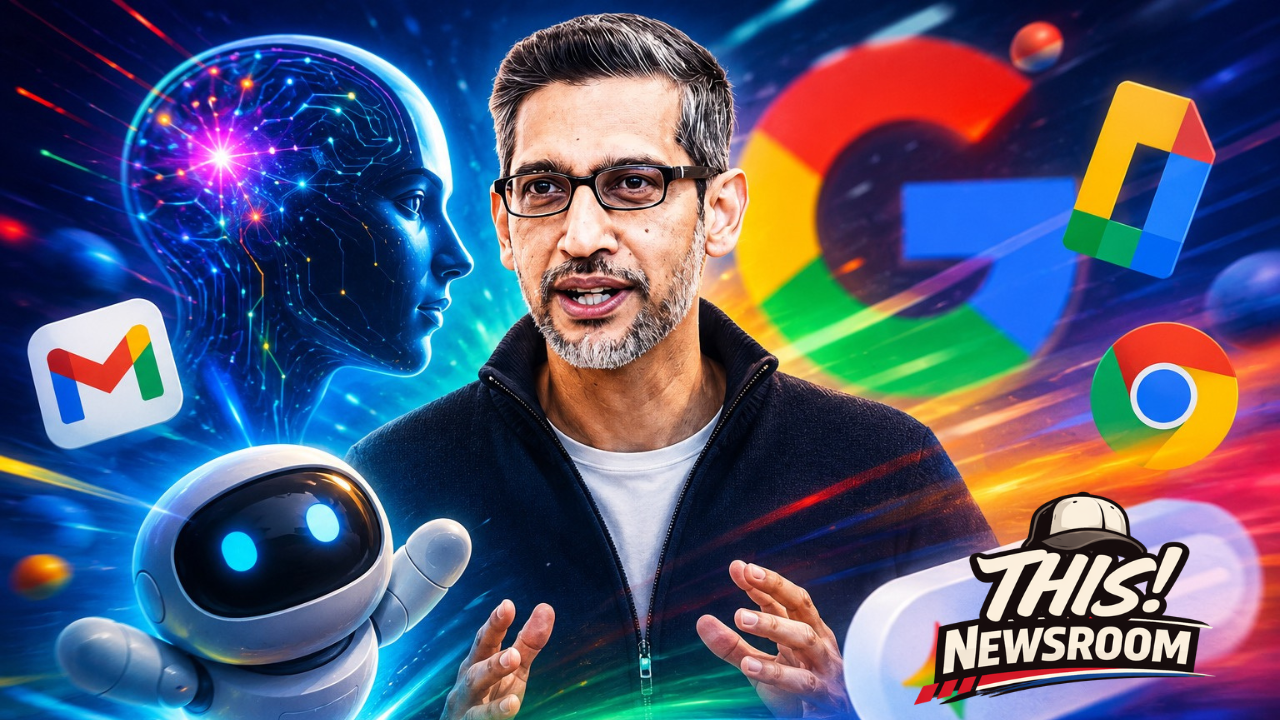
Google I/O 2026 Turns Into Massive AI Showcase With Gemini 3.5
Google I/O 2026 didn’t feel like a traditional developer conference. It felt like a warning shot to the rest of the tech industry.
For years, people joked that Google kept building incredible AI technology but struggled to turn it into products consumers actually cared about. That narrative may officially be over.
This year’s I/O event was packed with AI announcements so aggressive, so integrated, and so wide-reaching that it became clear Google is no longer treating artificial intelligence as a side project. AI is now the company’s entire operating system.
From Gemini 3.5 to Gemini Omni and Gemini Spark, Google unveiled a future where AI sits inside nearly every product people use daily. Search, Gmail, Chrome, Android, Workspace, YouTube, and even shopping experiences are all becoming AI-powered environments.
And honestly? OpenAI, Microsoft, Apple, Meta, and Amazon all just got put on notice.
Gemini 3.5 Is Google’s Most Important AI Model Yet
The biggest headline centered around Gemini 3.5, Google’s newest flagship AI model.
Google claims Gemini 3.5 delivers major improvements in reasoning, multimodal understanding, coding, memory, and real-time task execution. The company also emphasized that the model can understand text, voice, images, video, and live context simultaneously.
That matters because the AI race is no longer about chatbots.
The next phase is about agents.
Google wants Gemini to become an active assistant that can actually complete tasks instead of simply answering questions. During demos, Gemini handled email organization, created documents, summarized meetings, searched the web, and interacted across apps in real time.
That moves AI from “tool” to “co-worker.”
Gemini Omni Pushes Toward a Real-Time AI Assistant
One of the most talked-about reveals was Gemini Omni.
Omni appears designed to create a seamless conversational experience across devices and services. Google demonstrated AI interactions that looked far more fluid and human than traditional voice assistants.
The system responded naturally to interruptions, visual inputs, follow-up questions, and live contextual changes.
This is where the industry is heading fast.
Consumers no longer want separate apps for every task. They want one intelligent system that understands intent and handles everything in the background.
Google clearly sees that future coming.
Gemini Spark Could Reshape Search
Another major announcement involved Gemini Spark, which appears to be Google’s push toward fully AI-generated search experiences.
Traditional search results may slowly become secondary.
Instead of typing a query and scrolling through blue links, users could increasingly receive AI-generated summaries, recommendations, comparisons, shopping suggestions, and personalized answers instantly.
That has massive implications for publishers, advertisers, SEO professionals, and content creators.
For nearly two decades, Google Search rewarded websites that optimized content for ranking. But if AI delivers direct answers without requiring users to click websites, the internet economy changes dramatically.
That possibility has media companies and marketers paying very close attention.
Gmail, Chrome, and Workspace Are Becoming AI Platforms
Google also announced deep AI integrations across its core ecosystem.
Gmail can now draft smarter replies, summarize complex threads, and prioritize actions automatically. Chrome is becoming more AI-assisted for browsing and research. Google Workspace tools are getting enhanced AI-powered document creation, spreadsheet analysis, meeting summaries, and workflow automation.
This strategy may be Google’s greatest advantage.
Unlike many competitors, Google already owns billions of daily user interactions across products people rely on every single day. Integrating AI directly into those ecosystems gives Google immediate scale that few companies can match.
That’s terrifying for competitors.
The AI War Is Escalating Fast
What made this year’s I/O event feel different was the urgency.
Every major tech company now understands that AI could redefine the internet itself. Whoever controls the dominant AI ecosystem may control search, productivity, commerce, advertising, software, and eventually hardware experiences.
Google spent years looking reactive while OpenAI captured public attention.
This event felt like Google reclaiming confidence.
The company no longer appears interested in cautiously experimenting with AI. It’s moving aggressively and embedding artificial intelligence into every corner of its business.
And if these tools work as advertised, the competitive landscape may shift quickly.
Final Thoughts
Google I/O 2026 proved one thing clearly: the AI race is no longer theoretical.
It’s happening right now.
Gemini 3.5, Gemini Omni, and Gemini Spark signal a future where AI becomes deeply woven into how people search, communicate, work, shop, and consume information.
The biggest question now isn’t whether AI will change the internet.
It’s whether anyone can stop Google from becoming the company that defines what the AI internet looks like.
About the Author