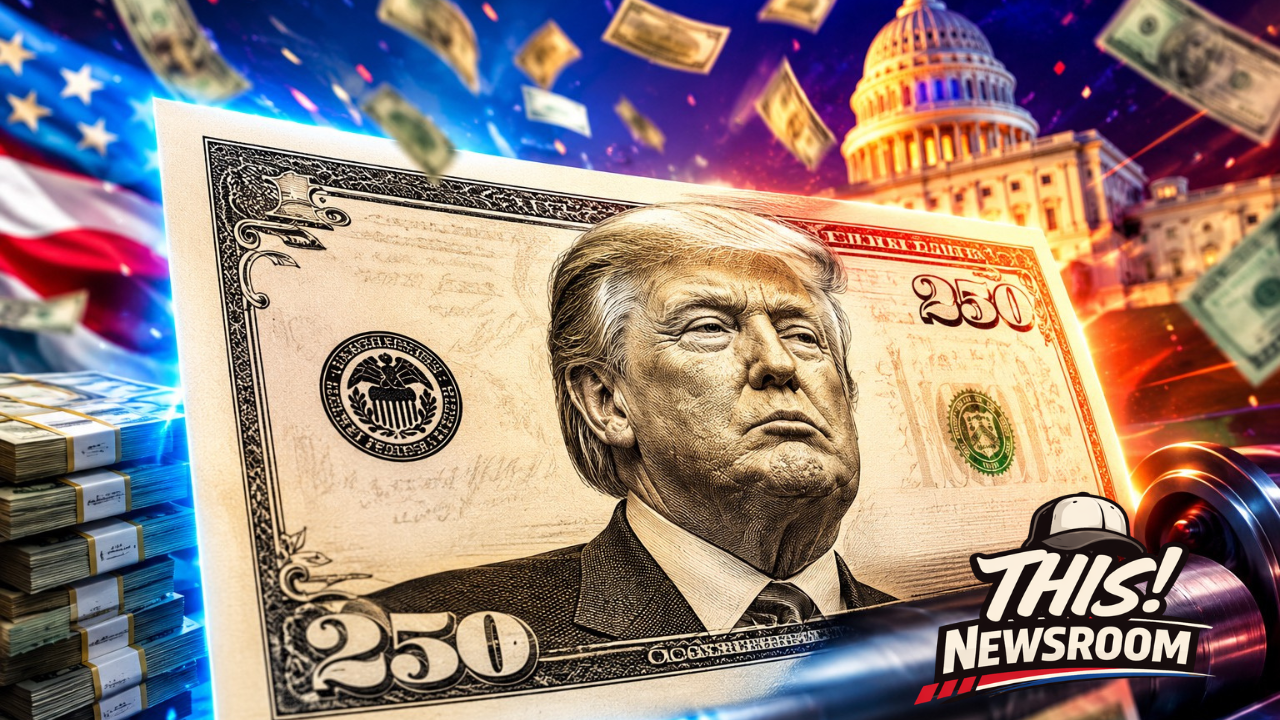
Trump $250 Bill? Treasury Confirms Design Exists and Sparks National Debate
A new chapter in America’s ongoing political theater may soon be headed straight for your wallet.
According to reports shared by the Associated Press, U.S. Treasury Secretary Scott Bessent confirmed that the Treasury Department has a design prepared for a potential $250 bill featuring President Donald Trump. The revelation has reignited one of the most polarizing debates in modern American politics: Should a living—or recently serving—president appear on U.S. currency?
The answer depends entirely on who you ask.
For Trump supporters, it’s long overdue recognition of one of the most influential political figures in modern American history. For critics, it’s another example of personality-driven politics pushing the boundaries of tradition.
And for everyone else? It’s simply another headline that sounds like it was generated by an AI trained exclusively on cable news and social media arguments.
Wait, Is a $250 Bill Actually Happening?
Not exactly.
The important distinction is that Treasury officials reportedly confirmed the existence of a design concept. Having a design is very different from having approval to print and circulate a new denomination.
The United States currently does not issue a $250 bill for public circulation. The largest denomination currently printed is the $100 bill featuring Benjamin Franklin.
Historically, larger denominations such as $500, $1,000, $5,000, and even $10,000 bills existed, but they were discontinued decades ago due to limited use and concerns about crime and money laundering.
So while a design may exist, several legal, political, and logistical hurdles would need to be cleared before Americans start receiving Trump-themed currency from an ATM.
Why Trump?
Whether you admire him or criticize him, Donald Trump remains one of the most consequential political figures of the 21st century.
He reshaped the Republican Party, survived two impeachments, faced multiple legal battles, won a historic political comeback, and continues to dominate national headlines years after first entering politics.
Supporters argue that few presidents have had a greater impact on American politics, media, immigration policy, trade negotiations, and foreign affairs.
Critics counter that currency should represent national unity rather than political division.
That disagreement is exactly why this story exploded across social media within minutes.
The Internet Reacts
As expected, reactions fell into several predictable categories.
Team “Print It Tomorrow”
Many Trump supporters celebrated the news, calling it a fitting tribute to a president they believe transformed the country.
Some joked that the bill would become the most popular piece of currency ever printed.
Others suggested it should replace the $100 bill entirely.
Team “Absolutely Not”
Critics quickly pointed out that U.S. currency traditionally features historical figures rather than contemporary politicians.
Many questioned whether placing Trump on money would further politicize national symbols.
Others argued the discussion itself reflects the increasingly blurred line between politics and celebrity culture.
Team “Can I Use It at Costco?”
A third group simply wanted practical answers.
Would vending machines accept it?
Could you get one from a bank?
Would it become a collector’s item?
And perhaps most importantly:
Would anyone ever have change for it?
A Brief History of Faces on Money
The faces Americans see on currency today weren’t selected overnight.
Figures such as George Washington, Abraham Lincoln, Alexander Hamilton, Andrew Jackson, and Benjamin Franklin became fixtures on U.S. currency because of their historical contributions and enduring national significance.
There are also long-standing traditions regarding who appears on currency and when.
While laws and policies have evolved over time, major changes to U.S. money are relatively rare and often spark significant public debate.
Adding a new denomination featuring a modern political figure would undoubtedly become one of the most controversial currency decisions in recent history.
Could Congress Stop It?
Almost certainly, Congress would have something to say.
Changes involving currency design, denominations, and circulation generally require coordination among Congress, the Treasury Department, and the Bureau of Engraving and Printing.
Any proposal involving Trump’s image would likely become a major political flashpoint and face intense scrutiny from both parties.
In other words, if you thought debates over taxes, spending, and immigration were heated, imagine Congress arguing over whose face belongs on a quarter-trillion-dollar stack of campaign memes.
Why a $250 Bill Specifically?
That’s one of the most interesting questions.
The choice of $250 seems unusual because it does not fit neatly within the traditional denomination structure Americans use today.
Some observers speculate that the number was selected largely for symbolic reasons rather than practical ones.
Others note that inflation has steadily eroded purchasing power, making larger denominations more reasonable than they once seemed.
Still, most financial experts believe digital payments have reduced the need for large physical bills altogether.
In a world dominated by credit cards, mobile payments, Venmo, Apple Pay, and cryptocurrency, introducing a new high-value paper note would certainly be unconventional.
The Bigger Picture
Whether a Trump $250 bill ever enters circulation may ultimately be beside the point.
The story highlights how Donald Trump continues to occupy a unique place in American culture. Few political figures generate this level of attention over something as seemingly simple as a currency design.
Supporters see recognition.
Critics see controversy.
The media sees headlines.
And social media sees unlimited opportunities for memes.
For now, Americans won’t be withdrawing Trump-branded $250 bills from their local bank branch. But the fact that the idea has moved beyond internet speculation and into official design discussions guarantees one thing:
This debate is far from over.
And if the bill ever does become reality, don’t be surprised if it becomes the most photographed piece of currency in American history.
About the Author