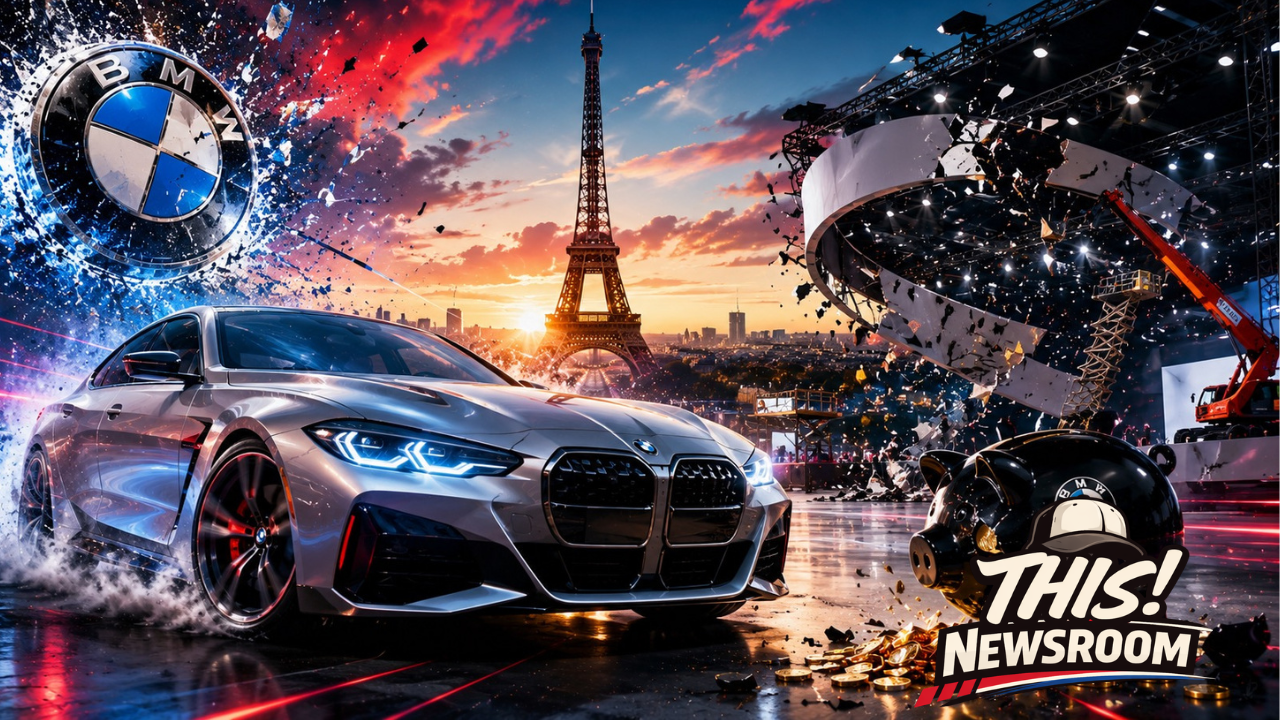
BMW will not attend the 2026 Paris Motor Show as the company's new CEO launches an aggressive expense reduction strategy.
BMW has abruptly canceled its appearance at the 2026 Paris Motor Show, signaling a major shift in priorities as newly appointed CEO Milan Nedeljkovic moves aggressively to reduce costs following a disappointing financial outlook.
The German luxury automaker confirmed Wednesday that both BMW and Mini will no longer participate in the October event, citing a “shift in priorities” while emphasizing that the company remains committed to maintaining a selective presence at future automotive exhibitions.
The decision marks one of the first high-profile cost-cutting moves under Nedeljkovic, who assumed the CEO role in May after succeeding Oliver Zipse.
A New CEO Faces Immediate Challenges
Nedeljkovic inherited a company facing increasing pressure on multiple fronts.
Last month, BMW stunned investors by lowering its financial guidance for 2026 after weakening demand in China, geopolitical uncertainty, and ongoing tariff pressures significantly impacted profitability. The company reduced its projected automotive operating margin from 4–6% to just 1–3%, while warning that overall profits would decline much more sharply than previously expected.
BMW also announced plans to accelerate company-wide cost reductions, although executives have offered few specifics regarding where those savings will ultimately come from.
Why Skip One of Europe’s Biggest Auto Shows?
International auto shows have become increasingly expensive marketing investments.
For manufacturers, exhibiting at events like the Paris Motor Show requires millions of dollars in transportation, custom displays, staffing, media events, and hospitality.
As automakers increasingly unveil vehicles through livestreams, dedicated launch events, and digital campaigns, many companies are questioning whether traditional motor shows still provide enough return on investment.
BMW’s withdrawal reflects that changing strategy.
Instead of spending heavily on a week-long exhibition, the company appears focused on directing resources toward product launches and its next-generation electric vehicle rollout.
The Paris Show Will Go On
Despite BMW’s absence, the 2026 Paris Motor Show is still expected to feature many major global manufacturers.
Mercedes-Benz, Volvo, Renault, Dacia, Alpine, Stellantis brands, Volkswagen, Hyundai, Ford, and several rapidly expanding Chinese automakers—including BYD, Changan, Xpeng, Geely, and Leapmotor—remain scheduled to attend.
BMW’s absence leaves one of Europe’s most recognizable premium brands missing from an event where it has historically introduced important new models.
The company famously unveiled the seventh-generation BMW 3 Series at the Paris Motor Show in 2018.
China Continues to Reshape the Industry
One of BMW’s biggest headwinds remains China.
The world’s largest automotive market has slowed considerably for foreign premium manufacturers as domestic electric vehicle makers continue gaining market share.
BMW has acknowledged weaker Chinese demand as one of the primary reasons behind its revised financial guidance, forcing executives to become increasingly disciplined with spending while protecting investments in future products.
Focus Remains on the Neue Klasse
Although BMW is trimming discretionary expenses, the company is not backing away from its long-term electric vehicle strategy.
Executives continue to prioritize the rollout of the Neue Klasse platform, which represents BMW’s next generation of electric vehicles and software architecture. More than 40 new or updated models are expected through 2027 as the company attempts to regain momentum in an increasingly competitive global market.
Bottom Line
BMW’s decision to withdraw from the Paris Motor Show illustrates how rapidly the automotive industry is changing.
For decades, international auto shows served as the centerpiece of vehicle launches and brand marketing. Today, even iconic luxury manufacturers are questioning whether the enormous cost of attending is justified.
As CEO Milan Nedeljkovic begins reshaping BMW during a challenging financial period, investors and industry analysts will be watching closely to see whether disciplined spending can help the company navigate slowing global demand while maintaining its position in the increasingly competitive premium EV market.
About the Author