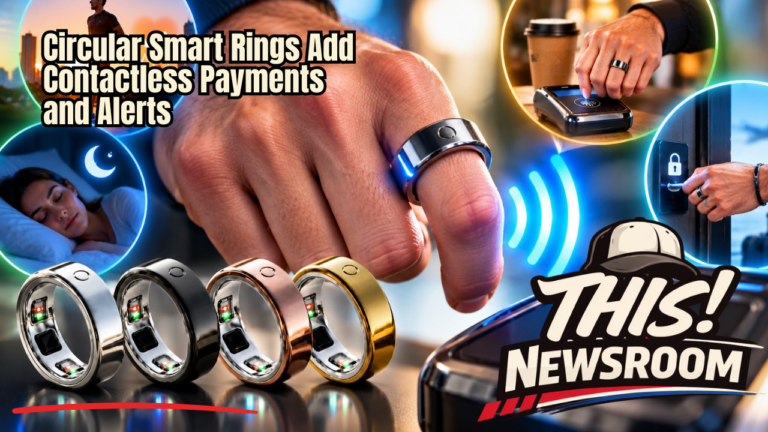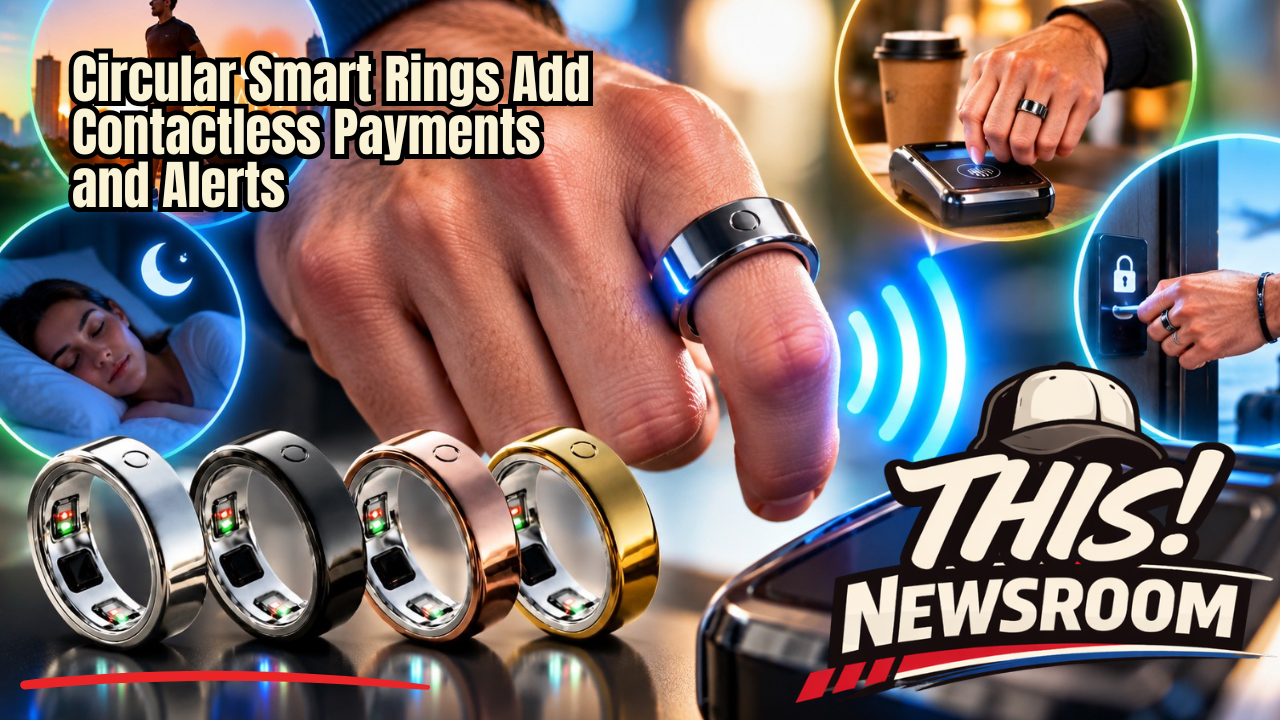
Smart rings are moving beyond health tracking as new features bring payments, alerts and everyday functionality to your finger.
Smart rings have spent years quietly tracking sleep, heart rate and activity. Now, Circular wants the tiny wearable on your finger to actually do something during your day.
Circular unveiled its new Ring 3 Series at IFA 2026, introducing the Circular Ring 3 Pro and Ring 3 Slim. Both models add two features that could significantly expand what consumers expect from a smart ring: NFC contactless payments and on-finger vibration alerts.
That means your next wearable could potentially track your sleep overnight, wake you with a silent vibration in the morning and then pay for your coffee without you ever reaching for your phone or wallet.
And that is where this gets interesting.
Circular Smart Rings Are Moving Beyond Health Tracking
The smart ring category has largely built its identity around passive health monitoring. Put the ring on, forget about it and let sensors collect information throughout the day and night.
Circular is trying to expand that formula.
Both new Ring 3 models include an integrated NFC chip designed to support contactless payments. Circular says payments will work with supported Visa and Mastercard cards, allowing users to simply bring the ring near a compatible payment terminal.
Think about the simplicity of that interaction.
No phone.
No smartwatch screen.
No wallet.
You are already wearing the payment device.
The exact list of supported banks, cards and markets has not yet been fully detailed, so the real-world usefulness of the payment system will ultimately depend on compatibility.
Still, putting payments directly into a health-focused smart ring represents an important step toward making the category useful beyond fitness data.
Contactless Payments Could Be the Killer Feature
Health monitoring might convince someone to buy a smart ring, but payments could become one of the features they use most frequently.
Imagine walking into a coffee shop after a morning run. Your ring has already tracked your activity, heart rate and other wellness metrics. When you reach the register, that same ring becomes your payment method.
Tap.
Done.
Circular is essentially attempting to combine two wearable categories into one tiny device: the discreet health tracking associated with smart rings and some of the everyday convenience traditionally associated with smartwatches.
That distinction matters because many people like smart rings precisely because they don’t have another screendemanding their attention.
Payments give the device additional utility without changing that philosophy.
Vibrating Alerts Bring Notifications Directly to Your Finger
Payments aren’t the only major addition.
Circular is also bringing vibration alerts to both Ring 3 models.
The haptic system can provide silent wake-up alarms, medication reminders, health alerts and feedback during guided breathing exercises.
This could prove surprisingly useful.
A traditional smart ring can detect information, but it generally relies on a connected phone to communicate much of that information back to you. A vibration motor gives the ring a simple way to get your attention without adding a display.
For example, a silent alarm could wake you without sounding an alarm across the room. A reminder could discreetly buzz your finger during the day.
Circular previously offered vibration functionality but removed it from the Ring 2. CEO Amaury Kosman said the company brought the technology back after user feedback and found a way to combine vibration with the newer health-sensing hardware.
Ring 3 Pro Packs in the Advanced Health Technology
Circular is splitting its new lineup into two distinct products.
The Ring 3 Pro targets users who want the company’s more advanced health-monitoring capabilities.
It includes ECG functionality with FDA-cleared AFib detection, along with heart rate, blood oxygen, HRV and other biometric monitoring capabilities. Circular is also promoting blood-pressure trend tracking and glucose-related insights.
Consumers should distinguish wellness estimates and trends from clinical measurements when evaluating health-related wearable features.
Circular says the Pro can deliver up to 12 days of battery life, compared with up to seven days for its predecessor. Its wireless charging case is designed to recharge the ring multiple times before the case itself needs to be plugged in.
For a device designed to stay on your finger around the clock, longer battery life could be a major advantage.
The Ring 3 Slim Takes a Different Approach
Not everyone wants the most advanced sensors possible.
That’s where the Circular Ring 3 Slim comes in.
Circular designed the Slim as a smaller and lighter alternative focused on everyday wellness tracking and payments.
It can monitor metrics including sleep, heart rate, HRV, blood oxygen, skin temperature and daily activity. However, it drops the ECG sensor and AFib detection available on the Pro.
Battery life remains substantial, with Circular advertising up to 10 days per charge.
Both models are expected in sizes 6 through 14 and finishes including silver, black, rose gold and gold. Circular is also touting 50-meter water resistance and wireless charging.
Smart Rings Are Becoming Everyday Computers
The bigger story isn’t necessarily Circular itself.
It’s what is happening to the entire smart ring category.
For years, the pitch was essentially:
Wear this instead of a smartwatch and we’ll track your health.
Now the ambition is becoming much larger.
Payments turn the ring into a wallet.
Haptics turn it into a notification device.
Health sensors turn it into a wellness tracker.
Smart access could eventually turn rings into digital keys.
Put enough of those capabilities together and the smart ring starts looking less like a fitness accessory and more like an incredibly small wearable computer.
The lack of a screen may actually become one of its biggest advantages.
Smartphones constantly ask for our attention. Smartwatches moved some of those interruptions onto our wrists. Smart rings have the opportunity to take a different approach: provide useful technology without creating another screen to stare at.
Competition for Your Finger Is Heating Up
Circular isn’t operating in a vacuum.
The smart ring market has become increasingly competitive, with established and emerging players racing to make rings smaller, more comfortable and more capable.
Circular’s strategy is to differentiate through features such as payments and haptic feedback rather than simply adding another health metric.
That’s a smart direction.
At some point, consumers may stop asking which wearable can collect the most data and start asking a much simpler question:
What can I actually do with it?
Contactless payments provide a very clear answer.
When Can You Buy the Circular Ring 3?
Not quite yet.
Circular has not announced final pricing for the Ring 3 Pro or Ring 3 Slim. The company says additional pricing and preorder information will arrive in the coming months, while availability is expected in early 2027.
That leaves some important questions unanswered, particularly around payment compatibility, participating banks and regional availability.
Those details could ultimately determine whether NFC becomes a transformative feature or something available only to a limited group of users.
The Bottom Line
Circular’s Ring 3 Series shows where wearable technology may be heading next.
Smart rings don’t necessarily need bigger screens or endless notifications. Their advantage could be doing useful things quietly in the background.
Track your sleep.
Monitor your health.
Wake you silently.
Remind you when something matters.
And now, potentially, pay for your coffee with your finger.
If Circular can make those interactions reliable and frictionless, the Ring 3 could help push smart rings beyond being miniature fitness trackers.
The future of wearable technology might not be another screen strapped to your body.
It might simply look like jewelry.
About the Author