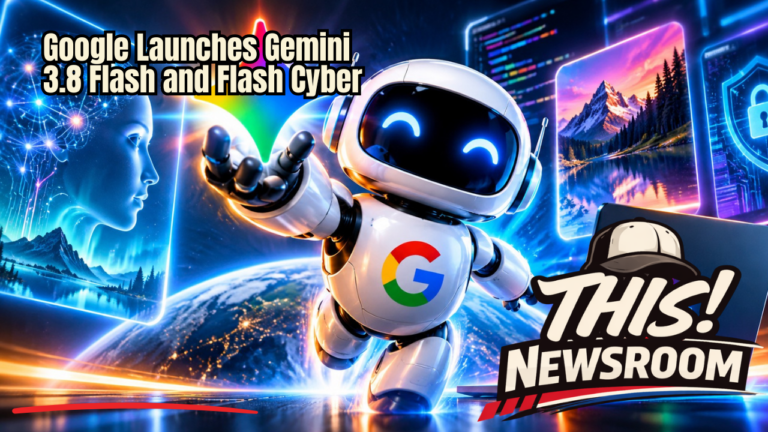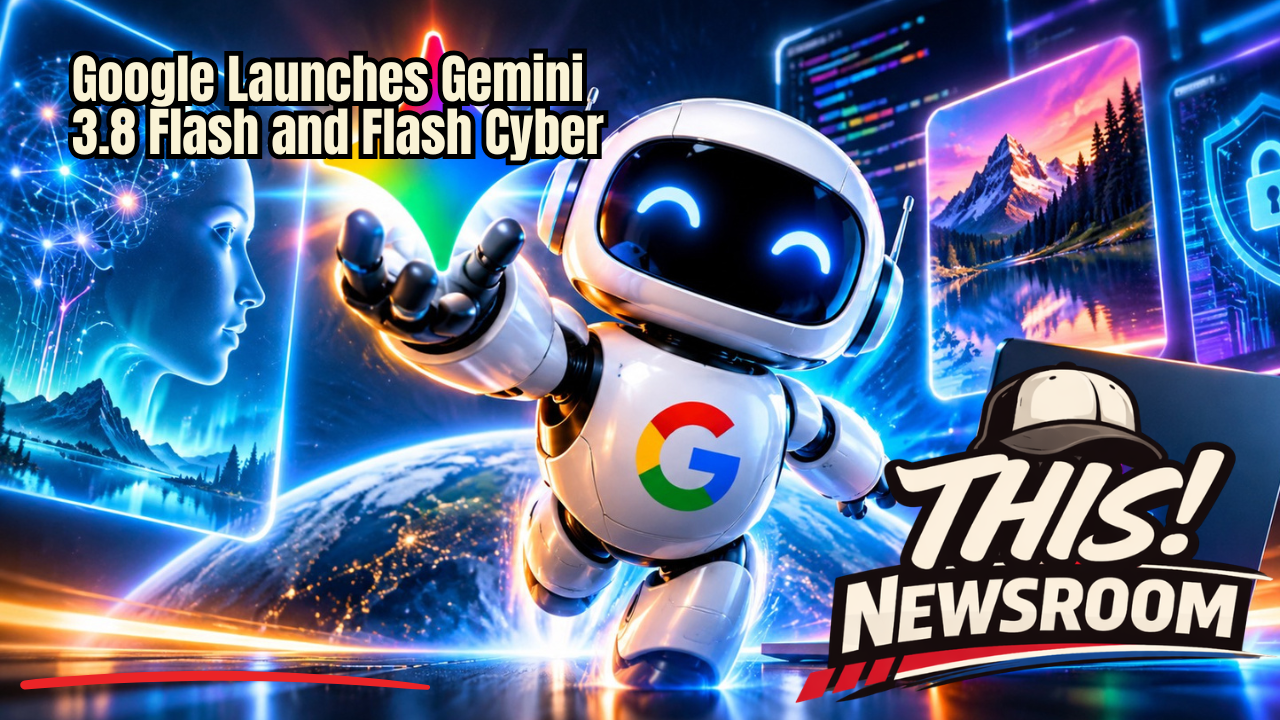
Google expands its Gemini AI lineup with new Flash and cybersecurity-focused capabilities.
Google is moving at a blistering pace in artificial intelligence.
Just three weeks after releasing Gemini 3.7 Flash, Google has introduced Gemini 3.8 Flash alongside a specialized cybersecurity model called Gemini 3.8 Flash Cyber. The September 2 launch marks Google’s third Flash release in only six weeks and puts an even bigger emphasis on coding, autonomous AI agents and complex reasoning.
Google is calling Gemini 3.8 its best reasoning and coding model yet, but perhaps the bigger story is how the company is trying to deliver frontier-level capabilities without the price and latency traditionally associated with the industry’s largest AI models.
And for developers, businesses and cybersecurity teams, that could matter considerably.
Gemini 3.8 Flash Is Google’s New AI Workhorse
Google describes Gemini 3.8 Flash as its “most intelligent workhorse model” to date.
The model specifically targets long-horizon software engineering, autonomous agents and complex enterprise workflows. It also supports text, images, video, audio and PDFs as inputs, while offering a context window of more than one million tokens and a maximum output of roughly 65,000 tokens.
That combination points toward where Google believes AI is headed.
Instead of simply asking a chatbot a question and receiving an answer, companies increasingly want AI systems capable of completing complicated sequences of work — planning tasks, calling tools, analyzing information, writing code, checking the results and continuing until the job is finished.
Gemini 3.8 Flash was designed with those longer workflows in mind.
Google Says Gemini 3.8 “Works Harder”
One interesting change involves how much effort the model can put into difficult problems.
Google says Gemini 3.8 Flash may execute additional reasoning steps and repeatedly call tools when handling complex requests. Developers can select low, medium or high thinking levels depending on how they want to balance performance, latency and cost.
That increased reasoning comes with a trade-off.
Even though the model’s introductory per-token price matches Gemini 3.7 Flash, a more complex task could consume additional tokens as Gemini 3.8 spends more time reasoning through it. Google itself notes that 3.8 delivers improved accuracy and reliability compared with 3.7 at the expense of higher token consumption.
In other words, the sticker price isn’t necessarily the entire cost story.
Gemini 3.8 Flash Takes Aim at Coding
Software development appears to be one of the biggest areas of improvement.
Google says Gemini 3.8 Flash delivers substantial gains over 3.7 Flash in software engineering and can approach the performance of more expensive frontier models on some evaluations. On the DeepSWE v1.1 long-horizon software engineering benchmark, Google says the model outperformed most larger frontier models tested.
The model also scored 54.9% on HLE-Verified, an evaluation covering difficult multi-step reasoning across STEM, humanities and professional fields. Google additionally reported improvements on finance and legal-agent benchmarks.
Those numbers are benchmark results rather than guarantees of real-world performance, but they demonstrate Google’s strategy: make its faster Flash family powerful enough to handle work that previously required much larger models.
That push is already spreading outside Google’s own ecosystem. Gemini 3.8 Flash became available in GitHub Copilot shortly after launch.
Then There’s Gemini 3.8 Flash Cyber
The second model may ultimately prove even more interesting.
Gemini 3.8 Flash Cyber is a cybersecurity-focused version designed to discover vulnerabilities and help defenders automatically patch them.
Unlike regular Gemini 3.8 Flash, however, Google isn’t simply opening the Cyber model to everyone.
Access is being provided to vetted defenders through Google’s new Fairwind Program, including trusted government authorities, critical-infrastructure operators and software maintainers.
The restrictions are intentional.
Powerful AI systems capable of understanding software vulnerabilities can potentially help defenders find security flaws faster, but similar capabilities can create risks if used offensively. Google says the Cyber version therefore uses a different set of safeguards and is limited to trusted defenders requiring broader cybersecurity capabilities.
Google Says Its Cyber AI Can Find and Fix Vulnerabilities
The early numbers are significant.
Google reports that Gemini 3.8 Flash Cyber achieved frontier-level performance on CyberGym, an industry benchmark focused on autonomous vulnerability discovery. On Google’s broader internal evaluation spanning complex codebases and 20 programming languages, the model reportedly exceeded a 70% success rate.
Automated patching is another major focus.
On CWE-Bench, Google says Gemini 3.8 Flash Cyber achieved a 47.2% pass@1 result, compared with 47.8% for a leading frontier model referenced in its testing, while operating at substantially lower cost.
But perhaps the most compelling examples come from Google’s own security operations.
Google says its Chrome Security team found that Gemini 3.8 Flash Cyber generated 2.6 times more correct vulnerability patches than much larger commercial models. Google’s Cloud Vulnerability Research team also used the model to identify a critical foundational vulnerability in less than two hours — research Google says would typically take much longer.
Those claims come from Google and its partners, so independent real-world testing will remain important. Still, they provide a glimpse at how dramatically AI could change cybersecurity work.
The Price Could Make Gemini 3.8 Particularly Competitive
Google isn’t only competing on intelligence.
It’s competing on economics.
Gemini 3.8 Flash launches at an introductory API price of $0.75 per million input tokens and $3.75 per million output tokens through December 31, 2026. Beginning January 1, 2027, Google says standard pricing will increase to $1.50 per million input tokens and $7.50 per million output tokens.
For companies running AI across millions or billions of interactions, those economics matter enormously.
The AI race is increasingly becoming about more than who can produce the smartest model. Businesses also care about how quickly a model responds, how reliably it completes multi-step tasks and how much every completed job costs.
That is precisely the territory Google’s Flash lineup is targeting.
Gemini 3.8 Is Already Spreading Across Google
Gemini 3.8 Flash isn’t an experimental announcement waiting months for deployment.
Google says the model is generally available and ready for production use through the Gemini API. Developers can use it through Google AI Studio, while the model is also available through Google Antigravity and Google’s enterprise offerings.
Consumers with Google AI Pro and Ultra subscriptions can access 3.8 Flash through the Gemini app. Google is also bringing it to AI Mode in Google Search and Gemini in Google Sheets.
That distribution gives Google an advantage few AI competitors can easily replicate.
Gemini doesn’t have to exist as a standalone chatbot. Google can increasingly weave its models into Search, productivity software, developer platforms and enterprise systems used by millions of people.
Three Flash Releases in Six Weeks Says Everything
Perhaps the most remarkable part of the announcement isn’t any individual benchmark.
It’s the speed.
Gemini 3.8 Flash arrived only three weeks after Gemini 3.7 Flash, making this Google’s third Flash release in just six weeks.
That is an extraordinarily compressed product cycle for technology this complicated.
OpenAI, Google, Anthropic, xAI and other AI developers are no longer competing through occasional flagship launches separated by long periods of relative quiet. Models, agents, coding systems and specialized AI tools are arriving at an increasingly rapid pace.
Today’s leading model can become yesterday’s technology remarkably quickly.
The Bigger Picture: AI Is Becoming Less About Chatbots
Gemini 3.8 also highlights a much larger transition happening across artificial intelligence.
The first phase of the generative AI boom centered largely around conversation: ask a question, generate an image, summarize a document or write some text.
The next phase is increasingly about AI doing work.
That means agents capable of writing and debugging software, navigating tools, performing financial analysis, processing massive documents, identifying security vulnerabilities and completing complicated workflows with less human intervention.
Gemini 3.8 Flash is Google’s latest attempt to make that kind of intelligence fast and inexpensive enough to deploy at enormous scale.
Flash Cyber takes the concept even further by showing what happens when increasingly capable general AI gets specialized for a high-value professional field.
This With Krish Take
Google isn’t slowing down — and neither is the broader AI industry.
Gemini 3.8 Flash arriving just three weeks after its predecessor shows how quickly the competitive clock is moving. But the most important development isn’t the version number.
It’s the convergence of speed, reasoning, coding, agents and cost.
If smaller and faster AI models can increasingly perform work once reserved for the industry’s most expensive frontier systems, the economics of deploying AI across businesses could change rapidly.
And Gemini 3.8 Flash Cyber may be an early look at an equally important future: specialized AI agents that aren’t simply answering questions but actively searching for problems and helping humans fix them.
The AI race is no longer just about building a smarter chatbot.
It’s becoming a race to build digital workers that can reason, act and complete real-world tasks — and Google just pushed that race forward again.
About the Author