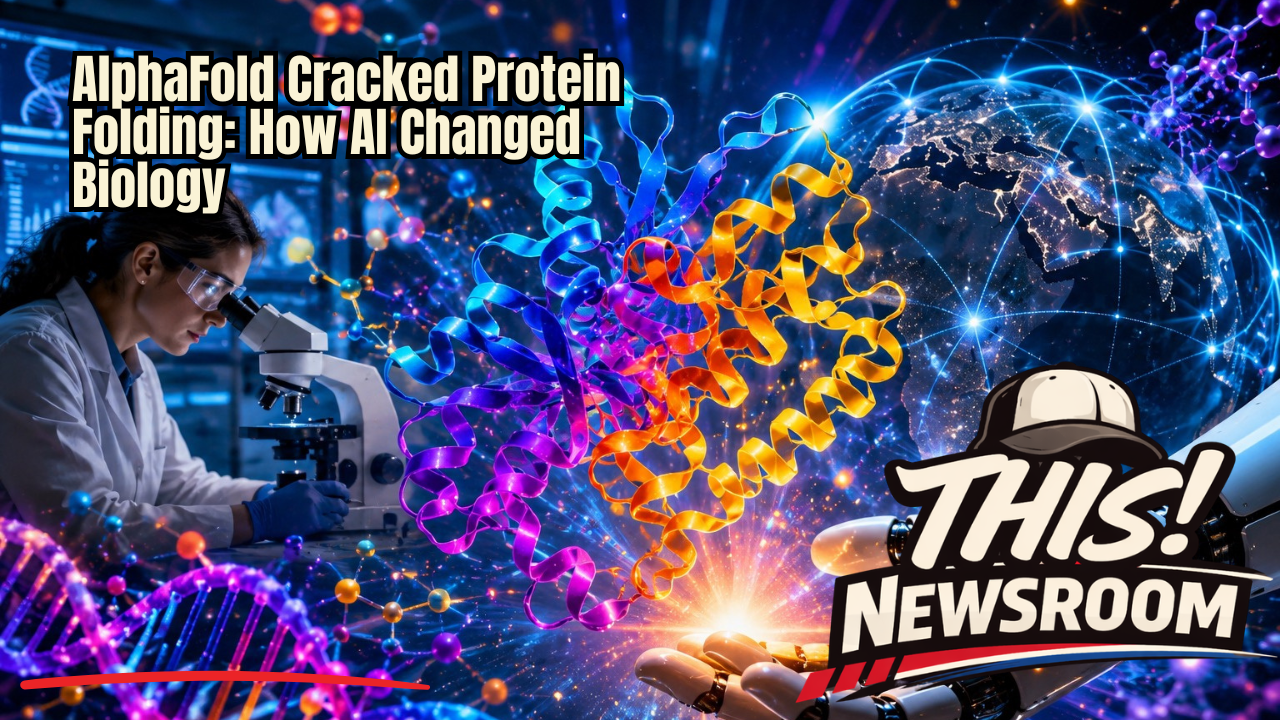
Artificial intelligence is transforming protein research as AlphaFold predicts structures across the known protein universe.
For decades, one of biology’s hardest problems sounded deceptively simple: If scientists know the sequence of amino acids that makes up a protein, can they predict the three-dimensional shape that protein will take?
Researchers spent more than half a century trying to answer that question.
Then artificial intelligence changed the equation.
AlphaFold, the AI system developed by Google DeepMind, demonstrated that machine learning could predict protein structures with remarkable accuracy. The breakthrough transformed a painstaking scientific process into something that, in many cases, can happen in minutes.
And the scale has become staggering.
The AlphaFold Protein Structure Database now contains more than 200 million predicted protein structures, giving researchers access to a vast portion of the molecular machinery underlying life on Earth.
Why Protein Folding Was Such a Massive Scientific Problem
Proteins are fundamental to life.
They help drive chemical reactions, form tissues, transmit signals, fight infections and perform countless other jobs inside living organisms.
But a protein’s amino-acid sequence tells only part of the story.
Those amino acids fold into intricate three-dimensional structures. The resulting shape largely determines what the protein can do.
Understanding that shape can therefore help scientists investigate diseases, understand biological mechanisms and identify molecules that could eventually become medicines.
Traditionally, determining those structures required experimental techniques such as X-ray crystallography and cryo-electron microscopy. Over roughly six decades, researchers experimentally determined more than 190,000 protein structures.
That represented an enormous scientific achievement.
AI suddenly introduced an entirely different level of scale.
AlphaFold Changed the Equation
In 2020, researchers led by Demis Hassabis and John Jumper presented AlphaFold2.
Its performance represented a major breakthrough in the decades-long protein structure prediction challenge.
The Nobel committee later noted that AlphaFold2 achieved accuracy competitive with experimental structures for many targets.
Instead of experimentally analyzing every protein individually, scientists could use AI to predict structures directly from amino-acid sequences.
The difference wasn’t merely speed.
It was scale.
In 2022, DeepMind and the European Molecular Biology Laboratory’s European Bioinformatics Institute expanded the public AlphaFold database from roughly one million predicted structures to more than 200 million.
That expansion covered nearly every catalogued protein known to science at the time and proteins from more than one million organisms.
But the Viral “214 Million in Three Years” Claim Needs Context
Social-media posts often summarize the AlphaFold story by saying scientists spent 50 years determining roughly 194,000 protein structures while AlphaFold predicted 214 million in three years.
The basic point is directionally correct: AI dramatically accelerated access to predicted protein structures.
However, there is an important distinction.
Experimentally determined structures and AI-predicted structures are not the same thing.
Traditional methods physically measure molecular structures. AlphaFold predicts them computationally. Its predictions can achieve experimental-level accuracy in many situations, but confidence varies depending on the protein and region being modeled.
The better comparison, therefore, isn’t simply “humans solved 194,000 and AI solved 214 million.”
It’s that decades of experimental biology produced the scientific knowledge and datasets that ultimately helped make an AI system capable of predicting structures at extraordinary scale possible.
Today, the AlphaFold database reports more than 262 million predicted models, showing that the resource has continued expanding beyond the original 200-million milestone.
The Breakthrough Was Big Enough for a Nobel Prize
The scientific significance became unmistakable in 2024.
The Royal Swedish Academy of Sciences awarded half of the 2024 Nobel Prize in Chemistry jointly to Demis Hassabis and John Jumper for protein structure prediction.
The other half went to David Baker for computational protein design.
The Nobel committee described protein structure prediction as a problem scientists had struggled with for more than 50 years.
AlphaFold effectively turned that long-running scientific challenge into a practical computational tool.
By the time of the Nobel announcement, AlphaFold2 had already been used by more than two million researchers and users across 190 countries.
Why This Matters for Medicine
Knowing the shape of a protein can provide important clues about how it functions.
That can help researchers understand how diseases develop, investigate antibiotic resistance and determine how potential medicines might interact with biological targets.
EMBL-EBI notes that protein structures can reveal information about a protein’s connection to health and disease and what kinds of chemical compounds may interact with it.
That doesn’t mean AlphaFold automatically creates new drugs.
Drug discovery still requires extensive laboratory testing, safety studies, clinical trials and regulatory review.
But AlphaFold can give researchers an extraordinarily powerful starting point.
Instead of spending months or years attempting to determine a structure before investigating it, scientists may already have a highly useful prediction available.
AI Is Becoming a Scientific Instrument
The AlphaFold story may ultimately represent something even bigger than protein folding.
For years, much of the public conversation surrounding artificial intelligence has focused on chatbots, image generators and workplace automation.
But AI’s greatest long-term impact could come from science.
AI systems can search enormous combinations, recognize patterns across datasets and perform computational experiments at scales humans simply cannot replicate manually.
AlphaFold demonstrates what happens when those capabilities collide with decades of carefully accumulated scientific knowledge.
AI didn’t replace biology.
It gave biologists a radically more powerful tool.
From Predicting Proteins to Understanding Molecular Interactions
The AlphaFold story also continues to evolve.
The original breakthrough centered largely on predicting individual protein structures. Researchers are increasingly interested in something even more complicated: understanding how proteins interact with other molecules.
That includes DNA, RNA, medicines and other proteins.
If scientists can accurately model those interactions, AI could help researchers understand not only what biological machinery looks like but how that machinery behaves.
That could have enormous implications across medicine, biotechnology, agriculture and environmental science.
The Bigger Picture
The protein-folding breakthrough offers a glimpse into what the next phase of artificial intelligence may look like.
The most important AI systems may not necessarily be the ones consumers interact with every day.
They could be systems quietly operating inside laboratories — helping researchers analyze molecules, design materials, model diseases and explore scientific problems that once required decades of painstaking work.
Scientists spent generations building our understanding of proteins.
AlphaFold didn’t erase that work.
It built on it — and then demonstrated how dramatically artificial intelligence can amplify human scientific knowledge.
A 50-year scientific challenge became one of the clearest examples yet of what happens when AI meets the fundamental machinery of life.
About the Author