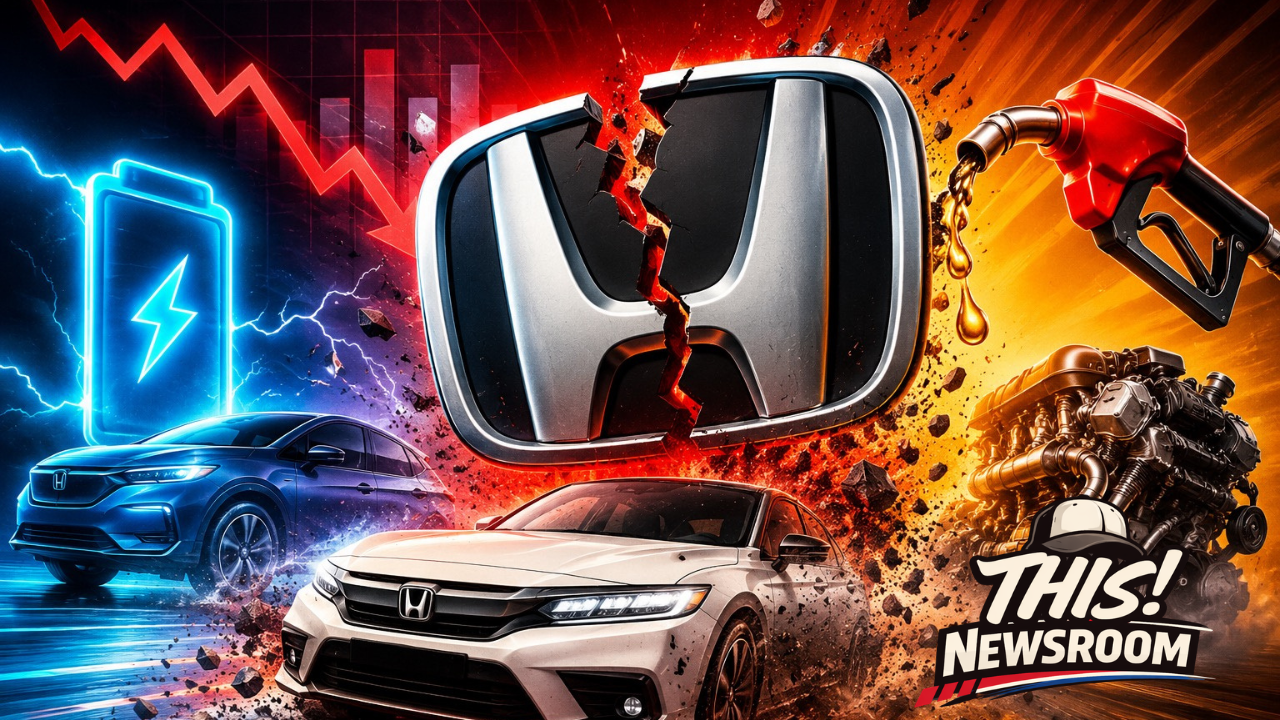
Honda pivots from aggressive EV expansion toward hybrid and mixed powertrain vehicles after reporting its first annual loss in nearly 70 years.
For decades, Honda built a reputation around reliability, efficiency, and steady growth. Recessions came and went. Oil crises happened. Supply chain nightmares hit the auto industry. Yet Honda kept moving forward.
Until now.
The company has officially posted its first annual loss since becoming a publicly traded company in 1957, marking one of the biggest strategic reversals in modern automotive history.
And the reason behind the collapse? Honda’s aggressive electric vehicle push.
The Numbers Are Brutal
Honda reported an operating loss of 414.3 billion yen, roughly $2.6 billion USD, for the fiscal year ending March 2026. Just one year earlier, the company posted an operating profit of more than 1.2 trillion yen.
The company also disclosed that EV-related losses and restructuring charges totaled between 1.45 trillion yen and 1.58 trillion yen — roughly $9–10 billion USD.
Even more staggering, Honda warned the total financial impact from its EV strategy reassessment could eventually reach 2.5 trillion yen, or approximately $15.7 billion USD.
That is not a typo.
Fifteen. Billion. Dollars.
Honda Is Scrapping Major EV Plans
Honda is now walking away from several major EV initiatives that only recently looked like the future of the company.
The automaker confirmed it is canceling development of three major North American EV models:
- Honda 0 SUV
- Honda 0 Saloon
- Acura RSX EV
Honda also indefinitely suspended its massive $11 billion EV and battery plant project in Canada.
Meanwhile, its ambitious goals for EV adoption are being tossed aside:
- The target for EVs to represent 20% of sales by 2030? Gone.
- The plan to transition fully to EV and fuel-cell vehicles by 2040? Also gone.
That’s a dramatic pivot from just a few years ago, when legacy automakers were racing to prove they were “all in” on electrification.
The New Strategy: Hybrids, Gas, and Flexibility
Honda CEO Toshihiro Mibe is now steering the company toward a mixed powertrain strategy focused heavily on hybrids.
Instead of betting the entire future on EVs, Honda says it will launch more than a dozen next-generation hybrid models by 2030 while continuing to improve gasoline efficiency and selectively develop EV technology where demand actually exists.
In other words, Honda is no longer treating EVs as the only answer.
The company openly admitted that EV demand slowed far more aggressively than expected, particularly in North America. Rising costs, reduced government incentives, political shifts, infrastructure concerns, and increased competition from Chinese automakers all contributed to the reversal.
And honestly? Honda isn’t alone.
Across the industry, several automakers have quietly started softening their once ultra-confident EV timelines. The difference is Honda’s reset is happening publicly — and painfully.
Investors Weirdly Liked the News
Here’s the part that feels almost backwards.
Despite reporting its worst financial performance in company history, Honda’s stock actually rose after the announcement.
Why?
Because investors seem relieved the company is finally pulling back from a strategy that was bleeding cash.
Honda also reassured shareholders by committing to dividends and large shareholder return programs while promising a faster return to profitability through hybrids, motorcycles, and cost-cutting measures.
The company is forecasting a return to profit next fiscal year.
This Isn’t Just a Honda Story
This may end up becoming one of the defining business stories of the decade.
For years, automakers were under enormous pressure from governments, regulators, investors, and public sentiment to move aggressively into EVs. Some companies moved cautiously. Others sprinted headfirst into the future.
Honda just became the biggest example yet of what happens when that timeline collides with reality.
Consumers still want affordability. Charging infrastructure remains inconsistent in many regions. Hybrid demand is exploding again. And many buyers simply are not ready to abandon gasoline vehicles completely.
So now the industry appears to be shifting toward something more practical:
Not EV-only.
Not gas-only.
But flexibility.
And Honda just made that pivot louder than anyone else.
About the Author